This is continued from part 3 - the previous post (http://mayas-corner.blogspot.com/2007/03/hiv-trial-in-libya-part-3-tale-of-two.html). Here, I'll try to keep my writing as short as possible and to use instead citations from people who know better. Two important terms, used below, are iatrogenic - caused by medical procedures, and nosocomial - acquired in a hospital; both terms refer to health damage, usually an infection.
Let's begin from the beginning: decades earlier and thousands of miles away from the Libyan "crime scene", a virus found a new host. The following citation is from http://main.uab.edu/show.asp?durki=8535.
"Origin of HIV-1 Discovered
...Scientists at the University of Alabama at Birmingham (UAB) have discovered the origin of Human Immunodeficiency Virus Type 1 (HIV-1)...The researchers identified a subspecies of chimpanzee (Pan troglodytes troglodytes) native to West-Central Africa as the natural reservoir for HIV-1...The final piece of the puzzle was put in place when the researchers realized that the natural habitat for Pan troglodytes troglodytes overlaps precisely with the region in West-Central Africa where all three groups of HIV-1(M, N, and O) were first recognized. Based on these findings, Hahn and her colleagues concluded that Pan troglodytes troglodytes is the origin of HIV-1 and has been the source of at least three independent cross-species transmission events...While the origin of the AIDS epidemic has been clarified, an explanation for why the epidemic arose in the mid-20th century, and not before, remains a matter of speculation."Chimpanzees are frequently hunted for food, especially in West-Central Africa, and we believe that HIV-1 was introduced into the human population through exposure to blood during hunting and field dressing of these animals," says Hahn. She further believes that while incidental transmissions of chimpanzee viruses to humans may have occurred throughout history, it was the socio-economic changes in post-World War II Africa that provided the particular circumstances leading to the spread of HIV-1 and the development of the AIDS epidemic. "Increasing urbanization, breakdown of traditional lifestyles, population movements, civil unrest, and sexual promiscuity are all known to increase the rates of sexually transmitted diseases and thus likely triggered the AIDS pandemic," adds Hahn."
Dr. Hahn omitted one very important factor for spreading HIV: the health care system, which was practically not present in Africa until the 20th century. You think I am stretching my thesis too much? First, please read the following translation from the book "Sanu, bature" by Bulgarian zoologist Peter Beron. He describes his experience in Nigeria in 1976:
"Before returning to Bulgaria, we had to be immunized against cholera. There was a special immunization center in the town. However, before we went there, Dr. Malyavko (a Russian physician - M.M.) gave me three sealed disposable syringes and told me to insist that the local doctor uses them. I was hesitating - the doctor could be offended by such lack of trust. I went to the center with Kinka and Vladko (the author's wife and son, respectively - M.M.). In the street, there was an endless line. The doctor was sitting in front of the door and immunizing everybody with one and the same needle. These were prospective hajjis. They were preparing to travel to Mecca and the local Asclepius evidently thought that Allah wouldn't let any hepatitis creep into such pious Muslims. At that time, nobody knew about AIDS. Seeing us, the Asclepius called us and offered to immunize us immediately. I told him I had had polyo before and for that reason had to use a separate syringe. Vladko had been in contact with a person with hepatitis etc. The doctor showed full understanding. He unsealed the first syringe, injected Vladko, then injected Kinka with the second syringe and me with the third one. Then he, with my needle, continued injecting the long line of the candidate hajjis."
The case of the infected more than 400 Libyan children would be tragic even if it were exceptional, but unfortunately it isn't. We shall never know the exact number of AIDS victims throughout Africa and elsewhere whom medicine, instead of helping, failed, betrayed and doomed. The following citation (as well as others which I'll indicate by their PubMed identification numbers) is obtained from PubMed, a database of biomedical literature. PubMed abstracts and some full text articles can be accessed at http://www.ncbi.nlm.nih.gov/entrez/query.fcgi?DB=pubmed.
Gisselquist D. et al. (2003). Let it be sexual: how health care transmission of AIDS in Africa was ignored. PMID: 12665437
"The consensus among influential AIDS experts that heterosexual transmission accounts for 90% of HIV infections in African adults emerged no later than 1988. We examine evidence available through 1988, including risk measures associating HIV with sexual behaviour, health care, and socioeconomic variables, HIV in children, and risks for HIV in prostitutes and STD patients. Evidence permits the interpretation that health care exposures caused more HIV than sexual transmission... Preconceptions about African sexuality and a desire to maintain public trust in health care may have encouraged discounting of evidence."
Another work: Brewer D.D. et al. (2003). Mounting anomalies in the epidemiology of HIV in Africa: cry the beloved paradigm. PMID: 12665436. The citation is from http://www.cirp.org/library/disease/HIV/brewer1/, where the full text of the article is given.
"A number of these observations raise the question of an alternative route of transmission, for which medical care and the use of injections are prime candidates17,19-22. Prostitutes, for example, are often recruited for studies from STI clinics, where treatment is frequently given by injection, where non-sterile equipment is used with high frequency, and wherein the underlying prevalence of HIV is high7. Many studies that have assessed the impact of sexual activity on HIV transmission -notably those in Mwanza and Rakai, whose discordant results are still a subject of debate23-failed to consider the potential confounding effects of medical care in the propagation of HIV24.
Rapid HIV transmission in Africa has often occurred in countries with good access to medical care, like Botswana, Zimbabwe, and South Africa. For example, high rates in rural South Africa have paralleled aggressive efforts to deliver health care to rural populations. It is difficult to understand how improved access to health care, with its offers of public health messages, free condoms, and preventive services, would be associated with increased HIV transmission. Similarly, HIV prevalence is often higher in cities and among persons of high socioeconomic attainment than in rural areas or among less fortunate persons. Favourable access to health care is one of the differences that distinguishes between these groups."
In my recent post, I argued that sexually transmitted diseases shouldn't be regarded as God's punishment because they infect the innocent as well as the "guilty". In fact, it is worse - they infect first and foremost the innocent. Just read the following citation:
Gisselquist D. et al. (2004). HIV transmission during paediatric health care in sub-Saharan Africa--risks and evidence. PMID: 15034989
"Health care systems in sub-Saharan Africa are challenged not only to improve care for the increasing number of HIV-infected children, but also to prevent transmission of HIV to other children and health care workers through contaminated medical procedures and needlestick accidents. HIV-infected children aged to 1 year typically have high viral loads, making them dangerous reservoirs for iatrogenic transmission... This leads to high HIV prevalence among inpatient and outpatient children... Investigations of large iatrogenic outbreaks in Russia, Romania, and Libya demonstrate efficient HIV transmission through paediatric health care... In addition, several studies have reported much higher HIV prevalence in children 5-14 years old than could be expected from mother-to-child transmission alone."
So we are coming to the Libyan scene. The following citation, I think, illustrates well how the Libyan health care system initially reacted to the crisis - it focused efforts not on controlling the infection but on attempting to cover it up:
Kovac C, Khandjiev R. (2001). Doctors face murder charges in Libya. PMID: 11157524
"Nine Libyans, including the director of the Al-Fateh Hospital and the undersecretary of Benghazi's Department of Health, are charged with exposing 19 of the mothers of the infected children to HIV. They "hid the fact that the children were already infected" and failed to take prophylactic measures to protect the mothers... Ironically, according to a UNAIDS report, Libya has not supplied any information on AIDS cases in that country for 1998-2000."
In the same year, doctors in Switzerland analyzed the blood of infected children:
Yerly S. et al. (2001). Nosocomial outbreak of multiple bloodborne viral infections. PMID: 11443566
"After a major outbreak of human immunodeficiency virus (HIV) infection in approximately 400 children in 1998 in Libya, we tested HIV, hepatitis C virus (HCV), and hepatitis B virus (HBV) markers in 148 children and collected epidemiological data in a subgroup of 37 children and 46 parents. HIV infection was detected in all children but one, with HCV or HBV coinfection in 47% and 33%, respectively... The children visited the same hospital 1-6 times; at each visit, invasive procedures with potential blood transmission of virus were performed."
The finding of other blood-borne viruses in such a high proportion of the HIV-infected children supports the poor hygiene hypothesis, not the intentional infection hypothesis which lies so close to the hearts of Libyan prosecutors. Mention also that some children visited the hospital several (up to 6) times, so it is possible that they after being infected became secondary sources of infection for other young patients.
The next report is by Italian scientists:
Visco-Comandini U. et al. (2002). Monophyletic HIV type 1 CRF02-AG in a nosocomial outbreak in Benghazi, Libya. PMID: 12167281
"A cluster of HIV-1 infection has been identified in Libya in 1999, involving 402 children admitted to "El-Fath" Children's Hospital in Benghazi (BCH) during 1998 and 19 of their mothers... Out of this group, 104 children and 19 adult women have been followed at the National Institute for Infectious Diseases L. Spallanzani in Rome during 1 year. At BCH, all children had received intravenous infusions but not blood or blood products. A single child receiving a blood transfusion in 1997 and the 17 infected mothers were never hospitalized in Benghazi. In addition, two nurses were diagnosed as HIV-1 infected... The phylogenetic analyses showed that a monophyletic recombinant HIV-1 form CRF02-AG was infecting all of the HIV-1-seropositive patients admitted at BCH... A different strain was found in the child infected by blood transfusion."
Please mention that a child was infected in 1997 by blood transfusion with a different strain of HIV. This fact alone seems to disprove the claims of many Libyans that before the accused medics introduced the virus in 1998, there had been no HIV in Libya. Rather, the virus had arrived but the Libyan health care officials weren't ready to confront the threat and preferred to bury their heads into the sands of wishful thinking - our people aren't promiscuous, so it won't happen here...
The other noteworthy detail in this report is that the HIV strain is described as "recombinant". This English term can mean "product of natural recombination process" (as above) or "product of recombinant DNA technology (gene engineering)". Bulgarian journalists reporting from the Libyan courtroom said that the term was translated to Arabic and interpreted by Libyans in its second meaning only, i.e. that it was not a natural HIV strain but one modified by gene engineering. Hence, the infection must have been intentional. I don't know whether this misinterpretation was due to deliberate framing of the accused or to incompetence of the Libyan "experts". Let's not be paranoic and prefer the second explanation. In fact, the incompetence of some of the experts seems to be a public secret in Libya. Defense lawyer Byzanti at one point, after hearing reports of such experts accusing his clients, exclaimed, "But what scientists are they?". (The judge didn't like the remark.) If we talk seriously, even if the infection was intentional, it wouldn't make sense to use modified virus. If you intend to use a common cold virus as a bioweapon, you of course first have to modify it quite a lot, because the original virus is almost harmless. But why modify a virus which is lethal as it is? Just to leave a smoking gun at the crime scene? Why don't people use their heads, why are they ready to believe every nonsense they hear?
The next citation is from one of the most prestigeous scientific journals, Nature.
De Oliveira T. et al. (2006). Molecular epidemiology: HIV-1 and HCV sequences from Libyan outbreak. PMID: 17171825
"In 1998, outbreaks of human immunodeficiency virus type 1 (HIV-1) and hepatitis C virus (HCV) infection were reported in children attending Al-Fateh Hospital in Benghazi, Libya. Here we use molecular phylogenetic techniques to analyse new virus sequences from these outbreaks. We find that the HIV-1 and HCV strains were already circulating and prevalent in this hospital and its environs before the arrival in March 1998 of the foreign medical staff (five Bulgarian nurses and a Palestinian doctor) who stand accused of transmitting the HIV strain to the children."
No comment needed, I think.
The last PubMed citation I'll give is an appeal by Sidaction (I don't know this organization but its name is evidently derived from SIDA - AIDS in French):
Fleutelot E. (2006). 'Libyan Trial': a verdict running counter to scientific evidence. PMID: 17192180
"Sidaction denounces this trial as a parody of justice, which cannot hide the total incapacity of the Libyan Government to promote an appropriate politics of prevention and take care of people who are ill secondary to HIV infection-adults and children-in an appropriate way. It is useful to recall that the majority of Libyan people living with AIDS who are in need of an antiretroviral treatment can still not afford it."
***
It is easy to violate safety rules when working with blood and other human material under inadequate funding and supervision. I admit I have done it myself.
In recent decades reusable syringes, needles and other items were largely replaced by disposable ones. This was meant to assure safety, because sterilization of reusable equipment can always fail for some technical reason. However, as a result medical workers lost their expertise in sterilization and the good habit to perform it. So, when they are short of disposable equipment, they are quite likely to reuse it without even attempting sterilization or at least disinfection. Simple boiling would kill HIV without damaging most types of disposable equipment; but there must be somebody to do the boiling.
What exactly happened in Benghazi? Of course I cannot know exactly, but this is how I imagine it. The hospital has too many patients and too few syringes and needles. So, a nurse or a sanitary worker at the end of the day collects the used ones, soaks them in water and then washes them. Just washing, no sterilization. The boss hasn't ordered sterilization or disinfection. Trapped in the "good-people-don't-get-STDs" mentality, he cannot even think that the hospital's patients, these little angels, may have AIDS. But one child has it, contracted somehow outside the hospital. He is injected and then, when his syringe and needle are soaked, the virus contaminates all the other soaked needles. So other children, possibly dozens of them at once, are infected. The remaining virus in the hospital eventually dies out, it cannot reproduce outside the human body, but then one of the infected children comes for a new shot...
I would wish to end my post here, but I remember something I read on Highlander's blog:
"Whilst I’m sure many of them (medics-guest workers in Libya) honoured their contracts I can tell you from personal experience that some of them could not care less, and even the fact that US sanctions resulted in the deterioration of Libyan hospitals and that probably some Libyan health workers were also unscrupulous does not give the right to foreign workers to treat the Libyan patients like 'shit'. I’ve seen it as some of them ruled unconditionally in the hospitals and clinics, and you don’t want to be on their bad side as they may not treat you or worse may give you the wrong treatment. So again I wanted to say that not all of them were angels and saviours" (http://lonehighlander.blogspot.com/2005/04/case-441999-story-of-bulgarian-medics.html).
Of course, among the health workers from any country some are not very good professionals, some are capable but not very polite, and even those who are both may have their bad days; besides, miscommunication because of language barrier can create impression of rudeness. This is not the point. The point, I think, is the implicit question behind the cited text: Was it a mere coincidence that the infection happened in a hospital with so many foreign workers? My answer: Maybe it wasn't. I must immediately state that this is not an admission that the defendants are guilty - there were dozens of other guest workers in the El Fateh hospital, while two of the accused had never worked there.
First, one of the most important factors pushing us to do good work is pressure from our clients. If we are health workers, this means that we shall work better if our relations, friends, neighbours or their children can become our patients any minute. If we are treating some completely unrelated people, we are more likely to take it easy. Remember, one of the other major iatrogenic AIDS outbreaks was among Romanian orphan children. The doctors and nurses immunizing them relaxed the safety rules because they knew their own children and their friends' children wouldn't be among the patients.
Second, a guest worker is unlikely to become a whistleblower. He'll prefer just to do what he is paid for and not risk trouble. Remember the Egyptian doctor who warned a Bulgarian nurse (in Part 2). However, he didn't warn the Libyan patients and the local community. The Bulgarian workers in fact couldn't do this even if they wanted, because they didn't speak Arabic. It was the journalists of the La magazine who first gave publicity of the outbreak, and they did get into trouble. They knew they were risking, but still wrote the article because they cared. They regarded it as their duty as citizens. So, before we all become true citizens of the world, it makes no harm to remember that only a citizen is likely to care.
Monday, March 19, 2007

Wednesday, March 14, 2007
The HIV trial in Libya, part 3: A tale of two idiotic states
This is the third part of my sequel; the first two parts are, respectively, at http://mayas-corner.blogspot.com/2006/09/hiv-trial-in-libya-part-1-infection.html and http://mayas-corner.blogspot.com/2006/09/hiv-trial-in-libya-part-2-victims.html (the trial is mentioned also in a number of other posts). Here, I'll try to tell how the accused medics were used as pawns in the unscrupulous chess games of Qaddafi and Bulgarian politicians.
Libya had been for decades the preferred (and often the only available) destination for Bulgarians willing to earn money as guest workers. Bulgaria and Libya as Socialist dictatorships were natural friends. Things began to change after 1989. Ordinary Bulgarians continued flocking to Libya, but the state policies became more pro-Western. In late 1991, the rightist government of Filip Dimitrov came to power and held it until the end of 1992. In order to move Bulgaria closer to the West, it condemned Libya as a state sponsor of terror. I liked this government, which I voted for, and still like it. I think it was right to condemn Libya. However, it was obliged then to discourage Bulgarians from going to Libya and to summon back the thousands of guest workers already there. Instead, the government "forgot" to inform the Bulgarian public about the move it had made! So the relations between Bulgarian and Libyan state became as bad as they could be without an official declaration of war, but Bulgarian guest workers in Libya were in happy ignorance of this important fact. If they knew it, possibly some would prefer to stay home.
As I wrote before (forgive me that I'm repeating some points from the previous part), when Libya made the first arrests of Bulgarian nurses in late 1998, the Bulgarian diplomatic missions "slept" and failed to intervene effectively. Later, there was much blame that Poland and the other nations whose nationals were arrested managed to release them and only Bulgaria failed. If we talk seriously, it is clear some country would fail, exactly as it is clear that in any sport contest there will be a loser. Qaddafi needed scapegoats and would get them, exactly as Scylla would take six men from every passing ship. (It is a curious coincidence that now, after Bulgarian doctor Georgiev was acquitted, the number of Qaddafi's victims is also six.) Even almighty USA felt unable to protect their citizens and, instead, prevented them from going to Libya.
I also don't know what exactly the diplomats had to do. I can't imagine myself being in their shoes and calling the Polish ambassador, "Hello, here is the Bulgarian ambassador. Colleague, could you please tell me how you got your medics released? Whom did you bribe, and how much?". So I don't blame the Bulgarian diplomats in Libya for not saving our arrested nurses; I blame them for apparently not trying to do this at all, for serving their own interests only and letting Bulgarian citizens in grave and undeserved trouble to save themselves.
After detained nationals of other countries were released and more Bulgarians were arrested, it became clear that local diplomacy was becoming powerless and intervention from Bulgarian government was needed (although still unlikely to succeed). At that time, Bulgarian government had other worries. There was war next door in Serbia and, to the horror of Bulgarians, our sky was being used by the NATO air forces and wayward NATO missiles were falling on our land (one hit a house in Sofia). The authorities had to deal with this.
However, the war ended and the Libyan problem could top the agenda. It didn't. Somewhen in the summer of 1999, I saw a head title in the 168 Hours weekly paper, Our nurse in Libya: I infected with AIDS intentionally. You could expect the public opinion to mobilize and force the government to act. It didn't happen. The efforts of the government (a rightist one, headed by Ivan Kostov) were focused on attempts to underestimate the seriousness of the case in Libya and to suppress the unofficial information that the arrested Bulgarians were being tortured and their lives were in danger. At some much later time, Ivan Kostov even said, "We mustn't just say that the accused Bulgarians are innocent. What if they are guilty?".
I had voted for this government and still find it, together with Filip Dimitrov's government, the best in our recent history. The non-Bulgarian reader here is likely to exclaim, "If these are your best governments, I wouldn't want to try your worst ones". And would be right. I wouldn't call my own state idiotic without a reason. Foreign minister in Kostov's government was Nadezhda Mihailova, a lady who did much harm to the Bulgarian democracy (Bulgarian readers know that I don't mean the Libyan case alone). She not only didn't hold to any moral principles, but evidently had too little intellect for the positions she occupied and used this intellect exclusively to enrich her family. Historians will (hopefully) reveal what brought her to the top of Bulgarian politics and kept her there for so long.
The wake-up call was an article about the process in the popular 24 Hours newspaper, titled Libya going to hang 6 Bulgarians?. It lingers in my memory that it was in late 1999, but checking the case's chronology, it is more likely to have been early 2000. The article reported that the six Bulgarians were charged with intentionally infecting Libyan children with HIV and the prosecutor was insisting for a death sentence. The public finally reacted and the government was forced to react as well.
What would I do if I were foreign minister at that time? I think I would speak loudly, bring the case to international human rights institutions, call the international media. This would most likely result in execution of the medics, but if we regard any hostage crisis from purely moral viewpoint, it's most important not to save the hostages but to avoid any appeasement of the hostage taker. Unfortunately, authorities more often follow the easy path and offer to the terrorist whatever he wants, just to have back the hostages. This of course only leads to more kidnappings.
There was another detail that determined our government's stance at that time. It was engaged in a "gas war" with Russia because of unwillingness to yield to insolent blackmail by Gasprom. Russia bought many of the Bulgarian media and the latter were attacking the government all the time. Most notably, it bought TV host Slavi Trifonov, whose show had a very large audience and was almost an institution. Now, the Libyan crisis came as a God's gift. All the pro-Russian, anti-government chorus began to sing, "The government must resign if the medics are executed". Satirical paper Starshel was one of the few sober voices. It wrote that whatever Bulgarian citizens thought about their current government, demanding its resignation in connection with the Libyan case would mean letting the Q-man decide who would rule our country. Unfortunately, nobody listened. Facing this internal crisis, the government naturally went to negotiate with Qaddafi, ready to make any concessions just to postpone the medics' executions till the end of its term!
Now, it's time for me to pay attention to the other idiotic state - Libya. On March 22, 2006, Highlander wrote, "If all the accused had been executed ages ago this story would not have dragged .... but then maybe they ARE innocent ?" (http://lonehighlander.blogspot.com/2006_03_01_archive.html). While the end of the sentence is typical for Highlander, I believe many Libyans and other Arabs would put their signatures under its beginning. Many think that the Bulgarians are guilty and had to be executed swiftly. Dear friends and enemies, don't blame Bulgaria that it didn't happen. It was up to the Q-man. And can you guess why he didn't do it? One needn't be in MENSA to answer this question. Qaddafi wanted things from Bulgaria. He wanted it to entreat in the UN for lifting of sanctions. More importantly, he wanted money - for the Libyan budget and for his own deep pocket. So he and the Bulgarian government had a common interest to protract the case.
Initially I suppose Qaddafi intended to use the Bulgarians just to solve his PR problem. However, when Bulgarian government became active in early 2000, he realized that the detainees were hens bringing him gold eggs. He of course wasn't motivated either to release or to slaughter them. Over the years, the Libyan foreign debt to Bulgaria was reduced more than tenfold. Now, it's reported to be only about $ 50 million and Libya will never pay it, but will put the money in a charity fund for the infected children on behalf of Bulgaria. Besides, undisclosed sums of money have been paid over the years to Qaddafi fund, managed by his son Seif al Islam (the name means "sword of Islam"). This was the legal way for his dad to fill his private pockets. To offer some appeasement to the Bulgarian donors, Qaddafi played the good cop, bad cop game. He was the bad cop and Seif al Islam the good one. The latter repeatedly said that the epidemics must have been due to poor hygiene and the defendants most likely hadn't any intention to infect anybody with AIDS. These statements were clearly meant for export use and, I believe, are still largely unknown to the Libyan public. Also, Seif al Islam gave the green light to call Western AIDS experts as defense witnesses - a move his dad possibly regrets now.
Meanwhile, Bulgaria's position in the world changed. It used to be just a small, poor postcommunist country separated from civilized Europe by the Serbian battlefields. But it became NATO member and recently EU member. So mighty countries began to feel obliged to show solidarity with Bulgaria. The country used the situation and, after so many years of fruitless "quiet diplomacy", gave maximum publicity to the case.
I think that, as Qaddafi observed these changes, he had to jump off the train at some point. He could have the nurses convicted of negligence. Alternatively, he could use the other scapegoat - Palestinian doctor al Hajuj. It was the easiest thing to add an attempt to accuse innocent people for his own crimes to the already long list of charges against the poor man. So Qaddafi could close the case and have no problems. But he didn't, because he wanted more and more gold eggs. Greed never leads to anything good. Now, Qaddafi has no easy way out, pressed by the international community, on one side, and the Libyans, on the other. He has repeatedly stated in public that the Bulgarians are guilty and it isn't easy for him now to admit the opposite. Unfortunately, this means the defendants also have no easy way out.
To the decent Libyans who suffer as they see their country not only scorned but also laughed at by the Western world, I wish to say that such idiocies sometimes help. I am not the only one who thinks that the idiotic move of our dictator Zhivkov to rename the Bulgarian Turks in 1984/85 facilitated his toppling in 1989. But only God knows whether and when Libya will enjoy a similar event. So, those who believe could just say a prayer for all in this case who deserve it - the accused Bulgarians and Palestinian and their families, the infected Libyan children and their families and, most importantly, the uninfected Libyan children.
Libya had been for decades the preferred (and often the only available) destination for Bulgarians willing to earn money as guest workers. Bulgaria and Libya as Socialist dictatorships were natural friends. Things began to change after 1989. Ordinary Bulgarians continued flocking to Libya, but the state policies became more pro-Western. In late 1991, the rightist government of Filip Dimitrov came to power and held it until the end of 1992. In order to move Bulgaria closer to the West, it condemned Libya as a state sponsor of terror. I liked this government, which I voted for, and still like it. I think it was right to condemn Libya. However, it was obliged then to discourage Bulgarians from going to Libya and to summon back the thousands of guest workers already there. Instead, the government "forgot" to inform the Bulgarian public about the move it had made! So the relations between Bulgarian and Libyan state became as bad as they could be without an official declaration of war, but Bulgarian guest workers in Libya were in happy ignorance of this important fact. If they knew it, possibly some would prefer to stay home.
As I wrote before (forgive me that I'm repeating some points from the previous part), when Libya made the first arrests of Bulgarian nurses in late 1998, the Bulgarian diplomatic missions "slept" and failed to intervene effectively. Later, there was much blame that Poland and the other nations whose nationals were arrested managed to release them and only Bulgaria failed. If we talk seriously, it is clear some country would fail, exactly as it is clear that in any sport contest there will be a loser. Qaddafi needed scapegoats and would get them, exactly as Scylla would take six men from every passing ship. (It is a curious coincidence that now, after Bulgarian doctor Georgiev was acquitted, the number of Qaddafi's victims is also six.) Even almighty USA felt unable to protect their citizens and, instead, prevented them from going to Libya.
I also don't know what exactly the diplomats had to do. I can't imagine myself being in their shoes and calling the Polish ambassador, "Hello, here is the Bulgarian ambassador. Colleague, could you please tell me how you got your medics released? Whom did you bribe, and how much?". So I don't blame the Bulgarian diplomats in Libya for not saving our arrested nurses; I blame them for apparently not trying to do this at all, for serving their own interests only and letting Bulgarian citizens in grave and undeserved trouble to save themselves.
After detained nationals of other countries were released and more Bulgarians were arrested, it became clear that local diplomacy was becoming powerless and intervention from Bulgarian government was needed (although still unlikely to succeed). At that time, Bulgarian government had other worries. There was war next door in Serbia and, to the horror of Bulgarians, our sky was being used by the NATO air forces and wayward NATO missiles were falling on our land (one hit a house in Sofia). The authorities had to deal with this.
However, the war ended and the Libyan problem could top the agenda. It didn't. Somewhen in the summer of 1999, I saw a head title in the 168 Hours weekly paper, Our nurse in Libya: I infected with AIDS intentionally. You could expect the public opinion to mobilize and force the government to act. It didn't happen. The efforts of the government (a rightist one, headed by Ivan Kostov) were focused on attempts to underestimate the seriousness of the case in Libya and to suppress the unofficial information that the arrested Bulgarians were being tortured and their lives were in danger. At some much later time, Ivan Kostov even said, "We mustn't just say that the accused Bulgarians are innocent. What if they are guilty?".
I had voted for this government and still find it, together with Filip Dimitrov's government, the best in our recent history. The non-Bulgarian reader here is likely to exclaim, "If these are your best governments, I wouldn't want to try your worst ones". And would be right. I wouldn't call my own state idiotic without a reason. Foreign minister in Kostov's government was Nadezhda Mihailova, a lady who did much harm to the Bulgarian democracy (Bulgarian readers know that I don't mean the Libyan case alone). She not only didn't hold to any moral principles, but evidently had too little intellect for the positions she occupied and used this intellect exclusively to enrich her family. Historians will (hopefully) reveal what brought her to the top of Bulgarian politics and kept her there for so long.
The wake-up call was an article about the process in the popular 24 Hours newspaper, titled Libya going to hang 6 Bulgarians?. It lingers in my memory that it was in late 1999, but checking the case's chronology, it is more likely to have been early 2000. The article reported that the six Bulgarians were charged with intentionally infecting Libyan children with HIV and the prosecutor was insisting for a death sentence. The public finally reacted and the government was forced to react as well.
What would I do if I were foreign minister at that time? I think I would speak loudly, bring the case to international human rights institutions, call the international media. This would most likely result in execution of the medics, but if we regard any hostage crisis from purely moral viewpoint, it's most important not to save the hostages but to avoid any appeasement of the hostage taker. Unfortunately, authorities more often follow the easy path and offer to the terrorist whatever he wants, just to have back the hostages. This of course only leads to more kidnappings.
There was another detail that determined our government's stance at that time. It was engaged in a "gas war" with Russia because of unwillingness to yield to insolent blackmail by Gasprom. Russia bought many of the Bulgarian media and the latter were attacking the government all the time. Most notably, it bought TV host Slavi Trifonov, whose show had a very large audience and was almost an institution. Now, the Libyan crisis came as a God's gift. All the pro-Russian, anti-government chorus began to sing, "The government must resign if the medics are executed". Satirical paper Starshel was one of the few sober voices. It wrote that whatever Bulgarian citizens thought about their current government, demanding its resignation in connection with the Libyan case would mean letting the Q-man decide who would rule our country. Unfortunately, nobody listened. Facing this internal crisis, the government naturally went to negotiate with Qaddafi, ready to make any concessions just to postpone the medics' executions till the end of its term!
Now, it's time for me to pay attention to the other idiotic state - Libya. On March 22, 2006, Highlander wrote, "If all the accused had been executed ages ago this story would not have dragged .... but then maybe they ARE innocent ?" (http://lonehighlander.blogspot.com/2006_03_01_archive.html). While the end of the sentence is typical for Highlander, I believe many Libyans and other Arabs would put their signatures under its beginning. Many think that the Bulgarians are guilty and had to be executed swiftly. Dear friends and enemies, don't blame Bulgaria that it didn't happen. It was up to the Q-man. And can you guess why he didn't do it? One needn't be in MENSA to answer this question. Qaddafi wanted things from Bulgaria. He wanted it to entreat in the UN for lifting of sanctions. More importantly, he wanted money - for the Libyan budget and for his own deep pocket. So he and the Bulgarian government had a common interest to protract the case.
Initially I suppose Qaddafi intended to use the Bulgarians just to solve his PR problem. However, when Bulgarian government became active in early 2000, he realized that the detainees were hens bringing him gold eggs. He of course wasn't motivated either to release or to slaughter them. Over the years, the Libyan foreign debt to Bulgaria was reduced more than tenfold. Now, it's reported to be only about $ 50 million and Libya will never pay it, but will put the money in a charity fund for the infected children on behalf of Bulgaria. Besides, undisclosed sums of money have been paid over the years to Qaddafi fund, managed by his son Seif al Islam (the name means "sword of Islam"). This was the legal way for his dad to fill his private pockets. To offer some appeasement to the Bulgarian donors, Qaddafi played the good cop, bad cop game. He was the bad cop and Seif al Islam the good one. The latter repeatedly said that the epidemics must have been due to poor hygiene and the defendants most likely hadn't any intention to infect anybody with AIDS. These statements were clearly meant for export use and, I believe, are still largely unknown to the Libyan public. Also, Seif al Islam gave the green light to call Western AIDS experts as defense witnesses - a move his dad possibly regrets now.
Meanwhile, Bulgaria's position in the world changed. It used to be just a small, poor postcommunist country separated from civilized Europe by the Serbian battlefields. But it became NATO member and recently EU member. So mighty countries began to feel obliged to show solidarity with Bulgaria. The country used the situation and, after so many years of fruitless "quiet diplomacy", gave maximum publicity to the case.
I think that, as Qaddafi observed these changes, he had to jump off the train at some point. He could have the nurses convicted of negligence. Alternatively, he could use the other scapegoat - Palestinian doctor al Hajuj. It was the easiest thing to add an attempt to accuse innocent people for his own crimes to the already long list of charges against the poor man. So Qaddafi could close the case and have no problems. But he didn't, because he wanted more and more gold eggs. Greed never leads to anything good. Now, Qaddafi has no easy way out, pressed by the international community, on one side, and the Libyans, on the other. He has repeatedly stated in public that the Bulgarians are guilty and it isn't easy for him now to admit the opposite. Unfortunately, this means the defendants also have no easy way out.
To the decent Libyans who suffer as they see their country not only scorned but also laughed at by the Western world, I wish to say that such idiocies sometimes help. I am not the only one who thinks that the idiotic move of our dictator Zhivkov to rename the Bulgarian Turks in 1984/85 facilitated his toppling in 1989. But only God knows whether and when Libya will enjoy a similar event. So, those who believe could just say a prayer for all in this case who deserve it - the accused Bulgarians and Palestinian and their families, the infected Libyan children and their families and, most importantly, the uninfected Libyan children.
Thursday, March 08, 2007
God and sexually transmitted diseases
This post is inspired by a discussion on Highlander's blog. On https://www2.blogger.com/comment.g?blogID=5760993&postID=2126398597000378614, she wrote, "...Even following treatment for AIDS, it will still be found in the semen and is capable of replication and infection of body cells again... Which led me to wonder whether the scriptures have been right ? Is that why all 3 monotheistic religion have always advocated chastity and the prohibition of fornication and adultery? Could it be their method of warning us about this killer disease in a way that is graspable by our limited psyche /knowledge 2000 years ago, and so have to disguise it as based on morality? How to inculcate morality in us? One husband per wife ? family virtues etc…"
I commented, "...Chastity norms meant to secure a stable family as a base of the society, rather than to protect people from STDs. If God didn't want us to die of AIDS (and of other STDs - syphilis has for centuries been as lethal as AIDS is today), why didn't He give humans natural immunity against pathogens causing STDs?"
Highlander replies, "You cannot explain to people of a certain mindset about STD so you tell them to be chaste because that is a virtue etc..But then you create STDs so that the ahem no offense meant 'unchaste' gets it . whether is is Syphillis , AIDS or simple chlamydia infection which can cause such havoc though right ? That's how God tests our strenght because it is difficult to overcome desire and humankind will be human after all :P."
I'll cite also two other bloggers who posted relevant comments.
The Lost Libyano: "Who said god didnt want people to die from AIDS. Quite the contrary he sent it to kill people, millions of people, just like he sent syphilis, and just like he sent the black plague, which wiped out 2/3 of Europes population, and he will send much more. "
Um Haleema: "I wonder what message he was trying to send to the babies born with aids and innocent 'pure' people that get aids through blood transfusions."
After this introduction of citations, I'll continue with new text.
The original Highlander's post didn't quite clarify what she thought about the origin of STD-causing pathogens. Has God set rules to protect us from germs created by someone else, e.g. the devil? Or are these germs created by God himself to punish us if we neglect His rules? Then, in the comment, Highlander was explicit that it was God who created the pathogenic bacteria and viruses.
Diseases definitely are an important theological problem. Most believers think that they are trials God sends to us. When this cannot apply, most notably when a young child has a fatal disease, they think that for some reason unknown to us God needed to take the child back right now. Although this is not my view, I generally like it because it doesn't label the sufferer as a sinner.
However, about sexually transmitted diseases (and occasionally about other infectious diseases, such as the plague) some believers think they are God's punishments. Notably the puritans. I wonder how many puritans, Highlander included, can be such wonderful, good and tolerant people while admiring such a nasty God.
While do I find this God nasty? First, because he has invented germs to punish people having unauthorized sex but nothing specific to punish true villains. There are no germs for murderers. What am I supposed to think of a God who finds making love worse than killing?
Second, because STD-causing pathogens don't punish just the "sinners". They are not precision bombs. They are weapons of mass destruction. They infect the innocent as well as the "guilty". If a rapist has a STD, he will transmit it to his victim. If an adulterous husband contracts HIV, he'll later infect his wife, even if she has never had sex with another man. And if they conceive, the baby will very likely be infected, too. Among other sexually transmitted diseases, Highlander mentioned the chlamydia infection. But if we call the pathogen by its full name, Chlamydia trachomatis, we'll imagine another picture: children who hopelessly scratch their eyes burning from pain and gradually lose their vision (see e.g. http://www.trachoma.org/trachoma.php).
Third, God hasn't saved all these goodies for humans. He has created STD-causing pathogens also for other species, where chastity (and other moral categories) simply makes no sense. In fact, HIV-1 and 2 are evidently viruses of non-human primates which recently discovered us as a new host species. So, if we are to regard AIDS as God's punishment (which I don't recommend), it is rather a punishment for invading and destroying the last remaining habitats of our little brothers.
I wonder how people can live under such a God and still enjoy life. I would be rather depressed. It seems much worse than living under Qaddafi. Of course, where the majority of people have a God like this one, they also tend to have a ruler like Qaddafi. But if you live under a dictator, you can attempt emigration, dream of a revolution or simply remember that sooner or later he will die. None of this applies to God. You cannot escape Him even by suicide.
Still, there is a way out. You could, like the girl in the Labyrinth movie say, "You have no power over me", and find a gentler God. Mine would be one who loves equally all His creatures. When they clash, He doesn't intervene and lets them have a fair fight. However, this would be just a biologist's God. Other people are likely to prefer a tyrant God to one who holds HIV and treponema as close to His heart as humans. Besides, all religions I know explicitly postulate a special status for the human species.
I commented, "...Chastity norms meant to secure a stable family as a base of the society, rather than to protect people from STDs. If God didn't want us to die of AIDS (and of other STDs - syphilis has for centuries been as lethal as AIDS is today), why didn't He give humans natural immunity against pathogens causing STDs?"
Highlander replies, "You cannot explain to people of a certain mindset about STD so you tell them to be chaste because that is a virtue etc..But then you create STDs so that the ahem no offense meant 'unchaste' gets it . whether is is Syphillis , AIDS or simple chlamydia infection which can cause such havoc though right ? That's how God tests our strenght because it is difficult to overcome desire and humankind will be human after all :P."
I'll cite also two other bloggers who posted relevant comments.
The Lost Libyano: "Who said god didnt want people to die from AIDS. Quite the contrary he sent it to kill people, millions of people, just like he sent syphilis, and just like he sent the black plague, which wiped out 2/3 of Europes population, and he will send much more. "
Um Haleema: "I wonder what message he was trying to send to the babies born with aids and innocent 'pure' people that get aids through blood transfusions."
After this introduction of citations, I'll continue with new text.
The original Highlander's post didn't quite clarify what she thought about the origin of STD-causing pathogens. Has God set rules to protect us from germs created by someone else, e.g. the devil? Or are these germs created by God himself to punish us if we neglect His rules? Then, in the comment, Highlander was explicit that it was God who created the pathogenic bacteria and viruses.
Diseases definitely are an important theological problem. Most believers think that they are trials God sends to us. When this cannot apply, most notably when a young child has a fatal disease, they think that for some reason unknown to us God needed to take the child back right now. Although this is not my view, I generally like it because it doesn't label the sufferer as a sinner.
However, about sexually transmitted diseases (and occasionally about other infectious diseases, such as the plague) some believers think they are God's punishments. Notably the puritans. I wonder how many puritans, Highlander included, can be such wonderful, good and tolerant people while admiring such a nasty God.
While do I find this God nasty? First, because he has invented germs to punish people having unauthorized sex but nothing specific to punish true villains. There are no germs for murderers. What am I supposed to think of a God who finds making love worse than killing?
Second, because STD-causing pathogens don't punish just the "sinners". They are not precision bombs. They are weapons of mass destruction. They infect the innocent as well as the "guilty". If a rapist has a STD, he will transmit it to his victim. If an adulterous husband contracts HIV, he'll later infect his wife, even if she has never had sex with another man. And if they conceive, the baby will very likely be infected, too. Among other sexually transmitted diseases, Highlander mentioned the chlamydia infection. But if we call the pathogen by its full name, Chlamydia trachomatis, we'll imagine another picture: children who hopelessly scratch their eyes burning from pain and gradually lose their vision (see e.g. http://www.trachoma.org/trachoma.php).
Third, God hasn't saved all these goodies for humans. He has created STD-causing pathogens also for other species, where chastity (and other moral categories) simply makes no sense. In fact, HIV-1 and 2 are evidently viruses of non-human primates which recently discovered us as a new host species. So, if we are to regard AIDS as God's punishment (which I don't recommend), it is rather a punishment for invading and destroying the last remaining habitats of our little brothers.
I wonder how people can live under such a God and still enjoy life. I would be rather depressed. It seems much worse than living under Qaddafi. Of course, where the majority of people have a God like this one, they also tend to have a ruler like Qaddafi. But if you live under a dictator, you can attempt emigration, dream of a revolution or simply remember that sooner or later he will die. None of this applies to God. You cannot escape Him even by suicide.
Still, there is a way out. You could, like the girl in the Labyrinth movie say, "You have no power over me", and find a gentler God. Mine would be one who loves equally all His creatures. When they clash, He doesn't intervene and lets them have a fair fight. However, this would be just a biologist's God. Other people are likely to prefer a tyrant God to one who holds HIV and treponema as close to His heart as humans. Besides, all religions I know explicitly postulate a special status for the human species.
Monday, January 22, 2007
What made Libya at the end of 2006 similar to Bulgaria at the end of 1944
A month ago, just 3 days before Christmas, the five Bulgarian nurses and Palestinian doctor accused of intentionally infecting Libyan children with HIV were sentenced to death, again. For details see e.g. http://www.post-trib.com/lifestyles/181771,Condemned.article.
Too busy to check the news, I heard about it from my father when he visited us at Christmas Eve. With more sadness than anger, he added, “And these crowds shouting “Death”! It was quite like our People’s Court.”
He was referring to the tribunal hastily established at the end of 1944, after the Soviet occupators installed Communist rule at Sept. 9 of the same year. Communists like to call everything “people’s”, their government was “People’s Rule”, even the country itself was soon renamed to “People’s Republic of Bulgaria”. (Here, the adjective “people’s” not only doesn’t match its literal meaning, but also corrupts the noun which follows.)
The official function of the People’s Court was to punish the people responsible for Bulgaria’s participation in World War II as ally of Nazi Germany, for the persecution of the Communist insurgents and for unspecified “crimes of the monarcho-fascist regime”. Today’s Communist historians link our People’s Court to the Nuremberg tribunal, although mere comparison of numbers reveals the disparity (in Bulgaria, only the death sentences were about 2000, exceeding with orders of magnitude the Nuremberg death sentences, as if Bulgaria and not Germany was the leader of the Axis.) The real function of the Court was to behead the Bulgarian nation, to destroy its elite. Bulgarian communists and their Soviet masters knew that Communist rule could be stable only if the ruled nation is degraded to scum. Hence, any important position of the person in the society was enough to get him tried and convicted. So, besides politicians who had worked for the German cause and policemen who had acted against Communist insurgents (as if any government could be required or expected to tolerate armed “opposition”), the victims included many opponents of “fascism”. Vladimir Kurtev, one of the four men who initiated the campaign to save Bulgarian Jews, was sentenced to death and executed. Dimitar Peshev, who did for the salvation more than anybody else, “the man who stopped Hitler”, received a prison term.
My father, then 22, remembers the People’s Court very well. It concerned him personally: among the victims was his own father, Georgi Markov. He was actually murdered in the blood bath orchestrated in the second half of September 1944, estimated to have taken at least 20000 lives (the exact number isn’t known to this day). Some of the killed were sentenced posthumously by the People’s Court. This served both to justify the murder and to allow convenient “legal” confiscation of their property. My grandfather had never done anything akin to a crime, but as an important member of a local community (he was a well-known lawyer in his town of Pleven) and as a political opponent of the communists (he was an activist of the Social-Democratic party) he represented a typical target of the September 1944 massacre. It was aimed to do at local level what the People’s Court had to do at national level, i.e. to destroy the brain and backbone of the Bulgarian society.
The communists never renounced the People’s Court. Until the very fall of the regime in 1989, applicants for “sensitive” jobs, visas etc. had to answer the question, “Have you relations who have been affected by the actions of the People’s Rule?” After 1989, communists (now calling themselves socialists) continued to claim that the People’s Court did justice and the sentenced people were guilty. Some of the victims, including my grandfather, were vindicated after they or their relations appealed the sentences, using the cumbersome procedure of the ordinary criminal cases. During one of the rare periods when socialists were not in power, a law was proposed to declare the People’s Court illegal and so to vindicate en masse the people sentenced by it. However, three leftist members of the European Parliament, alerted by Bulgarian socialists, passed a resolution appealing to Bulgaria not to support fascism. Bulgarian Parliament didn’t dare to oppose “Europe”. (After that, some members of the European Parliament privately admitted that they often nap or read unrelated texts when draft resolutions are proposed, and so later vote without really knowing what it’s all about.) So “world opinion” wasn’t very useful in the case of our People’s Court. Another example: a memorial plate in Israel devoted to Dimitar Peshev was removed because four Bulgarian communists asked Israeli authorities to do so.
Once I watched on TV a discussion on Tengiz Abuladze’s movie “Repentance”. One participant said, “The screenplay includes elements from very different historical periods; I don’t think this was a good idea.” Another one replied, “I, on the contrary, like this; it shows the ability of evil to erode tunnels through time.” I think that man was right – evil erodes tunnels, connecting points located at different times and places. At one stage, the HIV case in Libya was handled by an institution called People’s Court (if the translation is correct). This court is defined by Wikipedia as “a special status court for crimes against the state”. Any comment needed?
The similarity isn’t just in the court itself. As my father mentioned, it is also in the crowd. During the sessions of the Bulgarian People’s Court, the courthouse was filled and surrounded by a crowd shouting “Death!”. Now, we see the same crowd around the Libyan courthouses when the HIV trial is on the agenda. And it is shouting “Death” again. Every time in history when the tissue of the society becomes thin, this crowd emerges. It is always the same and always wants the same things – arson, destruction and death.
I checked several Libyan blogs and was happy to see that their authors didn’t mention the confirmed death sentences. I hope those Libyan bloggers didn’t quite believe that the sentences were just. When you read that the journal Nature and scores of Nobel Prize winners stand for the defendants, and at the same time under your windows a crowd able to make the bravest shiver wants their death, perhaps the best is to keep meaningful silence.
Too busy to check the news, I heard about it from my father when he visited us at Christmas Eve. With more sadness than anger, he added, “And these crowds shouting “Death”! It was quite like our People’s Court.”
He was referring to the tribunal hastily established at the end of 1944, after the Soviet occupators installed Communist rule at Sept. 9 of the same year. Communists like to call everything “people’s”, their government was “People’s Rule”, even the country itself was soon renamed to “People’s Republic of Bulgaria”. (Here, the adjective “people’s” not only doesn’t match its literal meaning, but also corrupts the noun which follows.)
The official function of the People’s Court was to punish the people responsible for Bulgaria’s participation in World War II as ally of Nazi Germany, for the persecution of the Communist insurgents and for unspecified “crimes of the monarcho-fascist regime”. Today’s Communist historians link our People’s Court to the Nuremberg tribunal, although mere comparison of numbers reveals the disparity (in Bulgaria, only the death sentences were about 2000, exceeding with orders of magnitude the Nuremberg death sentences, as if Bulgaria and not Germany was the leader of the Axis.) The real function of the Court was to behead the Bulgarian nation, to destroy its elite. Bulgarian communists and their Soviet masters knew that Communist rule could be stable only if the ruled nation is degraded to scum. Hence, any important position of the person in the society was enough to get him tried and convicted. So, besides politicians who had worked for the German cause and policemen who had acted against Communist insurgents (as if any government could be required or expected to tolerate armed “opposition”), the victims included many opponents of “fascism”. Vladimir Kurtev, one of the four men who initiated the campaign to save Bulgarian Jews, was sentenced to death and executed. Dimitar Peshev, who did for the salvation more than anybody else, “the man who stopped Hitler”, received a prison term.
My father, then 22, remembers the People’s Court very well. It concerned him personally: among the victims was his own father, Georgi Markov. He was actually murdered in the blood bath orchestrated in the second half of September 1944, estimated to have taken at least 20000 lives (the exact number isn’t known to this day). Some of the killed were sentenced posthumously by the People’s Court. This served both to justify the murder and to allow convenient “legal” confiscation of their property. My grandfather had never done anything akin to a crime, but as an important member of a local community (he was a well-known lawyer in his town of Pleven) and as a political opponent of the communists (he was an activist of the Social-Democratic party) he represented a typical target of the September 1944 massacre. It was aimed to do at local level what the People’s Court had to do at national level, i.e. to destroy the brain and backbone of the Bulgarian society.
The communists never renounced the People’s Court. Until the very fall of the regime in 1989, applicants for “sensitive” jobs, visas etc. had to answer the question, “Have you relations who have been affected by the actions of the People’s Rule?” After 1989, communists (now calling themselves socialists) continued to claim that the People’s Court did justice and the sentenced people were guilty. Some of the victims, including my grandfather, were vindicated after they or their relations appealed the sentences, using the cumbersome procedure of the ordinary criminal cases. During one of the rare periods when socialists were not in power, a law was proposed to declare the People’s Court illegal and so to vindicate en masse the people sentenced by it. However, three leftist members of the European Parliament, alerted by Bulgarian socialists, passed a resolution appealing to Bulgaria not to support fascism. Bulgarian Parliament didn’t dare to oppose “Europe”. (After that, some members of the European Parliament privately admitted that they often nap or read unrelated texts when draft resolutions are proposed, and so later vote without really knowing what it’s all about.) So “world opinion” wasn’t very useful in the case of our People’s Court. Another example: a memorial plate in Israel devoted to Dimitar Peshev was removed because four Bulgarian communists asked Israeli authorities to do so.
Once I watched on TV a discussion on Tengiz Abuladze’s movie “Repentance”. One participant said, “The screenplay includes elements from very different historical periods; I don’t think this was a good idea.” Another one replied, “I, on the contrary, like this; it shows the ability of evil to erode tunnels through time.” I think that man was right – evil erodes tunnels, connecting points located at different times and places. At one stage, the HIV case in Libya was handled by an institution called People’s Court (if the translation is correct). This court is defined by Wikipedia as “a special status court for crimes against the state”. Any comment needed?
The similarity isn’t just in the court itself. As my father mentioned, it is also in the crowd. During the sessions of the Bulgarian People’s Court, the courthouse was filled and surrounded by a crowd shouting “Death!”. Now, we see the same crowd around the Libyan courthouses when the HIV trial is on the agenda. And it is shouting “Death” again. Every time in history when the tissue of the society becomes thin, this crowd emerges. It is always the same and always wants the same things – arson, destruction and death.
I checked several Libyan blogs and was happy to see that their authors didn’t mention the confirmed death sentences. I hope those Libyan bloggers didn’t quite believe that the sentences were just. When you read that the journal Nature and scores of Nobel Prize winners stand for the defendants, and at the same time under your windows a crowd able to make the bravest shiver wants their death, perhaps the best is to keep meaningful silence.
Wednesday, December 27, 2006
Baby photos
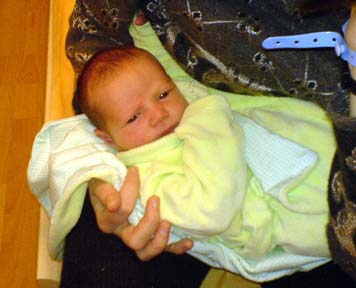

Thanks to all who wrote congratulations in their comments to the previous post. These photos of my baby (both from Dec. 7) are in response to Highlander's request.
Saturday, December 09, 2006
My baby
My younger son was born on Nov. 30.
Many thanks to Dr. Grancharov and his team at St. Sofia Maternity Hospital.
Blogging of course will be much reduced now - the baby wants his due.
Many thanks to Dr. Grancharov and his team at St. Sofia Maternity Hospital.
Blogging of course will be much reduced now - the baby wants his due.
Thursday, November 09, 2006
"Alfa Roma"
Recently, my husband had to go to the airport - one of the few occasions when he needs a taxi. As usual, he called his favourite taxi company. It is known as "1 Dollar Taxi" and isn't among the biggest in the industry.
And as usual, my mother in-law was angry. "Why did he call them again? There are only Gypsy drivers working there; in fact, the company is named "Alfa Roma". Some time they'll drive him to some remote place and rob him."
("Roma" is the politically correct term for "Gypsy".)
As a matter of fact my husband, despite his habit to go to the airport late, has never (yet) missed a plane. Besides, I feel there is something wrong with my mother in-law's logic. After we demand the Gypsies to work, it isn't very honest to boycott them when they do. So these days, when I needed a taxi and saw a "1 Dollar" approaching, I raised my hand.
The taxi was quite good. The company may hire Gypsy drivers (and I think it is good if it does) but that particular driver was white. And while on the outside of the car was written the popular name "1 Dollar Taxi", inside there was a label with the official name of the company. It was "Alfa Romeo" with some additional letters.
I don't know why. Possibly they have some agreement with the auto producer.
And as usual, my mother in-law was angry. "Why did he call them again? There are only Gypsy drivers working there; in fact, the company is named "Alfa Roma". Some time they'll drive him to some remote place and rob him."
("Roma" is the politically correct term for "Gypsy".)
As a matter of fact my husband, despite his habit to go to the airport late, has never (yet) missed a plane. Besides, I feel there is something wrong with my mother in-law's logic. After we demand the Gypsies to work, it isn't very honest to boycott them when they do. So these days, when I needed a taxi and saw a "1 Dollar" approaching, I raised my hand.
The taxi was quite good. The company may hire Gypsy drivers (and I think it is good if it does) but that particular driver was white. And while on the outside of the car was written the popular name "1 Dollar Taxi", inside there was a label with the official name of the company. It was "Alfa Romeo" with some additional letters.
I don't know why. Possibly they have some agreement with the auto producer.
Thursday, November 02, 2006
The aftermath of the elections
As expected, the current President Georgi Parvanov won a second term. He had 75.9% of votes at the second round, his rival Volen Siderov collected only 24.1%.
Yesterday, my husband commented while watching the news, "Now, when Parvanov was re-elected, everything goes on as expected. A Russian company is appointed to build the second nuclear plant and Bogomil Raynov was decorated with a medal."
I've mentioned in my previous post the tendency of Mr. Parvanov to decorate nasty people. Bogomil Raynov is a writer who used to be very well positioned during the Commnist era, in fact he was close friend of Lyudmila Zhivkova, the daughter of dictator Todor Zhivkov. Older generations remember that when Bogomil was young, he publicly renounced his father, writer Nikolay Raynov, in order to boost his career.
Yesterday, my husband commented while watching the news, "Now, when Parvanov was re-elected, everything goes on as expected. A Russian company is appointed to build the second nuclear plant and Bogomil Raynov was decorated with a medal."
I've mentioned in my previous post the tendency of Mr. Parvanov to decorate nasty people. Bogomil Raynov is a writer who used to be very well positioned during the Commnist era, in fact he was close friend of Lyudmila Zhivkova, the daughter of dictator Todor Zhivkov. Older generations remember that when Bogomil was young, he publicly renounced his father, writer Nikolay Raynov, in order to boost his career.
Thursday, October 26, 2006
Don't vote for Georgi Parvanov
On Sunday, Bulgaria will have a second round of presidential elections. The two competing candidates are the current President Georgi Parvanov (from the Socialist party) and Volen Siderov from the Ataka party. Their photos are shown, respectively, at http://www.parvanov.bg/eng/?go=53 for Parvanov and at http://news.bulgarianpost.com/story-read_parliamentat_sne_imuniteta_na_volen_siderov-5172.php for Siderov (the grey-haired guy in the middle).
I won't discuss Siderov now; he has been honoured by me earlier (http://mayas-corner.blogspot.com/2006/04/volen-siderov.html) and, besides, now everybody leads propaganda against him. Everybody tells us how important is not to elect Siderov and how we, the people whose views put us against Parvanov, must press our noses with two fingers and go to vote for him. Oh, really? Let's see.
I'll first translate the information about Parvanov given by Mediapool at http://www.mediapool.bg/show/?storyid=121454 and most likely originating from his official CV. It is usually said that Parvanov is a historian. His CV points exactly what kind of historian he is: "He graduates history in the Sofia St. Kliment Ohridski University, after which he becomes a PhD student at the Institute of History of Bulgarian Communist Party, affiliated to the Central Committee of the Bulgarian Communist Party. Until 1991 he is a research assistant in the same Institute. Since 1991 he has been Head of the Center for historic and political studies affiliated to the Supreme Council of the Bulgarian Socialist party. Since December 1996 Parvanov has been Head of the Supreme Council of the Bulgarian Socialist Party..."
So you see that his "history" was not any kind of history but history of the Party. To put the matter rudely, we have no proof that Parvanov has ever in his life done any work worth 2 cents (btw this is also true for our PM Sergey Stanishev, also a Socialist).
Strangely enough, in his relatively modest career as a historian, Parvanov still managed to stain his name by tying it to the State Security - the Communist Secret Services. He was asked by the State Security people to give his expert opinion about a book devoted to Macedonian history. He wrote a text and signed it by "Gotze" (in Macedonia, men named Georgi are often informally called Gotze). This fact surfaced several months ago. Parvanov tried to vindicate himself by saying he was only giving an expert opinion, as any expert would do. However, there are at least 2 reasons not to whitewash him. First, if the State Security wanted just an expert, why didn't they summon an expert? Why did they turn to an unexperienced researcher who seems to have always been an embodiment of mediocrity? Second, more important, why didn't he sign his opinion with his real name? When in 1990 the opposition politician Peter Beron was revealed to have written reports for State Security under the pen name "Boncho", my uncle said, "Of course, nobody could refuse to testify when subpoenated by State Security. His fatal mistake was that he accepted a pen name and so entered the game. (Peter Beron was among the presidential candidates at the 1st round last Sunday. An unfortunate country, isn't it?).
According to his Wikipedia page (http://en.wikipedia.org/wiki/Georgi_Parvanov), Parvanov "is in favour of Bulgarian membership of NATO and the European Union". Yes, he is now, when the NATO membership is a fact and the EU membership is inevitable. But in the meantime, he did everything he could to prevent Bulgaria from entering these unions. Well, this was according to his views, but why is he now pretending to be more pro-Western than people like me?
But let the distant past bury its dead, while we see Parvanov's performance as President. Generally, nothing special; according to the Bulgarian constitution, the President, although elected directly by the people, has little real power. But I don't like the little things he did. He decorated with the highest-rank Bulgarian medals nasty people such as the leader of the Turkish party Ahmed Dogan, the arms dealer and former publisher of Socialist newspaper "Duma" Peter Mandjukov, Todor Zhivkov's alcoholic son in-law Ivan Slavkov (ordered out of the International Olympic Committee after BBC journalists exposed his corruption) and, most importantly, Vasil Mrachkov, who was Chief Prosecutor during Todor Zhivkov's campaign of renaming Bulgarian Turks (1984-85). Among the few important items where the President has real power is dealing with foreigners wishing to remain in Bulgaria. Parvanov uses this power to reject the right of asylum to people fleeing "friendly" dictators (I've posted about one such case at http://mayas-corner.blogspot.com/2006/05/more-about-michail-vashkevich.html); I also know about a hard-working Russian mother of two who, without claiming to be a refugee, hoped to build a new life in Bulgaria but was kicked out. Meanwhile, every time when a foreign-born gangster is shot in the street by rival gangsters, he turns out to be a naturalized Bulgarian citizen. Last, a small but telltale fact - Parvanov periodically organizes charity campaigns for children in orphanages and sick children and takes care to snach all the credit for the results, forgetting the ordinary citizens who donate small sums, literally taking them out of their mouths.
Nevertheless, now people considering themselves democrats are appealing to us to vote for Mr. Parvanov. Here comes even Hans-Gert Poettering, the Chairman of the (rightist) EPP-ED Group in the European Parliament. I haven't heard him before the first round to speak in support of the rightist candidate Nedelcho Beronov, but now he summons the rightist Bulgarian parties and their electorate to vote for a "democratic candidate, even though he is our opponent". (Remarkably, the appeal is dated Oct. 23, just a day after the 1st round, which most likely means it was prepared beforehand.)
In principle, I don't entirely reject voting for a candidate with a programme not matching my views. I have actually done this - at the 2nd round of the last municipal elections, I voted for Socialist Tatyana Doncheva in a desperate effort to prevent the dangerous populist and Neanderthalian sex symbol Boyko Borisov from becoming mayor of Sofia. However, the candidate I would vote for must be a reasonably decent person. Parvanov isn't.
The arguments of Bulgarian commentors telling us to vote for Parvanov can be summarized as follows: "If we elect Siderov, all the Europe and the world will regard us as xenophobic idiots. And besides, imagine what will happen if Siderov is elected and begins to materialize his hateful agenda!"
Well, why should we try to conceal our nature of xenophobic idiots? I am for openness. Any attempt to present ouselves as people better than we actually are can only lead to later misunderstandings. Besides, even in countries with much more powerful democratic tradition elections frequently turn into census of idiots.
As for Siderov materializing his agenda, it's impossible. You cannot set up concentration camps for Gipsies, Jews, Turks etc. in 2006. This is not Germany, 1943, this is not even Bulgaria, 1984. Moreover, as I mentioned earlier, Bulgarian President is mainly a figurehead. If somebody is to set up concentration camps, this is the Prime Minister. Check the Constitution. So Siderov is just a scarecrow.
Somebody might say, "But your call to neglect the danger to minorities is a bit dishonest, after you are not a minority member."
Here I have a counter-argument I deliberately left last, the cherry on the cake. Why do you think that Parvanov is better? Siderov offers much xenophobic talk, but as far as I know, he has never supported an actual genocide, while Parvanov openly supported the "Butcher of the Balkans" Milosevic. As late as 1999, he sent to Milosevic an encouraging letter. So we have all the reasons to believe that if creating concentration camps (or any other form of genocide) becomes practically possible and socially acceptable, Parvanov would go ahead with it.
At the 1st round of any elections, there is always if not a good candidate, then one who can be regarded as lesser evil. At the 2nd round, there often isn't. So I won't vote on Sunday and recommend the same to everybody. Let the idiots elect the idiot they prefer.
I won't discuss Siderov now; he has been honoured by me earlier (http://mayas-corner.blogspot.com/2006/04/volen-siderov.html) and, besides, now everybody leads propaganda against him. Everybody tells us how important is not to elect Siderov and how we, the people whose views put us against Parvanov, must press our noses with two fingers and go to vote for him. Oh, really? Let's see.
I'll first translate the information about Parvanov given by Mediapool at http://www.mediapool.bg/show/?storyid=121454 and most likely originating from his official CV. It is usually said that Parvanov is a historian. His CV points exactly what kind of historian he is: "He graduates history in the Sofia St. Kliment Ohridski University, after which he becomes a PhD student at the Institute of History of Bulgarian Communist Party, affiliated to the Central Committee of the Bulgarian Communist Party. Until 1991 he is a research assistant in the same Institute. Since 1991 he has been Head of the Center for historic and political studies affiliated to the Supreme Council of the Bulgarian Socialist party. Since December 1996 Parvanov has been Head of the Supreme Council of the Bulgarian Socialist Party..."
So you see that his "history" was not any kind of history but history of the Party. To put the matter rudely, we have no proof that Parvanov has ever in his life done any work worth 2 cents (btw this is also true for our PM Sergey Stanishev, also a Socialist).
Strangely enough, in his relatively modest career as a historian, Parvanov still managed to stain his name by tying it to the State Security - the Communist Secret Services. He was asked by the State Security people to give his expert opinion about a book devoted to Macedonian history. He wrote a text and signed it by "Gotze" (in Macedonia, men named Georgi are often informally called Gotze). This fact surfaced several months ago. Parvanov tried to vindicate himself by saying he was only giving an expert opinion, as any expert would do. However, there are at least 2 reasons not to whitewash him. First, if the State Security wanted just an expert, why didn't they summon an expert? Why did they turn to an unexperienced researcher who seems to have always been an embodiment of mediocrity? Second, more important, why didn't he sign his opinion with his real name? When in 1990 the opposition politician Peter Beron was revealed to have written reports for State Security under the pen name "Boncho", my uncle said, "Of course, nobody could refuse to testify when subpoenated by State Security. His fatal mistake was that he accepted a pen name and so entered the game. (Peter Beron was among the presidential candidates at the 1st round last Sunday. An unfortunate country, isn't it?).
According to his Wikipedia page (http://en.wikipedia.org/wiki/Georgi_Parvanov), Parvanov "is in favour of Bulgarian membership of NATO and the European Union". Yes, he is now, when the NATO membership is a fact and the EU membership is inevitable. But in the meantime, he did everything he could to prevent Bulgaria from entering these unions. Well, this was according to his views, but why is he now pretending to be more pro-Western than people like me?
But let the distant past bury its dead, while we see Parvanov's performance as President. Generally, nothing special; according to the Bulgarian constitution, the President, although elected directly by the people, has little real power. But I don't like the little things he did. He decorated with the highest-rank Bulgarian medals nasty people such as the leader of the Turkish party Ahmed Dogan, the arms dealer and former publisher of Socialist newspaper "Duma" Peter Mandjukov, Todor Zhivkov's alcoholic son in-law Ivan Slavkov (ordered out of the International Olympic Committee after BBC journalists exposed his corruption) and, most importantly, Vasil Mrachkov, who was Chief Prosecutor during Todor Zhivkov's campaign of renaming Bulgarian Turks (1984-85). Among the few important items where the President has real power is dealing with foreigners wishing to remain in Bulgaria. Parvanov uses this power to reject the right of asylum to people fleeing "friendly" dictators (I've posted about one such case at http://mayas-corner.blogspot.com/2006/05/more-about-michail-vashkevich.html); I also know about a hard-working Russian mother of two who, without claiming to be a refugee, hoped to build a new life in Bulgaria but was kicked out. Meanwhile, every time when a foreign-born gangster is shot in the street by rival gangsters, he turns out to be a naturalized Bulgarian citizen. Last, a small but telltale fact - Parvanov periodically organizes charity campaigns for children in orphanages and sick children and takes care to snach all the credit for the results, forgetting the ordinary citizens who donate small sums, literally taking them out of their mouths.
Nevertheless, now people considering themselves democrats are appealing to us to vote for Mr. Parvanov. Here comes even Hans-Gert Poettering, the Chairman of the (rightist) EPP-ED Group in the European Parliament. I haven't heard him before the first round to speak in support of the rightist candidate Nedelcho Beronov, but now he summons the rightist Bulgarian parties and their electorate to vote for a "democratic candidate, even though he is our opponent". (Remarkably, the appeal is dated Oct. 23, just a day after the 1st round, which most likely means it was prepared beforehand.)
In principle, I don't entirely reject voting for a candidate with a programme not matching my views. I have actually done this - at the 2nd round of the last municipal elections, I voted for Socialist Tatyana Doncheva in a desperate effort to prevent the dangerous populist and Neanderthalian sex symbol Boyko Borisov from becoming mayor of Sofia. However, the candidate I would vote for must be a reasonably decent person. Parvanov isn't.
The arguments of Bulgarian commentors telling us to vote for Parvanov can be summarized as follows: "If we elect Siderov, all the Europe and the world will regard us as xenophobic idiots. And besides, imagine what will happen if Siderov is elected and begins to materialize his hateful agenda!"
Well, why should we try to conceal our nature of xenophobic idiots? I am for openness. Any attempt to present ouselves as people better than we actually are can only lead to later misunderstandings. Besides, even in countries with much more powerful democratic tradition elections frequently turn into census of idiots.
As for Siderov materializing his agenda, it's impossible. You cannot set up concentration camps for Gipsies, Jews, Turks etc. in 2006. This is not Germany, 1943, this is not even Bulgaria, 1984. Moreover, as I mentioned earlier, Bulgarian President is mainly a figurehead. If somebody is to set up concentration camps, this is the Prime Minister. Check the Constitution. So Siderov is just a scarecrow.
Somebody might say, "But your call to neglect the danger to minorities is a bit dishonest, after you are not a minority member."
Here I have a counter-argument I deliberately left last, the cherry on the cake. Why do you think that Parvanov is better? Siderov offers much xenophobic talk, but as far as I know, he has never supported an actual genocide, while Parvanov openly supported the "Butcher of the Balkans" Milosevic. As late as 1999, he sent to Milosevic an encouraging letter. So we have all the reasons to believe that if creating concentration camps (or any other form of genocide) becomes practically possible and socially acceptable, Parvanov would go ahead with it.
At the 1st round of any elections, there is always if not a good candidate, then one who can be regarded as lesser evil. At the 2nd round, there often isn't. So I won't vote on Sunday and recommend the same to everybody. Let the idiots elect the idiot they prefer.
Monday, October 23, 2006
Retiring
Self-respecting female bloggers are expected to write posts about their pregnancies before telling their husbands (http://jadmadi.net/2006/07/28/why-not-to-marry-a-blogger/, check No. 5).
However, I postponed making this matter public till the middle of the 3rd trimester. My pregnancy-and-maternity leave began on Saturday.
Of course most of the things I intended to do before "retiring" remained unfinished. I even left some glassware soaked, prepared for washing. Sorry, but I really couldn't do anything about it. I had calculated time to wash it, but on Friday I had to go home early to comfort the running nose of my son (my elder one, as I begin to think of him). Another piece of work I really had to finish (a blueprint for a new practical) was ready, or rather declared ready, in the very last moment. I presented it to my colleagues literally an hour before I left.
A note about my e-mail: Avoid using my office address - I'll visit that computer too rarely and the mail may stay unchecked for more than a month. I've opened a Gmail box and hope it will function properly. (Thanks to Programmer Craig who gave me the idea just in time.)
However, I postponed making this matter public till the middle of the 3rd trimester. My pregnancy-and-maternity leave began on Saturday.
Of course most of the things I intended to do before "retiring" remained unfinished. I even left some glassware soaked, prepared for washing. Sorry, but I really couldn't do anything about it. I had calculated time to wash it, but on Friday I had to go home early to comfort the running nose of my son (my elder one, as I begin to think of him). Another piece of work I really had to finish (a blueprint for a new practical) was ready, or rather declared ready, in the very last moment. I presented it to my colleagues literally an hour before I left.
A note about my e-mail: Avoid using my office address - I'll visit that computer too rarely and the mail may stay unchecked for more than a month. I've opened a Gmail box and hope it will function properly. (Thanks to Programmer Craig who gave me the idea just in time.)
Sunday, October 22, 2006
The preliminary election results
The first round of the presidential elections is over and preliminary results have been published: over 60% for the current President Georgi Parvanov, approximately 20% for Volen Siderov and approximately 10% for "my" candidate, Nedelcho Beronov.
There will be a ballotage next Sunday, because fewer than 50% of voters have taken part.
As you can guess, I am not happy with the results. Parvanov being challenged by Siderov for the presidency! I'd prefer to have for President a man picked randomly from a village pub.
Why are people such idiots?
There will be a ballotage next Sunday, because fewer than 50% of voters have taken part.
As you can guess, I am not happy with the results. Parvanov being challenged by Siderov for the presidency! I'd prefer to have for President a man picked randomly from a village pub.
Why are people such idiots?
Tuesday, October 17, 2006
Vote for Nedelcho Beronov!
On Sunday, Oct. 22, Bulgarians will vote for President. So it is high time for me to join the election campaign. Bulgarian readers, vote for Nedelcho Beronov! If we fail to elect him, we subscribe to another portion of miserable reality for which we'll have only ourselves to blame.
He is the candidate of the right-wing alliance - the best part of the Bulgarian political spectrum. As for his personal qualities, although I haven't had the opportunity to follow the campaign in detail, I have impression of him as a decent, serious, composed man. As far as I know, nobody so far has managed to dig out anything compromising from his past life (e.g. using his position to enrich himself, building his career on loyalty to the Communist regime or ties with the former State Security). Just see what his opponents and the media resort to in their efforts to say something against him: that he is too old and not known to the public!
Yes, Mr. Beronov is old. So what? He is not applying for the position of a sergeon or programmer. There is nothing in the job of a President that makes an aged person unable to do it. Despite his age, Greece's Konstantinos Karamanlis did excellent work, not to mention the great Ronald Reagan.
"But (if elected) he may die before finishing his term." This is true, but the same is possible, although less likely, for any younger person. So this statement rather points to the necessity to vote for a presidential candidate with a good candidate for Vice President. I quite like Juliana Nikolova, Beronov's candidate for Vice President. Compare her to the ridiculous figure of General Angel Marin, our current Vice President. Anybody knowing any reason for him to be made Vice President other than his love to Russia and despise to NATO (remember, he was dismissed from the Army by the previous president Stoyanov for publicly speaking against NATO while Bulgaria was applying for membership). There are jokes about him. The satirical paper Starshel once wrote, "Although I don't like President Parvanov very much, I pray every evening that no piece of his supper enters his trachea and suffocates him; because, if this happens, next morning Angel Marin will be our President." Another joke: Radio Erevan was asked whether it could name a presidential team worse than Parvanov - Marin. The answer, "Yes: the team Marin - Parvanov."
Having had low birth rate for decades and massive emigration of young people since 1989, Bulgaria now suffers from dysbalanced population structure with high percentage of aged citizens. Consequently, you'll hear in all corners of the public space how important the elderly people are and what more steps must be taken to improve their plight (of course, by adding more to the already unbearable tax burden of productive-age people). In the context of this "gerontophilia", it is even more bizarre to hear attacks against a candidate because of his age being repeated again and again by opponents and media and then parroted by retired voters.
The other argument against Mr. Beronov - that he is not known to the public, is, to my opinion, much worse. Who is in fact known to the public? I think of three groups of people: (1) those already in the political establishment; (2) those known because of the nature of their work, such as top actors, singers and athletes; (3) those made known by the media. Should we restrict our choice to members of these groups only? Can we trust the media that they will make the right people known to the public in time? No, we cannot. Let's just remember the rabid media campaigns against the two reasonably good governments we've had since 1989 (those of Filip Dimitrov and Ivan Kostov) and their permanent and equally rabid anti-Americanism. Or their nuclear lobbying. Who in fact funds these media, allowing the Skat TV channel to be broadcasted and the thick illustrated copies of Trud and 24 chasa to be sold at 0.70 leva? Isn't it ridiculous that people carefully hiding from the public are now brainwashing it not to vote for an "unknown" person?
If a candidate is little known, he will become known during the election campaign. Isn't this in fact the basic function of this campaign? If Bulgarian voters give an ear to the "argument" that an unknown person shouldn't be elected, this will have dangerous consequences exceeding far beyond the current elections. It will mean effective abolishment of our constitutional right to be elected. Yes, my Bulgarian reader, they are attacking your and my right to be elected, they impose on us, the "unknown" citizens, the role of a flock, while the right to actively participate in politics is reserved for a few "noblemen" selected by them. This must not pass.
Besides Beronov, there are only two candidates with chance to succeed - the current President Georgi Parvanov and the Ataka leader Volen Siderov. I don't want right now to engage in a "negative" campaign and to explain why neither of these men should be elected. The reasons are well known to all who live in Bulgaria and even to those who live abroad but occasionally check our political news. So, even if you don't like Beronov very much, regard him as the least evil and vote for him.
Among the other candidates, one deserves special attention: Georgi Markov (happily, no relation to me). He began his political career in the Union of the Democratic Forces (SDS) and now uses this fact to present himself as "the authentic anti-Communist candidate". He can speak damn well and will surely convince some to vote for him. But at times he betrays himself. I heard him say that his goal is "to go to the ballotage and to compete with the Socialist candidate Parvanov". So, his goal is not to win, just to displace Beronov. If you are hesitating, my reader, do you need another proof that Markov is in the campaign just to steal votes from Beronov?
Markov is widely believed to have collaborated with State Security (the former Communist secret service). It is impossible to prove, because the well-cleaned archive of the State Security now contains no document with Markov's signature, just a card with his name. So we can only speculate that his participation in these election is another task by his former masters. For those who still doubt, I suggest to have a fresh look at Markov's photo or videotape. Who could, in sobriety and sanity, trust a man with such a face?
(A photo of Markov, a small one unfortunately, is shown at http://www.bgbook.dir.bg/book.php?ID=16272.)
He is the candidate of the right-wing alliance - the best part of the Bulgarian political spectrum. As for his personal qualities, although I haven't had the opportunity to follow the campaign in detail, I have impression of him as a decent, serious, composed man. As far as I know, nobody so far has managed to dig out anything compromising from his past life (e.g. using his position to enrich himself, building his career on loyalty to the Communist regime or ties with the former State Security). Just see what his opponents and the media resort to in their efforts to say something against him: that he is too old and not known to the public!
Yes, Mr. Beronov is old. So what? He is not applying for the position of a sergeon or programmer. There is nothing in the job of a President that makes an aged person unable to do it. Despite his age, Greece's Konstantinos Karamanlis did excellent work, not to mention the great Ronald Reagan.
"But (if elected) he may die before finishing his term." This is true, but the same is possible, although less likely, for any younger person. So this statement rather points to the necessity to vote for a presidential candidate with a good candidate for Vice President. I quite like Juliana Nikolova, Beronov's candidate for Vice President. Compare her to the ridiculous figure of General Angel Marin, our current Vice President. Anybody knowing any reason for him to be made Vice President other than his love to Russia and despise to NATO (remember, he was dismissed from the Army by the previous president Stoyanov for publicly speaking against NATO while Bulgaria was applying for membership). There are jokes about him. The satirical paper Starshel once wrote, "Although I don't like President Parvanov very much, I pray every evening that no piece of his supper enters his trachea and suffocates him; because, if this happens, next morning Angel Marin will be our President." Another joke: Radio Erevan was asked whether it could name a presidential team worse than Parvanov - Marin. The answer, "Yes: the team Marin - Parvanov."
Having had low birth rate for decades and massive emigration of young people since 1989, Bulgaria now suffers from dysbalanced population structure with high percentage of aged citizens. Consequently, you'll hear in all corners of the public space how important the elderly people are and what more steps must be taken to improve their plight (of course, by adding more to the already unbearable tax burden of productive-age people). In the context of this "gerontophilia", it is even more bizarre to hear attacks against a candidate because of his age being repeated again and again by opponents and media and then parroted by retired voters.
The other argument against Mr. Beronov - that he is not known to the public, is, to my opinion, much worse. Who is in fact known to the public? I think of three groups of people: (1) those already in the political establishment; (2) those known because of the nature of their work, such as top actors, singers and athletes; (3) those made known by the media. Should we restrict our choice to members of these groups only? Can we trust the media that they will make the right people known to the public in time? No, we cannot. Let's just remember the rabid media campaigns against the two reasonably good governments we've had since 1989 (those of Filip Dimitrov and Ivan Kostov) and their permanent and equally rabid anti-Americanism. Or their nuclear lobbying. Who in fact funds these media, allowing the Skat TV channel to be broadcasted and the thick illustrated copies of Trud and 24 chasa to be sold at 0.70 leva? Isn't it ridiculous that people carefully hiding from the public are now brainwashing it not to vote for an "unknown" person?
If a candidate is little known, he will become known during the election campaign. Isn't this in fact the basic function of this campaign? If Bulgarian voters give an ear to the "argument" that an unknown person shouldn't be elected, this will have dangerous consequences exceeding far beyond the current elections. It will mean effective abolishment of our constitutional right to be elected. Yes, my Bulgarian reader, they are attacking your and my right to be elected, they impose on us, the "unknown" citizens, the role of a flock, while the right to actively participate in politics is reserved for a few "noblemen" selected by them. This must not pass.
Besides Beronov, there are only two candidates with chance to succeed - the current President Georgi Parvanov and the Ataka leader Volen Siderov. I don't want right now to engage in a "negative" campaign and to explain why neither of these men should be elected. The reasons are well known to all who live in Bulgaria and even to those who live abroad but occasionally check our political news. So, even if you don't like Beronov very much, regard him as the least evil and vote for him.
Among the other candidates, one deserves special attention: Georgi Markov (happily, no relation to me). He began his political career in the Union of the Democratic Forces (SDS) and now uses this fact to present himself as "the authentic anti-Communist candidate". He can speak damn well and will surely convince some to vote for him. But at times he betrays himself. I heard him say that his goal is "to go to the ballotage and to compete with the Socialist candidate Parvanov". So, his goal is not to win, just to displace Beronov. If you are hesitating, my reader, do you need another proof that Markov is in the campaign just to steal votes from Beronov?
Markov is widely believed to have collaborated with State Security (the former Communist secret service). It is impossible to prove, because the well-cleaned archive of the State Security now contains no document with Markov's signature, just a card with his name. So we can only speculate that his participation in these election is another task by his former masters. For those who still doubt, I suggest to have a fresh look at Markov's photo or videotape. Who could, in sobriety and sanity, trust a man with such a face?
(A photo of Markov, a small one unfortunately, is shown at http://www.bgbook.dir.bg/book.php?ID=16272.)
Monday, October 09, 2006
Tribute to a great woman
On Oct. 7, intrepid Russian journalist Anna Politkovskaya, 48, mother of two children, was assassinated in her home in Moscow.
The international community doesn't seem to care much. At http://news.bbc.co.uk/1/hi/world/europe/5416238.stm, you can read the too short and cold (to my opinion) BBC obituary. Bulgarian media covered her life and death in more detail. Below, I'm translating from the Netinfo page http://netinfo.bg/?tid=40&oid=946991. The photo is also from there; it was originally published by her newspaper "Novaya gazeta".
"Anna Politkovskaya, called "The victims' voice", is known worldwide mainly for her uncompromising publications about the war in Chechnya and North Caucasia and her criticism of President Vladimir Putin's policies... She received many death threats... Her colleagues from "Novaya gazeta" wrote that it was absolutely impossible for her to be intimidated or bribed into silence... Since 1999, she has visited many times war zones and refugee camps in Dagestan, Ingushetia and Chechnya. She wrote the documentary book Journey to Hell: A Chechen Diary... Her fiercely critical book isn't accessible to the Russian readers... She told the British Independent newspaper that on Sept. 1, 2004 she contacted Chechen rebels and persuaded thom to allow Aslan Mashadov... to go to Beslan and convince the terrorists to free the children they had taken as hostages. Then she went to Beslan to secure a pass for Mashadov... But during the flight she had a cup of tea and so was poisoned..."
Putin and his gang prefered to let all hostages die rather than allow any opposition figure help them and so get some credit. Anna Politkovskaya, on the contrary, could never accept the murder of innocents. Neither the innocent hostages nor the innocent Chechens. Such a person in Russia apparently is not entitled to a natural death.
Saturday, September 30, 2006
Dimitar Stoyanov, the child prodigy of the Ataka party
The Ataka party is the newest jewel in the crown of the Bulgarian democracy. I have devoted an earlier post to it and its fuhrer Volen Siderov (http://mayas-corner.blogspot.com/2006/04/volen-siderov.html).
The youngest member of the parliamentary group of the Ataka party is the student Dimitar Stoyanov. He is grandson of the late satirical writer Radoi Ralin, whose short poems mocking the Communist reality had made him a legend. He is also an informal stepson of Volen Siderov. (Stoyanov's mother has divorced his father, Radoi Ralin's son, and is now living with Siderov). You guess that with such relations, the young man's personal qualities were hardly decisive for his political career.
Last year, the election campaign in my district, Zaharna fabrika, was shaped by an ugly crime. A crowd of Gipsies attacked partying Bulgarians and beat to death one of them. Then, Ataka made a series of rallies in the district, gathering Bulgarian audience and supplying anti-Gipsy talk to it. Of course I didn't take part in these rallies, neither did my husband, but my mother in-law attended most of them. I know from her that Stoyanov was a regular speaker and was "talking very well". Indeed, she added, there was another student who was talking equally well, if not better, yet the party didn't include him in its parliamentary group. I commented that the other student had no famous grandfather and no mother sleeping with Volen Siderov, so his rhetorical abilities weren't enough to catapult him into the Parliament.
Later, Stoyanov was sent to the European Parliament as an observer. And here comes the present scandal. You can read a short version in English at http://www.sofiaecho.com/article/observer-from-bulgaria-causes-european-parliament-scandal/id_17938/catid_68. However, the report at http://www.dnes.bg/article.php?id=27977 (in Bulgarian, but look at it anyway to see Stoyanov's photo) is much more juicy, so I'm translating below.
"Two days after the EU decided about Bulgarian membership, Ataka MP Dimitar Stoyanov managed to create a racist scandal in the European Parliament... Invited to support the nomination of Hungarian member of Parliament of Roma origin Livia Jaroka for a human rights award, Stoyanov sent to his colleagues an e-mail to explain why he was against it.
Here is the text of the e-mail: "In my country, there are tens of thousands of Gipsy girls, much more beautiful than this respectable lady. In fact, if you are at the right place in the right time, you can even buy one (aged 12-13) to make her your loving wife. The best of them are very expensive - up to EUR 5000... Let's return to Miss Laroka's nomination. Believe me, I've seen many Gipsy women, but all of them at her age were much leaner. Doesn't she share the terrible suffering Roma people throughout Europe have to endure, the poverty, miserable conditions and unemployment?..."
...The mailbox of the Bulgarian observers was flooded by dozens of angry e-mails... In response, Siderov's stepson sent out a second e-mail presumed to be an apology. However, the scandal's author added to his apology accusation to the members of the European Parliament. Here is the text: "In the 21st century, to accuse somebody in racism is the gravest insult. According to Bulgarian law, if somebody is insulted and replies with an insult, charges against both can be dropped. I think this is what happened. Once again, I offer my sincere apology to Miss Livia Laroka... But I also feel insulted because I am not a racist, I am proud to be a Bulgarian, a member of Parliament and observer...""
No comment needed, I think.
By the way, my mother in-law first heard the story from me. Her reaction: "Unfortunately, this isn't very surprising. There are even rumours he is taking drugs."
It seems to be true that you cannot deceive people indefinitely!
The youngest member of the parliamentary group of the Ataka party is the student Dimitar Stoyanov. He is grandson of the late satirical writer Radoi Ralin, whose short poems mocking the Communist reality had made him a legend. He is also an informal stepson of Volen Siderov. (Stoyanov's mother has divorced his father, Radoi Ralin's son, and is now living with Siderov). You guess that with such relations, the young man's personal qualities were hardly decisive for his political career.
Last year, the election campaign in my district, Zaharna fabrika, was shaped by an ugly crime. A crowd of Gipsies attacked partying Bulgarians and beat to death one of them. Then, Ataka made a series of rallies in the district, gathering Bulgarian audience and supplying anti-Gipsy talk to it. Of course I didn't take part in these rallies, neither did my husband, but my mother in-law attended most of them. I know from her that Stoyanov was a regular speaker and was "talking very well". Indeed, she added, there was another student who was talking equally well, if not better, yet the party didn't include him in its parliamentary group. I commented that the other student had no famous grandfather and no mother sleeping with Volen Siderov, so his rhetorical abilities weren't enough to catapult him into the Parliament.
Later, Stoyanov was sent to the European Parliament as an observer. And here comes the present scandal. You can read a short version in English at http://www.sofiaecho.com/article/observer-from-bulgaria-causes-european-parliament-scandal/id_17938/catid_68. However, the report at http://www.dnes.bg/article.php?id=27977 (in Bulgarian, but look at it anyway to see Stoyanov's photo) is much more juicy, so I'm translating below.
"Two days after the EU decided about Bulgarian membership, Ataka MP Dimitar Stoyanov managed to create a racist scandal in the European Parliament... Invited to support the nomination of Hungarian member of Parliament of Roma origin Livia Jaroka for a human rights award, Stoyanov sent to his colleagues an e-mail to explain why he was against it.
Here is the text of the e-mail: "In my country, there are tens of thousands of Gipsy girls, much more beautiful than this respectable lady. In fact, if you are at the right place in the right time, you can even buy one (aged 12-13) to make her your loving wife. The best of them are very expensive - up to EUR 5000... Let's return to Miss Laroka's nomination. Believe me, I've seen many Gipsy women, but all of them at her age were much leaner. Doesn't she share the terrible suffering Roma people throughout Europe have to endure, the poverty, miserable conditions and unemployment?..."
...The mailbox of the Bulgarian observers was flooded by dozens of angry e-mails... In response, Siderov's stepson sent out a second e-mail presumed to be an apology. However, the scandal's author added to his apology accusation to the members of the European Parliament. Here is the text: "In the 21st century, to accuse somebody in racism is the gravest insult. According to Bulgarian law, if somebody is insulted and replies with an insult, charges against both can be dropped. I think this is what happened. Once again, I offer my sincere apology to Miss Livia Laroka... But I also feel insulted because I am not a racist, I am proud to be a Bulgarian, a member of Parliament and observer...""
No comment needed, I think.
By the way, my mother in-law first heard the story from me. Her reaction: "Unfortunately, this isn't very surprising. There are even rumours he is taking drugs."
It seems to be true that you cannot deceive people indefinitely!
Wednesday, September 27, 2006
Pinocchio, Tom Sawyer convert to Islam
How much do I hate being right. Didn't I write only days ago that there are "signs that Turkey is finally succumbing to Islamism" (http://www.blogger.com/comment.g?blogID=25206081&postID=115880625016674991)?
Eh well, yesterday Netinfo's Web news started with a report about Pinocchio converting to Islam in Turkey. I cannot give this link (Bulgarian Web pages for news have short life span), but it was easy to find the same information in English. It will also spare me the need to translate. Below, I'm pasting from Telegraph's report Pinocchio and friends converted to Islam (http://www.telegraph.co.uk/news/main.jhtml?xml=/news/2006/08/31/wpino31.xml) by Malcolm Moore. It is in fact nearly a month old.
"Pinocchio, Tom Sawyer and other characters have been converted to Islam in new versions of 100 classic stories on the Turkish school curriculum.
"Give me some bread, for Allah's sake," Pinocchio says to Geppetto, his maker, in a book stamped with the crest of the ministry of education...
In The Three Musketeers, D'Artagnan is told that he cannot visit Aramis. The reason would surprise the author, Alexandre Dumas. An old woman explains: "He is surrounded by men of religion. He converted to Islam after his illness."
Tom Sawyer may always have shirked his homework, but he is more conscientious in learning his Islamic prayers. He is given a "special treat" for learning the Arabic words."
What would you say if you open a new edition of the Arabian Nights and read how Ali Baba, while hiding from the forty thieves, prays to Jesus Christ his Savior?
I wonder, has the copyright protection of all these classics expired? And once a text is in the public domain, does it mean that every idiot can prey on it and do with it whatever he wishes? Somebody must have the mandate to do something in such a situation.
Eh well, yesterday Netinfo's Web news started with a report about Pinocchio converting to Islam in Turkey. I cannot give this link (Bulgarian Web pages for news have short life span), but it was easy to find the same information in English. It will also spare me the need to translate. Below, I'm pasting from Telegraph's report Pinocchio and friends converted to Islam (http://www.telegraph.co.uk/news/main.jhtml?xml=/news/2006/08/31/wpino31.xml) by Malcolm Moore. It is in fact nearly a month old.
"Pinocchio, Tom Sawyer and other characters have been converted to Islam in new versions of 100 classic stories on the Turkish school curriculum.
"Give me some bread, for Allah's sake," Pinocchio says to Geppetto, his maker, in a book stamped with the crest of the ministry of education...
In The Three Musketeers, D'Artagnan is told that he cannot visit Aramis. The reason would surprise the author, Alexandre Dumas. An old woman explains: "He is surrounded by men of religion. He converted to Islam after his illness."
Tom Sawyer may always have shirked his homework, but he is more conscientious in learning his Islamic prayers. He is given a "special treat" for learning the Arabic words."
What would you say if you open a new edition of the Arabian Nights and read how Ali Baba, while hiding from the forty thieves, prays to Jesus Christ his Savior?
I wonder, has the copyright protection of all these classics expired? And once a text is in the public domain, does it mean that every idiot can prey on it and do with it whatever he wishes? Somebody must have the mandate to do something in such a situation.
Saturday, September 23, 2006
The HIV trial in Libya, part 2: The victims
(This is coutinued from Part 1, which is at http://mayas-corner.blogspot.com/2006/09/hiv-trial-in-libya-part-1-infection.html.)
From now on, the story may be wrong in some details because it will rely only on occasional official and unofficial Bulgarian and Libyan sources, which are not very trustworthy (esp. the official ones). Corrections are welcome. However, I believe the picture as a whole is fairly accurate.
An author of detective stories once said that the victim of a crime usually has some characheristics that have led to him/her becoming a victim. In this story, we have two groups of victims: the infected little patients of Benghazi and the accused medics. Let's consider them, the children first.
Why Benghazi
In a recent comment, I called the Iranian opposition "better and stronger" than the Libyan one, implying that the latter, apart from being weak (no wonder - Qaddafi is not the ruler to tolerate alive opposition), doesn't appeal very much to me. It is because, while Iranian opposition is generally pro-Western, opposition-minded Libyans (those who live in Libya and still make their voices heard) are Islamists. In other words, they rebel against the Q-man not because he is an incompetent ruler, liar, oppressor, terrorist and mass murderer, but because they think he isn't Islamist enough. And the center of this opposition is the city of Benghazi. Here, I expect the reader to remember that exactly this city was the center of Libyan February cartoon riots, when at least 11 people laid down their lives (at the same time, residents of Tripoli were reluctant to take part even in an official peaceful demonstration - testimony of Khadija-Teri). Hanu thought that the Benghazi protests were orchestrated by government. I would rather suppose they were provoked by government agents but the ordinary participants were quite sincere. So, the residents of Benghazi must have (on average) more courage than any other group of Libyans but, unfortunately, the same cannot be said about their intellect. The Q-man knows this, understands their way of thinking very well and although they hate him, he can most of the time manipulate them as he wishes.
In 1986, a group of Benghazi residents killed a high-ranking Libyan official. Nine were sentenced and hanged (http://www.libyanet.com/feb1987.htm; warning: graphic photos). I've read (though can't give a link) that the plot was not just secret work of a few people but had wide popular support. Some Bulgarian journalists wrote that, after crushing the rebels, Qaddafi decided to punish the entire city by sharply reducing its funds. Such measures are used in many countries by the central governments against regions expressing dissent (in dictatorships) or just voting for the other party (in semi-democracies). Of course most severely affected are the industries most dependent on subsidies, such as health care.
In the following years, as admitted by a former Libyan health care minister, hospitals throughout Libya were poorly supplied with even the most basic consumatives and medications. This was conveniently blamed on the sanctions and may indeed have been partly due to them. However, in Benghazi the situation was worse than in other places. A Bulgarian nurse who worked for some time at the El Fateh Children's hospital later said, "The senior nurse every morning distributed syringes - 5 for each nurse. No more, no matter how many patients would come."
Another Bulgarian nurse, when beginning work at the same hospital in early 1998, said, "Upon arrival, I was immediately warned by an Egyptian doctor to be very careful, because there was an ongoing AIDS epidemic in the hospital." But nobody warned the patients and the community of Benghazi. Parents continued to bring their little ones to the hospital, thinking they were doing the best for them.
Later in 1998, another Bulgarian nurse - Nasya Nenova, was assigned to work at the same hospital, at a department newly formed especially for the children with AIDS. She wrote to her family: "I am of course very afraid that I may get infected, I work with two pairs of rubber gloves... Some of the children are already in very grave condition. One died last night. At least I hadn't to watch him die, a Philippino nurse was on duty then."
In the following years, dozens more children would die.
Why Bulgarians
As anger accumulated in Benghazi, the regime had to find a way out of the crisis. Of course the truth - that the epidemics was due to the punitive starvation funding of the city, plus shocking incompetence of the hospital's most responsible people - would do little to calm down the spirits. But if the virus was distributed intentionally, then the Q-man and his officials would deserve no blame. So scapegoats were needed. And because the goal was to pacify the Libyans, foreigners would make the best scapegoats.
The regime had plenty of them. Highlander once wrote, "in Libya we have thousands of foreign guest workers in the health sector for whom I am grateful as they make up the deficit." As I wrote before, I'm not sure she should be grateful. Even when they are good and caring professionals, they take positions that would otherwise be occupied by Libyans. To keep the status quo, "they enjoy an enormously better salary than the locals" (same Highlander's post). So they, together with the numerous guest workers in other industries, allow the regime to minimize the number of educated and skilled workers-citizens who are the brain and backbone of any society and in dictatorships often form dangerous opposition. Ottoman Turks made their best to keep the Libyans uneducated and unqualified, and I think Qaddafi today is following their example. Of course the guest workers themselves don't realize this (I haven't seen such a discussion in Bulgarian media, and what isn't in the media doesn't exist for the public). Nor do they realize that one of the reason they are hired is to serve as scapegoats if something goes wrong.
The first scapegoat was Ashraf al Hajuj, a doctor of Palestinian origin. I know little about him; he had lived in Libya since early childhood (probably born there) but, according to the good Arab tradition, was regarded as a Palestinian and not a naturalized Libyan. He was engaged to a Libyan girl who supported him during the following 5 years, but then left him, exhausted to be a fiance of an inmate on death row. After the arrest, al Hajuj was tortured until he was ready to confess anything that was wanted from him.
It is easy to figure out why he was taken. Much later, he said, "The interrogators were telling me that there was nobody to entreat for me because I (as a Palestinian) had no state. I am sure that, hadn't Bulgaria taken me under its protection together with the nurses, I would be now rotting in some mass grave." (I think that if Palestinians had common sense, the name and fate of al Hajuj would be known in every Palestinian house as an illustration of how much their Arab "allies" care for them. If I had such friends, I'd try to strike an immediate deal with my enemy! But of course if Palestinians had common sense, the world would be another and much better place. Mention also that he said "mass grave", not just "grave".)
However, al Hajuj alone was not enough. Non-Arab infidels would make far better villains in the eyes of Benghazeeans, so numerous guest workers were arrested - not only from Bulgaria but also from the Philippines, Poland and other countries. At this stage, there were only two Bulgarian detainees - nurses Snezhana Dimitrova and Sevda Yablanska.
I believe that Libyan authorities made these wide and apparently random arrests to probe which country was least able and willing to protect its nationals. (This protection, I think, contradicts to the very idea of justice, but unfortunately seems needed in today's imperfect world where so many countries are eager to put foreigners to cangaroo courts.) The guest worker communities of Poles and Philippinos, but NOT Bulgarians, swiftly organized and threatened that they would all abandon their contracts and leave Libya immediately if their fellow countrymen were not released. Also, the diplomatic missions of these countries made some unknown to me but apparently effective moves. The Bulgarian embassy also took measures, if you read the official Bulgarian site. However, the unofficial story is different. When a nurse informed the Embassy that two her colleagues were arrested, she obtained the answer, "Let the whores save themselves". So the Bulgarian tradition to fill the diplomatic missions with arrogant, incompetent and lazy people who care neither for the Bulgarian state nor for its nationals brought disastrous results.
There were also other reasons making Bulgaria a good target. It was a small poor coutry outside the mighty Western alliances: we were only applying for NATO, and the EU membership was behind mountains. At the same time, the Bulgarian government in 1992 had condemned Libya as a atate sponsor of terror. Significantly, this government "forgot" to inform its people about this, so Bulgarians going to Libya didn't know that Qaddafi had a reason to regard them as citizens of a hostile state. Next door in Serbia, the next Yugoslavian war was about to burst out (it would be the last one, but nobody knew it at the time). And finally, Libya had a debt to Bulgaria and Qaddafi hoped, with good reason, to get rid of that debt and even to extort additional money.
So the first group of arrested foreign nationals were released, but then 17 Bulgarians were detained. Nurse Nelia Zhdereva said, "They had come for me also, but I didn't open the door. I just stayed quiet, pretending not to be at the quarter." After this, she returned to Bulgaria within days and nobody tried to apprehend her. Those who have read Gulag Archipelago will remember quite similar cases in Stalin's Soviet Union when the security forces, unable to find immediately their intended targets, arrested other people instead. This is to be expected when a certain number of detainees is planned, but their personalities are not very important because they have actually done no crime and the police know this better than anyone else.
Most of the arrested Bulgarians were soon released (some after being tortured), but six were kept. Of the original two detainees, Snezhana Dimitrova was rearrested. Three other nurses working at the El Fateh hospital were also arrested: Valentina Siropulo, Valya Chervenyashka and the above mentioned Nasya Nenova. Another arrested nurse, Kristiana Valcheva, had never been in the hospital in question. She was working at another hospital hundreds of kilometers away from Benghazi, so she couldn't be accused of infecting kids. Her alleged crime was that she collaborated with Hajuj and obtained the virus from the CIA/Mossad agents "John the Englishman" and "Adel the Egyptian" and handed it to the other nurses to inject the children. Kristiana's husband, Dr. Zdravko Georgiev, was working away from both Benghazi and his wife's workplace. Hearing that his wife had disappeared, he tried to find out what had happened and how to help her. He was arrested also, finishing the list of the accused.
The six Bulgarians were tortured in order to confess. Some of them showed remarkable courage. Valya Chervenyashka later said, "I never considered it possible to help them, to confess the nonsense they wanted from me. I was just awaiting my death." However, she was middle-aged and with kidney and heart problems (her heart stopped twice during the interrogations), so her torturers were aware she could die if they pushed her too hard - and this was not what they wanted.
Kristiana Valcheva and Nasya Nenova were younger and healthier and were pushed harder. Kristiana confessed, but this was not found enough. The investigation brought also evidence - blood banks with HIV found in her quarter. Just don't ask why the banks were found during the 4th search of the quarter, how the virus remained detectable in dried droplets after weeks at room temperature and what methods were used to detect it.
Nasya Nenova, when threatened to be injected with HIV, said, "Well, inject me, so please don't beat me more!" (This is the same nurse who had worked with double rubber gloves to avoid HIV infection.) The worst torturer was Juma Misheri. At one point, he left the city for a couple of days; when Nasya heard he had returned, she attempted suicide. Finally, she was so broken that she confessed three times and now is in a worse situation that even Kristiana.
Juma Misheri was later accused of having used torture but of course was acquitted. He is hailed as a popular hero because he has made the "witches" confess. Oh sancta simplicitas! Don't the people of Benghazi ever ask how many of THEM have been tortured by him?
UPDATE: Today (Sept. 26) I received an e-mail from Dr. Declan Butler, a senior reporter at the top science journal Nature. He is currently trying to use the opportunities of the blogosphere to help the accused medics in Libya. Here is a citation from his Sept. 20 post "Can the blogosphere help free the Tripoli six? — innocent medics risking execution in Libya" (http://declanbutler.info/blog/?p=59):
"“Imagine that five American nurses and a British doctor have been detained and tortured in a Libyan prison since 1999, and that a Libyan prosecutor called at the end of August for their execution… on trumped-up charges of deliberately contaminating more than 400 children with HIV in 1998. Meanwhile, the international community and its leaders sit by, spectators of a farce of a trial, leaving a handful of dedicated volunteer humanitarian lawyers and scientists to try to secure their release.
Implausible? That scenario, with the medics enduring prison conditions reminiscent of the film Midnight Express, is currently playing out in a Tripoli court, except that the nationalities of the medics are different. The nurses are from Bulgaria and the doctor is Palestinian.”
These are the opening paragraphs of an unusually strongly-worded editorial — ‘Libya’s travesty‘ – published in tomorrow’s issue of Nature. It is accompanied by a news story over two pages — ‘Lawyers call for science to clear AIDS nurses in Libya‘ — explaining the case. (Both articles are on free access; to access free articles on Nature you just need to register once, and it is free.)"
At http://www.connotea.org/user/Declan/tag/tripoli%20six?num=100, Dr. Butler has listed the blog posts since on the Libya HIV affair.
From now on, the story may be wrong in some details because it will rely only on occasional official and unofficial Bulgarian and Libyan sources, which are not very trustworthy (esp. the official ones). Corrections are welcome. However, I believe the picture as a whole is fairly accurate.
An author of detective stories once said that the victim of a crime usually has some characheristics that have led to him/her becoming a victim. In this story, we have two groups of victims: the infected little patients of Benghazi and the accused medics. Let's consider them, the children first.
Why Benghazi
In a recent comment, I called the Iranian opposition "better and stronger" than the Libyan one, implying that the latter, apart from being weak (no wonder - Qaddafi is not the ruler to tolerate alive opposition), doesn't appeal very much to me. It is because, while Iranian opposition is generally pro-Western, opposition-minded Libyans (those who live in Libya and still make their voices heard) are Islamists. In other words, they rebel against the Q-man not because he is an incompetent ruler, liar, oppressor, terrorist and mass murderer, but because they think he isn't Islamist enough. And the center of this opposition is the city of Benghazi. Here, I expect the reader to remember that exactly this city was the center of Libyan February cartoon riots, when at least 11 people laid down their lives (at the same time, residents of Tripoli were reluctant to take part even in an official peaceful demonstration - testimony of Khadija-Teri). Hanu thought that the Benghazi protests were orchestrated by government. I would rather suppose they were provoked by government agents but the ordinary participants were quite sincere. So, the residents of Benghazi must have (on average) more courage than any other group of Libyans but, unfortunately, the same cannot be said about their intellect. The Q-man knows this, understands their way of thinking very well and although they hate him, he can most of the time manipulate them as he wishes.
In 1986, a group of Benghazi residents killed a high-ranking Libyan official. Nine were sentenced and hanged (http://www.libyanet.com/feb1987.htm; warning: graphic photos). I've read (though can't give a link) that the plot was not just secret work of a few people but had wide popular support. Some Bulgarian journalists wrote that, after crushing the rebels, Qaddafi decided to punish the entire city by sharply reducing its funds. Such measures are used in many countries by the central governments against regions expressing dissent (in dictatorships) or just voting for the other party (in semi-democracies). Of course most severely affected are the industries most dependent on subsidies, such as health care.
In the following years, as admitted by a former Libyan health care minister, hospitals throughout Libya were poorly supplied with even the most basic consumatives and medications. This was conveniently blamed on the sanctions and may indeed have been partly due to them. However, in Benghazi the situation was worse than in other places. A Bulgarian nurse who worked for some time at the El Fateh Children's hospital later said, "The senior nurse every morning distributed syringes - 5 for each nurse. No more, no matter how many patients would come."
Another Bulgarian nurse, when beginning work at the same hospital in early 1998, said, "Upon arrival, I was immediately warned by an Egyptian doctor to be very careful, because there was an ongoing AIDS epidemic in the hospital." But nobody warned the patients and the community of Benghazi. Parents continued to bring their little ones to the hospital, thinking they were doing the best for them.
Later in 1998, another Bulgarian nurse - Nasya Nenova, was assigned to work at the same hospital, at a department newly formed especially for the children with AIDS. She wrote to her family: "I am of course very afraid that I may get infected, I work with two pairs of rubber gloves... Some of the children are already in very grave condition. One died last night. At least I hadn't to watch him die, a Philippino nurse was on duty then."
In the following years, dozens more children would die.
Why Bulgarians
As anger accumulated in Benghazi, the regime had to find a way out of the crisis. Of course the truth - that the epidemics was due to the punitive starvation funding of the city, plus shocking incompetence of the hospital's most responsible people - would do little to calm down the spirits. But if the virus was distributed intentionally, then the Q-man and his officials would deserve no blame. So scapegoats were needed. And because the goal was to pacify the Libyans, foreigners would make the best scapegoats.
The regime had plenty of them. Highlander once wrote, "in Libya we have thousands of foreign guest workers in the health sector for whom I am grateful as they make up the deficit." As I wrote before, I'm not sure she should be grateful. Even when they are good and caring professionals, they take positions that would otherwise be occupied by Libyans. To keep the status quo, "they enjoy an enormously better salary than the locals" (same Highlander's post). So they, together with the numerous guest workers in other industries, allow the regime to minimize the number of educated and skilled workers-citizens who are the brain and backbone of any society and in dictatorships often form dangerous opposition. Ottoman Turks made their best to keep the Libyans uneducated and unqualified, and I think Qaddafi today is following their example. Of course the guest workers themselves don't realize this (I haven't seen such a discussion in Bulgarian media, and what isn't in the media doesn't exist for the public). Nor do they realize that one of the reason they are hired is to serve as scapegoats if something goes wrong.
The first scapegoat was Ashraf al Hajuj, a doctor of Palestinian origin. I know little about him; he had lived in Libya since early childhood (probably born there) but, according to the good Arab tradition, was regarded as a Palestinian and not a naturalized Libyan. He was engaged to a Libyan girl who supported him during the following 5 years, but then left him, exhausted to be a fiance of an inmate on death row. After the arrest, al Hajuj was tortured until he was ready to confess anything that was wanted from him.
It is easy to figure out why he was taken. Much later, he said, "The interrogators were telling me that there was nobody to entreat for me because I (as a Palestinian) had no state. I am sure that, hadn't Bulgaria taken me under its protection together with the nurses, I would be now rotting in some mass grave." (I think that if Palestinians had common sense, the name and fate of al Hajuj would be known in every Palestinian house as an illustration of how much their Arab "allies" care for them. If I had such friends, I'd try to strike an immediate deal with my enemy! But of course if Palestinians had common sense, the world would be another and much better place. Mention also that he said "mass grave", not just "grave".)
However, al Hajuj alone was not enough. Non-Arab infidels would make far better villains in the eyes of Benghazeeans, so numerous guest workers were arrested - not only from Bulgaria but also from the Philippines, Poland and other countries. At this stage, there were only two Bulgarian detainees - nurses Snezhana Dimitrova and Sevda Yablanska.
I believe that Libyan authorities made these wide and apparently random arrests to probe which country was least able and willing to protect its nationals. (This protection, I think, contradicts to the very idea of justice, but unfortunately seems needed in today's imperfect world where so many countries are eager to put foreigners to cangaroo courts.) The guest worker communities of Poles and Philippinos, but NOT Bulgarians, swiftly organized and threatened that they would all abandon their contracts and leave Libya immediately if their fellow countrymen were not released. Also, the diplomatic missions of these countries made some unknown to me but apparently effective moves. The Bulgarian embassy also took measures, if you read the official Bulgarian site. However, the unofficial story is different. When a nurse informed the Embassy that two her colleagues were arrested, she obtained the answer, "Let the whores save themselves". So the Bulgarian tradition to fill the diplomatic missions with arrogant, incompetent and lazy people who care neither for the Bulgarian state nor for its nationals brought disastrous results.
There were also other reasons making Bulgaria a good target. It was a small poor coutry outside the mighty Western alliances: we were only applying for NATO, and the EU membership was behind mountains. At the same time, the Bulgarian government in 1992 had condemned Libya as a atate sponsor of terror. Significantly, this government "forgot" to inform its people about this, so Bulgarians going to Libya didn't know that Qaddafi had a reason to regard them as citizens of a hostile state. Next door in Serbia, the next Yugoslavian war was about to burst out (it would be the last one, but nobody knew it at the time). And finally, Libya had a debt to Bulgaria and Qaddafi hoped, with good reason, to get rid of that debt and even to extort additional money.
So the first group of arrested foreign nationals were released, but then 17 Bulgarians were detained. Nurse Nelia Zhdereva said, "They had come for me also, but I didn't open the door. I just stayed quiet, pretending not to be at the quarter." After this, she returned to Bulgaria within days and nobody tried to apprehend her. Those who have read Gulag Archipelago will remember quite similar cases in Stalin's Soviet Union when the security forces, unable to find immediately their intended targets, arrested other people instead. This is to be expected when a certain number of detainees is planned, but their personalities are not very important because they have actually done no crime and the police know this better than anyone else.
Most of the arrested Bulgarians were soon released (some after being tortured), but six were kept. Of the original two detainees, Snezhana Dimitrova was rearrested. Three other nurses working at the El Fateh hospital were also arrested: Valentina Siropulo, Valya Chervenyashka and the above mentioned Nasya Nenova. Another arrested nurse, Kristiana Valcheva, had never been in the hospital in question. She was working at another hospital hundreds of kilometers away from Benghazi, so she couldn't be accused of infecting kids. Her alleged crime was that she collaborated with Hajuj and obtained the virus from the CIA/Mossad agents "John the Englishman" and "Adel the Egyptian" and handed it to the other nurses to inject the children. Kristiana's husband, Dr. Zdravko Georgiev, was working away from both Benghazi and his wife's workplace. Hearing that his wife had disappeared, he tried to find out what had happened and how to help her. He was arrested also, finishing the list of the accused.
The six Bulgarians were tortured in order to confess. Some of them showed remarkable courage. Valya Chervenyashka later said, "I never considered it possible to help them, to confess the nonsense they wanted from me. I was just awaiting my death." However, she was middle-aged and with kidney and heart problems (her heart stopped twice during the interrogations), so her torturers were aware she could die if they pushed her too hard - and this was not what they wanted.
Kristiana Valcheva and Nasya Nenova were younger and healthier and were pushed harder. Kristiana confessed, but this was not found enough. The investigation brought also evidence - blood banks with HIV found in her quarter. Just don't ask why the banks were found during the 4th search of the quarter, how the virus remained detectable in dried droplets after weeks at room temperature and what methods were used to detect it.
Nasya Nenova, when threatened to be injected with HIV, said, "Well, inject me, so please don't beat me more!" (This is the same nurse who had worked with double rubber gloves to avoid HIV infection.) The worst torturer was Juma Misheri. At one point, he left the city for a couple of days; when Nasya heard he had returned, she attempted suicide. Finally, she was so broken that she confessed three times and now is in a worse situation that even Kristiana.
Juma Misheri was later accused of having used torture but of course was acquitted. He is hailed as a popular hero because he has made the "witches" confess. Oh sancta simplicitas! Don't the people of Benghazi ever ask how many of THEM have been tortured by him?
UPDATE: Today (Sept. 26) I received an e-mail from Dr. Declan Butler, a senior reporter at the top science journal Nature. He is currently trying to use the opportunities of the blogosphere to help the accused medics in Libya. Here is a citation from his Sept. 20 post "Can the blogosphere help free the Tripoli six? — innocent medics risking execution in Libya" (http://declanbutler.info/blog/?p=59):
"“Imagine that five American nurses and a British doctor have been detained and tortured in a Libyan prison since 1999, and that a Libyan prosecutor called at the end of August for their execution… on trumped-up charges of deliberately contaminating more than 400 children with HIV in 1998. Meanwhile, the international community and its leaders sit by, spectators of a farce of a trial, leaving a handful of dedicated volunteer humanitarian lawyers and scientists to try to secure their release.
Implausible? That scenario, with the medics enduring prison conditions reminiscent of the film Midnight Express, is currently playing out in a Tripoli court, except that the nationalities of the medics are different. The nurses are from Bulgaria and the doctor is Palestinian.”
These are the opening paragraphs of an unusually strongly-worded editorial — ‘Libya’s travesty‘ – published in tomorrow’s issue of Nature. It is accompanied by a news story over two pages — ‘Lawyers call for science to clear AIDS nurses in Libya‘ — explaining the case. (Both articles are on free access; to access free articles on Nature you just need to register once, and it is free.)"
At http://www.connotea.org/user/Declan/tag/tripoli%20six?num=100, Dr. Butler has listed the blog posts since on the Libya HIV affair.
Wednesday, September 20, 2006
An update on our Islamist students, or how to study medicine without a brain
I’ve posted earlier about our Islamist students from Turkey who were outraged by Darwinism and kept missing classes on Fridays in order to attend prayers in the mosque (http://mayas-corner.blogspot.com/2006/08/my-turkish-student-eva-islamist.html). At that time, they were in their preparatory year, learning Bulgarian and some secondary-school-level biology. To become full-right freshmen, they had to do a multiple choice test of biology in Bulgarian in the summer. This test is a joke; it serves just to fulfill the requirement of our law that nobody becomes a university student without an entry exam. However, the Islamist girls failed it. Is it surprising? Even from purely physiological point of view, such a result could be expected. A huge and hard-working brain generates a lot of heat which could easily damage it. The need to efficiently cool the brain has shaped the evolution of head circulation (see e.g. http://www.mc.maricopa.edu/~reffland/anthropology/anthro2003/origins/bipedality.html.) What could you expect if you wrap your head in a piece of cloth and stay so all day at Celsium 30? I think that the brain will either be damaged by overheating or, to prevent damage, will switch off from intensive work and stay in a kind of safe mode, showing just a little of what it originally could do.
Yesterday, a colleague came to me to complain. She was furious, and for a good reason.
“The headscarves have come to one of my groups,” she said. “What are they doing there? As far as I know, they failed the examination. However, one of them gave her faculty number, this means she is a student, doesn’t it? It will be a scandal if the administration has enlisted them as 1st year students anyway. I gave them student files to fill. (The files are sheets where students write their names and faculty numbers and then the teacher marks their attendance and performance – M.M.) They couldn’t write their names, asked their Bulgarian colleagues to help. I am here to teach medical students, not mentally retarded people! Our University administration is making fools of us, forcing us to teach such retards!”
I think she is right. Bulgarian language is written in a Cyrillic alphabet with 30 letters, some of which are the same as in Latin and all have a fixed way of pronunciation. I think that every adult with average IQ and familiar with the Latin alphabet needs 2 to 3 days to learn our alphabet so that to be able to write his (her) name with the Cyrillic letters. If the person’s intellect is clearly sub-average but still in the normal range, the task could take a week or two. What should we think if a young person has spent a year learning Bulgarian and still cannot write her name in Bulgarian letters? Mental retardation seems a good explanation. So Turks should be careful when their fellow countrymen come from Bulgaria with a doctor’s diploma and want to treat them, because we here teach medicine to anybody who walks through the door.
Yesterday, a colleague came to me to complain. She was furious, and for a good reason.
“The headscarves have come to one of my groups,” she said. “What are they doing there? As far as I know, they failed the examination. However, one of them gave her faculty number, this means she is a student, doesn’t it? It will be a scandal if the administration has enlisted them as 1st year students anyway. I gave them student files to fill. (The files are sheets where students write their names and faculty numbers and then the teacher marks their attendance and performance – M.M.) They couldn’t write their names, asked their Bulgarian colleagues to help. I am here to teach medical students, not mentally retarded people! Our University administration is making fools of us, forcing us to teach such retards!”
I think she is right. Bulgarian language is written in a Cyrillic alphabet with 30 letters, some of which are the same as in Latin and all have a fixed way of pronunciation. I think that every adult with average IQ and familiar with the Latin alphabet needs 2 to 3 days to learn our alphabet so that to be able to write his (her) name with the Cyrillic letters. If the person’s intellect is clearly sub-average but still in the normal range, the task could take a week or two. What should we think if a young person has spent a year learning Bulgarian and still cannot write her name in Bulgarian letters? Mental retardation seems a good explanation. So Turks should be careful when their fellow countrymen come from Bulgaria with a doctor’s diploma and want to treat them, because we here teach medicine to anybody who walks through the door.
Sunday, September 17, 2006
Muslims outraged, again
When I started this blog, I didn't mean it to be a war blog. It happened spontaneously. Time and again, something appears that I feel I cannot simply let pass with dignified silence.
Now, pious Muslims are outraged again, this time by the Pope. Last week, he delivered a speech criticizing Islam. It contained a citation from a 14th century Byzantine emperor: "Show me just what Muhammad brought that was new, and there you will find things only evil and inhuman, such as his command to spread by the sword the faith he preached."
Predictably, Muslim anger accumulated and bursted out. Protests mounted in various Muslim countries, the Web was filled with threats. A representative photo is shown by Leilouta at http://leilouta.blogspot.com/2006/09/recipe-for-muslim-anger.html. In her post, she gives a recipe for Muslim anger and adds: "This delicious dish will give the eater the strength and courage to burn flags, destroy property, and kill 70 year old women who spend their life in the service of God."
The murdered old lady was an Italian Catholic nun in Mogadishu, Somalia. She and her bodyguard were shot dead inside a children's hospital. Tell me, if the Pope and that Byzantine emperor were so wrong, why did she need in the first place a bodyguard while visiting a hospital?
Meanwhile, Benedict XVI expressed deep regrets that his words had elicited so much anger in the Muslim world and said he wanted to invite Muslims to a sincere dialogue. However, Muslim leaders don't find this regret enough, they demand a clear apology instead (http://news.netinfo.bg/?tid=40&oid=937514). I hope to be wrong, but I expect more people to be killed. As for myself, I am unhappy that the Pope expressed regret at all.
A link from Hyscience has just brought me to a blog with a delighting motto: "Civilization, in every generation, must be defended from barbarians. The barbarians outside the gate, the barbarians inside the gate, and the barbarian in the mirror." Its author Matteo gave to his post the following long title: "Are Unreasonable Bloodthirsty Savages Preparing To Rampage In Response To Pope Saying That Being An Unreasonable Bloodthirsty Savage Is Unreasonable?". Read the entire post at http://cartagodelenda.blogspot.com/2006/09/are-unreasonable-bloodthirsty-savages.html.
Iranian expatriate Winston is even sharper: "Well, idiot muslims are mad again about what Pope said about their crazy prophet. He was damn right and nailed it on point. And it is also my question: What else the crazy prophet of Islam has brought us except war, craziness, rage, torture and murder?" (http://thespiritofman.blogspot.com/2006/09/pope-nails-it.html). If you think that Winston is too insensitive to people's feelings, remember that his beloved country was brought to its current miserable state by Islam and that many of his fellow countrymen were murdered in the name of Islam.
And finally, let me quote an old Nadz's post from the time of the cartoon crisis: "Religion is fair game. It may be a sacred subject for you, but for others who don't follow your particular deity and holy man, it is a fit subject for ridicule and scrutiny. We will respect your right to follow your own religion if you respect our right to not believe and criticize it. Do these nuts fail to see the irony of their violent rampages? How dare you denounce our religion as irrational and violent? Because of this, I'll go on an irrational and violent rampage! Hand me the molotov!" (http://nadz101.blogspot.com/2006_02_01_nadz101_archive.html)
UPDATE: For more representative photos and a humorous comment on the event, see Shlemazl's post at http://shlemazl.blogspot.com/2006/09/muslims-suffer-from-pope-and-blue.html.
Big Pharaoh's post (http://www.bigpharaoh.com/2006/09/18/nope-to-the-pope/) is also worth seeing. Alas, it serves well to illustrate that even the best moderate Muslims are not to be relied as our allies, because in the decisive moment they choose to be in the same boat as the radicals. But Big Pharaoh has good audience - the comments show it.
Now, pious Muslims are outraged again, this time by the Pope. Last week, he delivered a speech criticizing Islam. It contained a citation from a 14th century Byzantine emperor: "Show me just what Muhammad brought that was new, and there you will find things only evil and inhuman, such as his command to spread by the sword the faith he preached."
Predictably, Muslim anger accumulated and bursted out. Protests mounted in various Muslim countries, the Web was filled with threats. A representative photo is shown by Leilouta at http://leilouta.blogspot.com/2006/09/recipe-for-muslim-anger.html. In her post, she gives a recipe for Muslim anger and adds: "This delicious dish will give the eater the strength and courage to burn flags, destroy property, and kill 70 year old women who spend their life in the service of God."
The murdered old lady was an Italian Catholic nun in Mogadishu, Somalia. She and her bodyguard were shot dead inside a children's hospital. Tell me, if the Pope and that Byzantine emperor were so wrong, why did she need in the first place a bodyguard while visiting a hospital?
Meanwhile, Benedict XVI expressed deep regrets that his words had elicited so much anger in the Muslim world and said he wanted to invite Muslims to a sincere dialogue. However, Muslim leaders don't find this regret enough, they demand a clear apology instead (http://news.netinfo.bg/?tid=40&oid=937514). I hope to be wrong, but I expect more people to be killed. As for myself, I am unhappy that the Pope expressed regret at all.
A link from Hyscience has just brought me to a blog with a delighting motto: "Civilization, in every generation, must be defended from barbarians. The barbarians outside the gate, the barbarians inside the gate, and the barbarian in the mirror." Its author Matteo gave to his post the following long title: "Are Unreasonable Bloodthirsty Savages Preparing To Rampage In Response To Pope Saying That Being An Unreasonable Bloodthirsty Savage Is Unreasonable?". Read the entire post at http://cartagodelenda.blogspot.com/2006/09/are-unreasonable-bloodthirsty-savages.html.
Iranian expatriate Winston is even sharper: "Well, idiot muslims are mad again about what Pope said about their crazy prophet. He was damn right and nailed it on point. And it is also my question: What else the crazy prophet of Islam has brought us except war, craziness, rage, torture and murder?" (http://thespiritofman.blogspot.com/2006/09/pope-nails-it.html). If you think that Winston is too insensitive to people's feelings, remember that his beloved country was brought to its current miserable state by Islam and that many of his fellow countrymen were murdered in the name of Islam.
And finally, let me quote an old Nadz's post from the time of the cartoon crisis: "Religion is fair game. It may be a sacred subject for you, but for others who don't follow your particular deity and holy man, it is a fit subject for ridicule and scrutiny. We will respect your right to follow your own religion if you respect our right to not believe and criticize it. Do these nuts fail to see the irony of their violent rampages? How dare you denounce our religion as irrational and violent? Because of this, I'll go on an irrational and violent rampage! Hand me the molotov!" (http://nadz101.blogspot.com/2006_02_01_nadz101_archive.html)
UPDATE: For more representative photos and a humorous comment on the event, see Shlemazl's post at http://shlemazl.blogspot.com/2006/09/muslims-suffer-from-pope-and-blue.html.
Big Pharaoh's post (http://www.bigpharaoh.com/2006/09/18/nope-to-the-pope/) is also worth seeing. Alas, it serves well to illustrate that even the best moderate Muslims are not to be relied as our allies, because in the decisive moment they choose to be in the same boat as the radicals. But Big Pharaoh has good audience - the comments show it.
Monday, September 11, 2006
Five years since September 11, 2001
Here is the World Trade Center, as I photographed it during my visit to the USA in 1997. I admit I didn't appreciate very much the Twin Towers while they were still standing. Now, in retrospect, the old Manhattan skyline in the golden mist of the sunset seems to me a picture of a blessed realm too beautiful to exist in this world - not for long at least. It represents a lost paradise.
September 11, 2001 became one of the most important events in my life. It changed my view on the world. Before it, I worried whether and when my country would fully join the civilization. After it, I realized that the entire civilization was at stake, brought by its prosperity to a comfortable nap, having neglected the power of barbarism for too long and now attacked by the 7th century Barbarians at its heart.
At the fifth anniversary of the tragedy, I have to say with regret that I am less optimistic than I was at Sept. 12, 2001. Then, I hoped that the Western world would awaken to defend its values with unity and resolve, while many millions of Muslims, disgusted by this mass murder, would be driven by their conscience to either reform their faith or leave it. Neither did happen.
One of the best songs of Bee Gees is New York Mining Disaster 1941. Although commemorating a much earlier event unknown to me, it is strikingly coherent with my feelings about Sept. 11. Here are the first three couplets of the lyrics (copied from http://www.absolutelyrics.com/lyrics/view/bee_gees/new_york_mining_disaster_1941/; the other couplets repeat the first two):
In the event of something happening to me,
there is something I would like you all to see.
It's just a photograph of someone that I new.
Have you seen my wife, Mr. Jones?
Do you know what it's like on the outside?
Don't go talking too loud, you'll cause a landslide, Mr. Jones.
I keep straining my ears to hear a sound.
Maybe someone is digging underground,
or have they given up and all gone home to bed,
thinking those who once existed must be dead.
In memory of the Sept. 11 victims, I translated the lyrics to Bulgarian:
Понеже нещо може да се случи с мен,
моля, всички погледнете за момент -
това е снимката на скъп за мен човек.
Да сте виждали моята жена?
Знаете ли навън какво става?
Тихо, че ще се срути от гласа ви някой пласт.
Все наострям уши да чуя звук -
дали някой за нас копае тук,
или спасителният отряд се е прибрал,
мислейки, че няма никой оцелял.
Subscribe to:
Posts (Atom)