Friday, March 29, 2024

After stopping all aid to Ukraine, the USA tells it not to harm the aggressor Russia

 From the Washington Post

By , March 29, 2024
 
"Zelensky: ‘We are trying to find some way not to retreat’
 
President Volodymyr Zelensky delivered a stark message to Congress in an interview on Thursday as Russian missiles were pounding southern Ukraine: Give us the weapons to stop the Russian attacks, or Ukraine will escalate its counterattacks on Russia’s airfields, energy facilities and other strategic targets.
 
Zelensky spoke in a sandbagged, heavily guarded presidential compound that seemed nearly empty of its old civilian workforce after more than two years of war...
 
The congressional delay in approving a $60 billion military aid package has been costly for Ukraine, Zelensky said...

“If there is no U.S. support, it means that we have no air defense, no Patriot missiles, no jammers for electronic warfare, no 155-milimeter artillery rounds,” he said. “It means we will go back, retreat, step by step, in small steps.”

To describe the military situation, Zelensky took a sheet of paper and drew a simple diagram of the combat zone. “If you need 8,000 rounds a day to defend the front line, but you only have, for example, 2,000 rounds, you have to do less,” he explained. “How? Of course, to go back. Make the front line shorter. If it breaks, the Russians could go to the big cities.”...

Zelensky summed up the zero-sum reality of this conflict: “If you are not taking steps forward to prepare another counteroffensive, Russia will take them. That’s what we learned in this war: If you don’t do it, Russia will do it.”

When I asked whether Ukraine was running short of interceptors and other air-defense weapons to protect its cities and infrastructure, he responded: “That’s true. I don’t want Russia to know what number of air-defense missiles we have, but basically, you’re right. Without the support of Congress, we will have a big deficit of missiles. This is the problem. We are increasing our own air-defense systems, but it is not enough.”

As Russian drones, missiles and precision bombs break through Ukrainian defenses to attack energy facilities and other essential infrastructure, Zelensky feels he has no choice but to punch back across the border — in the hope of establishing deterrence. An example is Ukraine’s drone strikes against Russian refineries over the past month. I asked Zelensky if U.S. officials had warned against such attacks on energy facilities inside Russia, as has been rumored in Washington.

“The reaction of the U.S. was not positive on this,” he confirmed, but Washington couldn’t limit Ukraine’s deployment of its own home-built weapons. “We used our drones. Nobody can say to us you can’t.”

Zelensky argued that he could check Russian attacks on Ukraine’s energy grid only by making Russia pay a similar price. “If there is no air defense to protect our energy system, and Russians attack it, my question is: Why can’t we answer them? Their society has to learn to live without petrol, without diesel, without electricity. … It’s fair.”...

“When Russia has missiles and we don’t, they attack by missiles: Everything — gas, energy, schools, factories, civilian buildings,” Zelensky said...

The lesson of war for Zelensky, after two years of brutal fighting that has killed many of the best officers and soldiers in the Ukrainian army, is that Putin should have been stopped sooner.

President Barack Obama “was not strong against him” when Putin seized Crimea in 2014, Zelensky said. “Europe wanted to have security on the border and big trade with Russia. That opened the way to war with Ukraine.”

“He captured Crimea, and there was no reaction at all. Nobody pushed him back. Nobody stopped him.” When I asked whether he would have allowed Biden to send U.S. troops into Ukraine to deter the February 2022 invasion, he said simply: “Yes.” In hindsight, that show of force might have been the only way this terrible conflict could have been averted...

“We lost half a year” while Congress bickered, he said. “We can’t waste time anymore. Ukraine can’t be a political issue between the parties.” He said critics of aid for Ukraine didn’t understand the stakes in the war. “If Ukraine falls, Putin will divide the world” into Russia’s friends and enemies, he said.

Zelensky has been the X-factor in this war, mobilizing his country and much of the world to resist Russian aggression. I wish members of Congress who balk at aiding Ukraine could have listened to the Ukrainian leader talk about the price that Ukraine has paid for its defiance — and the risks ahead for the United States if it doesn’t stand with its friends."

***

I wish just to remind anyone who reads this that the only reason Ukraine is now being destroyed is that the USA disarmed it, giving a solemn promise to defend it that turned out to be pure lie. I don't know why Americans dislike Ukrainians so much to want them slaughtered.


Tuesday, March 26, 2024

The Budapest Memorandum, and the American betrayal of Ukraine

In 1994, when Russia grabbed Crimea and started its war in Donbas, the USA under Obama did practically nothing. It gave Ukraine some aid that didn't include weapons, implemented some toothless sanctions, and that was it.

In 2022, when Russia started its full-scale invasion of Ukraine, the USA under Biden did something. It helped with money and weapons. But the help was always too little and too late to ensure a victory over Russia, and came with a string attached: not to be used for attacks on Russian soil. It was later revealed, in William Arkin's 2023 Newsweek article Exclusive: The CIA's Blind Spot about the Ukraine War, that Biden's officials secretly made a deal with Putin to prevent Ukraine from "any actions that might threaten Russia itself", and in exchange, Putin wouldn't "escalate the war beyond Ukraine". In other words, the USA, while doing lip service to the heroic struggle of the Ukrainians, in fact bound their hands and offered them to Putin for extermination. 

Moreover, as the German newspapre Bild reported, the Biden administration, by not delivering enough aid, sought to force Ukrainian leadership to negotiate with Russia and surrender some territories, rewarding Putin's aggression and land grab: "The U.S. and Germany allegedly hope to nudge Ukraine to negotiate with Russia through a carefully targeted scope of arms deliveries... Kyiv's two leading military donors... plan to provide the exact quantity and quality of arms to ensure that Ukraine can hold the front and have a strong negotiating position, but not enough to fully liberate its territory."

In fact, things have become worse. As a result of the policy of the Republican Party, which has by now become strongly pro-Russian, US aid to Ukraine stopped altogether about half a year ago.

Ordinary Americans, as far as I can see, sympathize with Ukraine but not enough to want their tax money used to rescue it. They think that it is too bad that Russia has attacked Ukraine but the USA should not send more aid because it hasn't enough money for its own citizens. In addition, they don't want "escalation", i.e. nuclear war. In their minds, angering Putin is "escalation" while the full destruction of Ukraine isn't.

What they don't know, or rather don't want to know, is that the USA has an obligation to defend Ukraine. It is called the Budapest Memorandum and it was signed thirty years ago, in 1994. According to it, Ukraine would surrender its nuclear arsenal (third largest in the world) to Russia. In return, Russia, the USA (under Clinton) and the UK would "respect the signatory's independence and sovereignty in the existing borders". Ukraine, which was a newly independent country by this time, perceived the promise of the three superpowers as a guarantee, while they perceived it as empty words.

Recently, Clinton expressed regrets about persuading Ukraine to denuclearize: “I feel a personal stake because I got them (Ukraine) to agree to give up their nuclear weapons. And none of them believe that Russia would have pulled this stunt if Ukraine still had their weapons.” He is right. Ukraine is being destroyed and hundreds of thousands of valiant Ukrainians have already been murdered because the USA tricked and betrayed it with a false promise.

The Budapest Memorandum is little known among Americans. They don't know about it because they don't want to. When I write about it in comments to Yahoo!News articles, I get multiple downvotes. The great American nation which I admired is no more. Today's America is full of people who lack the compassion to sympathize with an innocent nation subjected to a genocide, lack the sense to realize that Putin will wage World War III unless stopped in Ukraine, lack the honor to keep their country's pledge, and lack the courage to stand up to a rogue nuclear power. In addition, despite living in the strongest economy in the world, they somehow cannot make a decent earning, and are sure that this is because the USA gives too much aid to Ukraine.

I don't say that such heartless, mindless, greedy, whiny, pathetic losers are all present-day Americans, or even the majority of them. But it is an undeniable fact is that their proportion is large enough to shape the present American policy.

America is done for. It has been reduced to a shadow of its former self. But we mustn't allow its victim, Ukraine, to be dragged down and perish.

Friday, March 15, 2024

Russia openly proclaims its goal to destroy Ukraine

 From the Institute for the Study of War:

Karolina Hird, Riley Bailey, Grace Mappes, and Frederick W. Kagan

March 14, 2024, 8:15pm ET

"Russian Security Council Deputy Chairperson Dmitry Medvedev posted a detailed call for the total elimination of the Ukrainian state and its absorption into the Russian Federation under what he euphemistically called a “peace formula.”[1] Medvedev’s demands are not novel but rather represent the Kremlin’s actual intentions for Ukraine — intentions that leave no room for negotiations for purposes other than setting the precise terms of Ukraine’s complete capitulation. Medvedev begins the “peace plan” by rhetorically stripping Ukraine of its sovereignty, referring to it as a “former” country and placing the name Ukraine in quotation marks. Medvedev laid out the seven points of his “peace formula,” which he sardonically described as “calm,” “realistic,” “humane,” and “soft.”[2] The seven points include: Ukraine’s recognition of its military defeat, complete and unconditional Ukrainian surrender, and full “demilitarization”; recognition by the entire international community of Ukraine’s “Nazi character” and the “denazification” of Ukraine’s government; a United Nations (UN) statement stripping Ukraine of its status as a sovereign state under international law, and a declaration that any successor states to Ukraine will be forbidden to join any military alliances without Russian consent; the resignation of all Ukrainian authorities and immediate provisional parliamentary elections; Ukrainian reparations to be paid to Russia; official recognition by the interim parliament to be elected following the resignation of Ukraine’s current government that all Ukrainian territory is part of Russia and the adoption of a “reunification” act bringing Ukrainian territory into the Russian Federation; and finally the dissolution of this provisional parliament and UN acceptance of Ukraine’s “reunification” with Russia.[3]

The tone of Medvedev’s post is deliberately sardonic, and the calls he is making appear extreme, but every one of the seven points in Medvedev’s “peace formula” are real and central pieces of the Kremlin’s ideology and stated war aims and justifications — Medvedev just simplified and synthesized them into a single brutal Telegram post. The first two of the seven points call for the complete military defeat, disarmament, “demilitarization,” and “denazification” of Ukraine. Russian President Vladimir Putin identified the full “demilitarization” (stripping Ukraine of all its military and self-defense capabilities) and “denazification” (complete regime change) as Russia’s main goals in Ukraine when initially announcing the invasion on February 24, 2022. Putin and other Kremlin officials have frequently re-emphasized these goals in the subsequent two years of the war.[4] Medvedev’s calls for the resignation of all Ukrainian authorities and the creation of a new provisional government are calls for regime change simply made with more specificity about the methods. The demand that any successor state to Ukraine be forbidden to join military alliances without Russian permission is a call for Ukraine’s permanent neutrality, a demand that Putin and other Kremlin officials reiterate regularly.[5]

Putin established the principles that align the Kremlin’s objectives in Ukraine with Medvedev’s seven points in Putin’s 2021 essay “On the Historical Unity of Russians and Ukrainians.” Putin claimed in that article that Ukrainians and Russians are historically one united people who were violently and unjustly separated by external nefarious forces.[6] Putin used this essay to undermine Ukraine’s sovereignty and claims over its own political, social, historical, linguistic, and cultural development — all suggestions that underpin Medvedev’s calls to dissolve Ukraine as a legal entity and fully absorb it into the Russian Federation. Putin and other Russian officials have long set informational conditions to define Ukraine as an integral and inseparable part of Russian territory and set Russia’s goal in Ukraine as “reuniting” Ukrainian territories with their supposed historic motherland.[7] Medvedev’s “peace formula” makes explicit and brutal what Putin and the Kremlin have long demanded in somewhat more euphemistic phrases: that peace for Russia means the end of Ukraine as a sovereign and independent state of any sort with any borders. Those advocating for pressing Ukraine to enter negotiations with Russia would do well to reckon with this constantly reiterated Russian position."

[1] https://t.me/medvedev_telegram/464

[2] https://t.me/medvedev_telegram/464

[3] https://t.me/medvedev_telegram/464

[4] https://isw.pub/UkrWar121423; https://isw.pub/UkrWar040723; https://isw.pub/UkrWar022823

[5] https://isw.pub/UkrWar122823; https://isw.pub/UkrWar121423

[6] http://kremlin dot ru/events/president/news/66181

[7] https://isw.pub/UkrWar121923


Monday, March 04, 2024

The Modest Request of Valiant Ukrainians

 The photo below is from the Ukrainian town of Chasiv Yar which is at risk now that the Russian invaders have taken Avdiivka.


“We are not asking too much,” reads the graffiti in Chasiv Yar, which two years of intense fighting has slowly razed to the ground. “We just need artillery shells and aviation. Rest we do ourselves. Armed Forces of Ukraine.”

(Source: NBC)

Thursday, February 15, 2024

Why there cannot be "two-state solution"

 Copying from Gadi Taub, Tablet:

"Sorry, but There Is No Two-State Solution

 I don’t fault any Zionist or ally of Israel for having embraced the two-state solution, as I did for many years. No other peace plan could reconcile self-interest and lofty principles so seamlessly...

The two-state solution was also naturally appealing to Israel’s friends in the West, especially liberal Jews: Faced with attempts to paint Zionism as colonialism, Judaism as fundamentalist messianism, the IDF as an army of occupation, or Israel as an apartheid state, the two-state solution would dissolve such smears with a single flourish.

But compelling as it is as a debating strategy, or a form of self-therapy, the two-state solution is, sadly, no solution at all. Rather, it is a big step down the road to another Lebanon. It would doom the Zionist project, not save it, while producing much greater misery and more bloodshed for Israelis and Palestinians alike. By now most of us in Israel understand this dreadful math. If there was still a substantial minority among us who clung to the two-state promise against the evidence of the Second Intifada and everything that followed, that minority has shrunk considerably since Oct. 7.

We now know exactly what our would-be neighbors have in mind for us. We see that a majority of Palestinians support Hamas and are well pleased by its massacres. Most of us therefore believe that turning Judea and Samaria into another Hamastan to satisfy those who see the massacre as an inspiration and its perpetrators as role models would be suicidal. Who in their right mind would inflict the ensuing bloodshed on their partners, children, friends, and parents? If one is determined to feel overwhelming sympathy for one of the many stateless peoples of the world, why not start with the Kurds, or the Catalans, or the Basques, or the Rohingya, or the Baluchis, or any of one of dozens of subnational groups—none of whom seem likely to attain their longed-for goals of statehood anytime soon. After all, it took nearly 2,000 years for the Jews to succeed in refounding their state. If the Palestinians are determined to kill us on the road to replacing us, then presumably they can wait, too...

To be sure, the two-state solution was a noble dream. But it turns out it always was just that—a dream. What enabled those who clung to it long enough to continue sleepwalking through the wrecks of exploding buses, the bodies of slain civilians, the constant wild calls for violence against us, the massive efforts to build terror infrastructures under our noses and on our borders, was our own tendency to imagine Palestinians in our own image. For all the fashionable talk of diversity, we too find it hard to imagine a people that is not like ourselves. Knowing our own striving for self-determination, we assumed that the Palestinians, too, want above all to be masters of their own fate in their own sovereign state.

But that is not what they want. The huge amount of international aid Palestinians have received since 1948 was never used for nation-building. It wasn’t used for building houses and roads or for planting orange groves. It was harnessed to one overarching cause: the destruction of the Jewish state. This is what the United Nations Relief and Works Agency for Palestine Refugees (UNRWA) does: subsidize and shield Palestinian terror infrastructure. This is what the PA does with its pay-for-slay salaries—underwritten by the U.S.—to the families of terrorists. And this is what Hamas was able to do as a result of the billions invested in Gaza: It bought weapons, trained terrorists, and built a sprawling network of terror tunnels—and not one bomb shelter for civilians.

As Einat Wilf and Adi Schwarz demonstrate in their bestselling book The War of Return, the Palestinian national movement has built its ethos and identity around the so-called “right of return” of the Palestinian “refugees”—by which they mean the destruction of Israel through the resettlement of the Palestinian diaspora, the so-called refugees that UNRWA numbers at 5.9 million, within Israel’s borders. But there’s no such thing as the right of return: First, it is not an internationally recognized right; second, if implemented it would not be a return, since almost all of those who demand it have never been to Israel themselves. And finally, of those who fled or were expelled from the land of Israel in 1948, only an estimated 30,000 are still alive today.

No other group of people on Earth is considered to be refugees decades after so many of its members have resettled as passport-holding citizens of other countries. No other group has its refugee status conferred automatically on its offspring. And no group of actual refugees is excluded from the purview of the U.N. High Commissioner for Refugees (UNHCR), entrusted instead to the care of a special agency, UNRWA, whose mandate is to perpetuate the problem rather than solve it. UNRWA cultivates Palestinian hopes for a “free” Palestine “from the river to the sea,” allows for weapons to be stored inside its facilities and schools, and for a Hamas intelligence and communications center to be built under its headquarters, indoctrinates children to glorify terrorists—whom it also employs—and disseminates wild antisemitism, while still steering clear of what it should have been doing all along: resettling those who were, or still are, actual refugees.

What the centrality of the “right of return” to the Palestinian ethos means, of course, is that Palestinian identity itself is structured as a rejection of the two-state solution, and denies the legitimacy of any form of Jewish sovereignty anywhere in the land of Israel. The two-state solution presupposes mutual recognition between both peoples. Each would affirm the right of the other to national self-determination. If you demand partition but also insist on the right of return then what you are really asking for is a two-Palestinian-states solution: one state in the West Bank and Gaza, ethnically cleansed of Jewish settlers, and one in Israel, where the Jews would eventually become a minority, and would consequently suffer the fate of the Jewish communities in every other Arab state. There has never been a Palestinian leadership ready to give up the right of return, which means that they have always manipulated their Israeli counterparts, as well as all mediators (including, of course, American mediators) with fake negotiations intended to extract temporary benefits, and to buy time, in preparation for the larger goal of eradicating all traces of Jewish sovereignty between the river and the sea. Fortunately, they have failed each time. But failure hardly keeps them from trying.

There never was a Palestinian leadership ready to recognize the legitimacy of a Jewish nation-state. That is a constant fact of life in the conflict. The Arab side has rejected any and all partition plans starting with the Peel Commission in 1937, the United Nations partition resolution of 1947, and all the way through the various American mediation plans and Israeli offers, and those offered by Israeli leaders, including the Camp David 2000 offer, in which Prime Minister Ehud Barak agreed to the partition of Jerusalem, and the further concessions offered later by Prime Minister Ehud Olmert. All have crashed on the nonnegotiable demand for the right of return. Even Salam Fayyad, the technocrat former Palestinian prime minister, a figurehead with no popular support at home but beloved by Western peace processors—and who’s receiving renewed attention in administration-friendly media—insisted on the right of return in an article he wrote mere days after the Oct. 7 pogrom.

Luckily, the Palestinians were never patient enough to even temporarily put a stop to terrorism or defer their demand for return until they could muster better-organized forces. It seems that the cult of death and the worship of martyrs make for an addiction to terror, and a need for violent venting. If you bring your children from kindergarten to stage plays where they pretend to kill Jews, you cannot also tell them to hold back forever on acting them out once they’ve grown up. The tree of Palestinian identity, it seems, must be constantly watered with the blood of Jews to sustain it through the many sacrifices required for a nonproductive life of permanent victimhood.

Had our neighbors been able to restrain themselves for a time, our seduction by the two-state illusion, the game we played with ourselves to relieve our moral pangs from the imperative to rule over another people, could easily have been fatal...

Israel is a strong country, but it is also a small country surrounded by enemies. It is important for Israel to mark the difference between embracing folly and being polite. It is time that Israel and her leaders be more vocal about the folly of America’s misguided Middle East policy. We can afford to continue limping along with the burdens of the occupation for another generation or two, by which point many unforeseen things will have come to pass that may make a solution either more or less obvious. But we will not live that long if we are once again seduced by the two-state siren song."

***

Hattip for this article: Prof. Jerry Coyne's post The myth of the two-state solution. I want to add two comments from there:

"Emily

When I leaned that the PA pays sizable sums to the families of terrorists for committing their acts of terror against innocent Israelis with money it receives from Europe and the US my stomach sank and I understood immediately there is no effing way that a two state settlement is a viable solution to the conflict.

There is just no way to live in peace next to a state and people who value their own deaths and the deaths of their enemy more than their self determination and peaceful development. It’s impossible. That’s the sad reality Israelis have to live with."

"Doug

A point about language: perhaps best to refrain from using the terms set by one’s opponents. Whether that be in the DEI realm, “gender” wars, or a host of other contentious topics, the “progressive” left excels at dictating the terms of discussion and, thus, controlling the perceptions and bounds of debate.

The two-state “solution.” Notice it isn’t a proposal, an idea, a wish, a dream. It is a solution. Who could be against a solution? A solution SOLVES things! Except that this “solution” would prove quite a bit like another “Solution” the Jews once faced."

Saturday, January 13, 2024

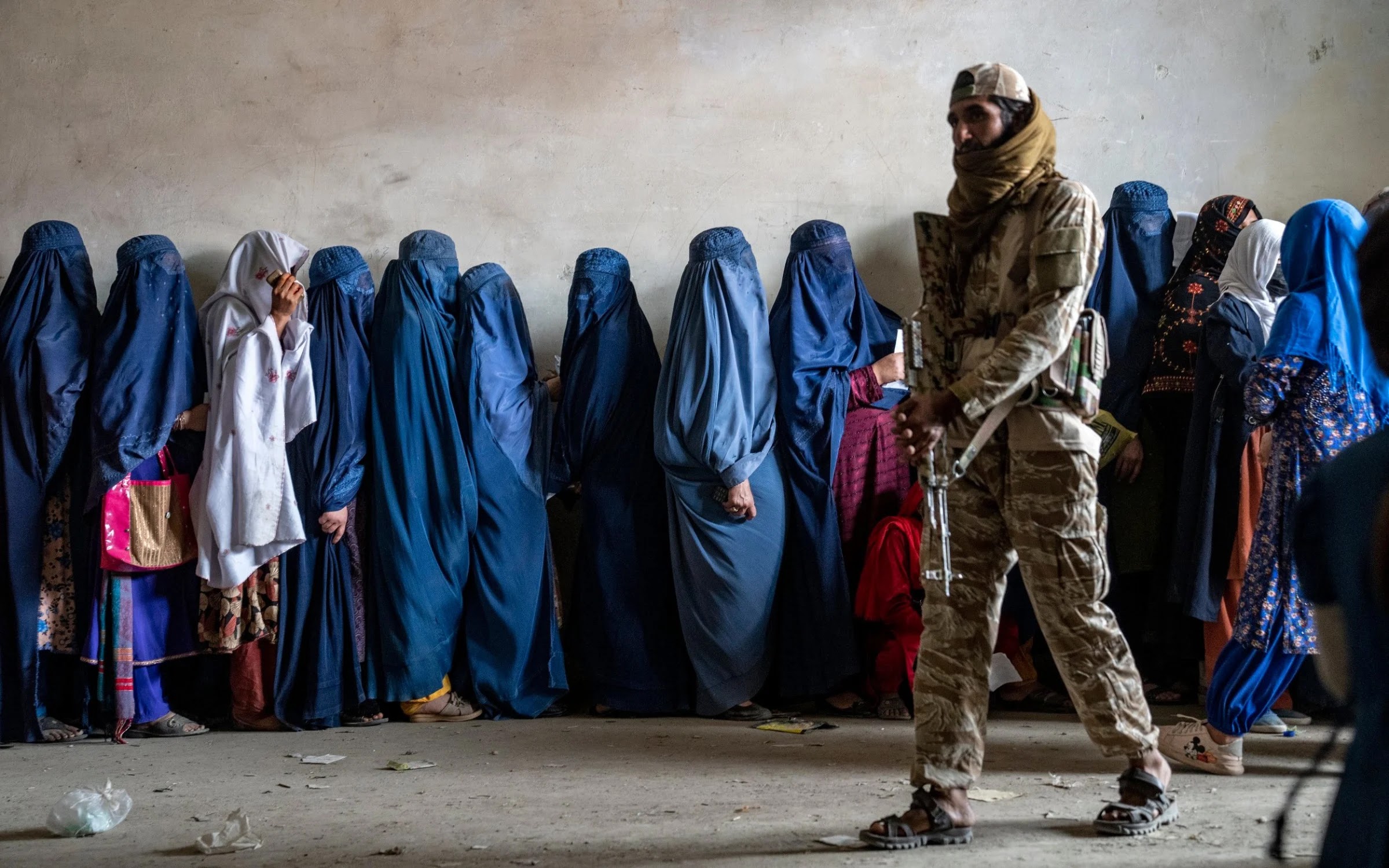
Islam, in one picture


Afghanistan under theTaliban. Photo by Ebrahim Noroozi/AP, copied from this report.

Readers' comments:

"What a shame! They look like closed up patio umbrellas!"

"Why leftists cheer and support this is beyond me."

"We should have armed the women."

Thursday, January 11, 2024

Australia prefers to destroy helicopters instead of giving them to Ukraine

 From Kyiv Post:

"OPINION: Australia – Let Ukraine Have Your “Retired” Taipan Helicopters

by Stefan Romaniw

The idea of transferring Australia’s retired fleet of MRH-90 helicopters to Ukraine has been suggested by several parties since the government decided upon early retirement. Yet the most recently reported development in the MRH-90 saga is that the ADF plans to dismantle and bury these aircraft rather than donate them to Ukraine.

There are compelling reasons why donating the MRH-90 fleet to Ukraine makes much more sense than scrapping them.

Ukraine has had a chronic shortage of helicopters since Russia initiated its partial invasion in 2014, and its full-scale invasion of Ukraine almost two years ago.

The Armed Forces of Ukraine inherited more than 400 military helicopters when the USSR collapsed three decades ago, mostly Mi-8 HIP multi-purpose helicopters and Mi-24 HIND helicopter gunships. By 2014 most of these helicopters were no longer airworthy, with worn out engines, gearboxes and rotor blades, and many had been cannibalized to keep others flying. Ukraine lacked production capabilities for many spare parts and was only able to get replacement rotor blades into production shortly before the 2022 full scale invasion.

The Ukrainian helicopter fleet numbering a few dozen flyable aircraft was heavily overused from the earliest days of the 2022 full-scale invasion. During the Battle for Kyiv in the first weeks of the war, the fleet was used round the clock to strike at Russian forces besieging the capital, with many helicopters and courageous aircrew lost to Russian air defenses. The besieged Ukrainian garrison at Mariupol was resupplied for weeks by helicopters that flew in under Russian air defenses. But that heroic operation ceased after the Russians blocked access and shot down a flight killing the crew and wounded troops that were being evacuated.

NATO allies, including the US, donated what remaining Soviet and Russian helicopters they had to partially compensate for Ukraine's losses. The fleet now comprises a proverbial “zoo” of no less than sixteen variants of the two main helicopter types.

As the HIND gunships are scarce, many of the HIP transports have been modified to fire Western supplied Hydra and Zuni air to surface rockets. But modifying leftover transport helicopters into gunships cannot not solve the more basic headache of a worn-out, understrength, shrinking, and largely obsolete fleet of military helicopters.

Ukraine needs modern Western helicopters, both quickly, and in large numbers.

Why the Australian government did not pre-emptively offer the MRH-90 helicopters to Ukraine when the decision was made on early retirement remains an unanswered question.  Agreeing to the ADF plan to scrap and bury assets for which taxpayers had spent over $3 billion dollars, and which have years of remaining life in them, qualifies as bizarre.

No doubt the defense ministry can dredge up any number of irrelevant “explanations”, as we have seen with their ongoing media campaign which seems designed to discourage Ukraine from asking for the forty plus mothballed RAAF F/A-18 Super Hornet multirole fighter aircraft.

Donating the MRH-90 fleet, remaining spare parts, documentation and support equipment does not incur any future financial or support obligations for Australia. Variants of the NH-90 series are operated by nine European allies of Ukraine all of whom have been generous donors of military equipment and training.

Ukraine already operates the Airbus Super Puma and has established supply chains in Europe. So, the supply chain and maintenance woes that bedeviled the ADF while operating the MRH-90 simply do not apply to Ukraine – Ukraine's European allies can solve these problems.

No differently, airlifting the MRH-90 fleet to Europe is also a task Ukraine's other allies can handle should the defense department decide that it is too expensive or inconvenient.

Donating the remaining MRH-90s to Ukraine would offer a strategic payoff to Australia. Russia's long running campaign to destabilize Europe and the Middle East, and meddle in Western politics, directly threatens Australia's interests as a global exporter.

In the zero-sum game between Russia and the West scrapping the MRH-90s, instead of donating them to Ukraine, is in effect aiding Russia in its genocidal campaign to conquer Ukraine.

The Australian Government might want to ask some hard questions of its defense department - especially as Ukraine has requested these helicopters as aid.

The Kafkaesque episode of the disposal of the MRH-90s is one of many we have seen play out in the ADF over the last two decades and one that should have politicians and the public asking for some real explanations – not contrived excuses that make little sense.

The bottom line is that donating the MRH-90 fleet to Ukraine is cheap and yields good strategic and political payoffs with no baggage for the Government or the taxpayer."


Wednesday, December 27, 2023

The US Democratic Party's Troubling Recent History Concerning Russia

 From Brookings:

"Why it’s hard to take Democrats seriously on Russia

James Kirchick Former Brookings Expert

July 27, 2017

Democrats are exasperated that Republicans don’t share their outrage over the ever-widening scandal surrounding Donald Trump and Russia. The president’s personal solicitousness toward Vladimir Putin, the alacrity of his son in welcoming potential assistance from Russians during the 2016 campaign, and mounting questions as to whether Trump associates colluded with Russia as part of its influence operation against Hillary Clinton are leading Democrats to speak of impeachment and even treason.

As a longtime Russia hawk who has spent most of the past decade covering Kremlin influence operations across the West, I share their exasperation. Over the past year, I have authored pieces with headlines like “How Putin plays Trump like a piano,” “How Trump got his party to love Russia,” and, most recently in this space, “How the GOP became the party of Putin.” As I see it, conservatives’ nonchalance about Russia’s attempt to disrupt and discredit our democracy ranks as one of the most appalling developments in recent American political history.

But as much as Democrats may be correct in their diagnosis of Republican debasement, they are wholly lacking in self-awareness as to their own record regarding Russia. This helps explain why conservatives have so much trouble taking liberal outrage about Russia seriously: Most of the people lecturing them for being “Putin’s pawns” spent the better part of the past eight years blindly supporting a Democratic president, Barack Obama, whose default mode with Moscow was fecklessness. To Republicans, these latter-day Democratic Cold Warriors sound like partisan hysterics, a perception that’s not entirely wrong.

Consider the latest installment of the unfolding Trump-Russia saga: Donald Trump Jr.’s meeting last summer with a Russian lawyer promising dirt on Clinton. Before inexplicably publicizing his own email correspondence, which revealed him eager to accept information that would allegedly “incriminate” his father’s opponent, Trump Jr. claimed the confab concerned nothing more salacious than the issue of “adoption.” Democrats have rightly pointed out that this was a ruse: When the Russian government or its agents talk about international adoption, they’re really talking about the Magnitsky Act, a 2012 measure sanctioning Russian human rights abusers named after a Russian lawyer tortured to death after exposing a massive tax fraud scheme perpetrated by government officials. The law’s passage so infuriated Putin that he capriciously and cruelly retaliated by banning American adoption of Russian orphans. Five years after its enactment, the law continues to rankle Russia’s president. According to Trump himself, it was the ostensibly innocuous issue of “adoption” that Putin raised with him during a previously undisclosed dinner conversation at the G-20 summit in Hamburg earlier this month.

Yet for all the newfound righteous indignation in defense of the Magnitsky Act being expressed by former Obama officials and supporters, it wasn’t long ago that they tried to prevent its passage, fearing the measure would hamper their precious “reset” with Moscow. In 2012, as part of this effort, the Obama administration lobbied for repeal of the Jackson-Vanik amendment, a Cold War-era law tying enhanced trade relations with Russia to its human rights record. Some voices on Capitol Hill proposed replacing Jackson-Vanik with Magnitsky, a move the administration vociferously opposed. Shortly after his appointment as ambassador to Moscow, Michael McFaul (today one of the most widely cited critics on the subject of Trump and Russia) publicly stated that the Magnitsky Act would be “redundant” and that the administration specifically disagreed with its naming and shaming Russian human rights abusers as well as its imposition of financial sanctions. McFaul even invoked the beleaguered Russian opposition, which he said agreed with the administration’s position.

This was a mischaracterization of Russian civil society, the most prominent leaders of which supported repeal of Jackson-Vanik only on the express condition it be superseded by the Magnitsky Act. “Allowing [Jackson-Vanik] to disappear with nothing in its place … turns it into little more than a gift to Mr. Putin,” Russian dissidents Garry Kasparov and Boris Nemtsov wrote for the Wall Street Journal days after McFaul’s remarks. (Nemtsov, one of Putin’s loudest and most visible critics, was assassinated in 2015 just a few hundred meters from the Kremlin walls). Anti-corruption activist Alexei Navalny, meanwhile, wrote that while he supported repealing Jackson-Vanik, “no doubt the majority of Russian citizens will be happy to see the U.S. Senate deny the most abusive and corrupt Russian officials the right of entry and participation in financial transactions in the U.S., which is the essence of the Magnitsky Bill.”

Nevertheless, the Obama administration not only persisted in opposing Magnitsky, but continued to claim that it had the support of the Russian opposition in this endeavor. “Leaders of Russia’s political opposition,” then-Secretary of State Hillary Clinton wrote in an op-ed for The Wall Street Journal, “have called on the U.S. to terminate Jackson-Vanik, despite their concerns about human rights and the Magnitsky case.” Despite administration protestations, Congress passed the Magnitsky Act and Obama reluctantly signed it into law. Reflecting on the legislative battle two years later, Bill Browder, the London-based investor for whom Magnitsky worked and the driving force behind the bill, told Foreign Policy, “The administration, starting with Hillary Clinton and then John Kerry, did everything they could do to stop the Magnitsky Act.”

Today’s liberal Russia hawks would have us believe that they’ve always been clear-sighted about Kremlin perfidy and mischief. They’re displaying amnesia not just over a single law but the entire foreign policy record of the Obama administration. From the reset, which it announced in early 2009 just months after Russia invaded Georgia, to its removal of missile defense systems in the Czech Republic and Poland later that year, to its ignoring Russia’s violations of the 1987 Intermediate-Range Nuclear Forces Treaty (while simultaneously negotiating New START) and its ceding the ground in Syria to Russian military intervention, the Obama administration’s Russia policy was one, protracted, eight-year-long concession to Moscow. Throughout his two terms in office, Obama played down the threat Russia posed to America’s allies, interests and values, and ridiculed those who warned otherwise. “The traditional divisions between nations of the south and the north make no sense in an interconnected world nor do alignments of nations rooted in the cleavages of a long-gone Cold War,” Obama lectured the United Nations General Assembly in 2009, a more florid and verbose way of making the exact same criticism of supposed NATO obsolescence that liberals would later excoriate Trump for bluntly declaring.

When it abandoned missile defense installations in Poland and the Czech Republic that same year—announcing the decision on the anniversary of the Soviet Union’s invasion of Poland, no less—the Obama administration insisted that the move wasn’t about kowtowing to Moscow but rather more robustly preparing for the looming Iranian threat. Notwithstanding the merits of that argument, perception matters in foreign policy, and the perception in Central and Eastern Europe was that America was abandoning its friends in order to satiate an adversary. That characterizes the feelings of many American allies during the Obama years, whether Israelis and Sunni Arabs upset about a perceived tilt to Iran, or Japanese concerned about unwillingness to confront a revisionist China. Liberals are absolutely right to criticize the Trump administration for its alienation of allies. But they seem to have forgotten the record of the man who served as president for the eight years prior.

Three years later, in the midst of what he thought was a private conversation about arms control with then-Russian President Dmitri Medvedev, Obama was famously caught on an open microphone promising that he would have “more flexibility” (that is, be able to make even more concessions to Moscow) after the presidential election that fall. (Imagine the uproar if Trump had a similar hot mic moment with Putin.) Later that year, after Mitt Romney suggested Russia was America’s “No. 1 geopolitical foe,” Obama ridiculed his Republican challenger. “The 1980s are now calling and they want their foreign policy back,” Obama retorted, in a line that has come back to haunt Democrats. An entire procession of Democratic politicians, foreign policy hands and sympathetic journalists followed Obama’s lead and repeated the critique. According to soon-to-be secretary of state John Kerry, Romney’s warning about Russia was a “preposterous notion.” His predecessor Madeleine Albright said Romney possessed “little understanding of what is actually going on in the 21stcentury.”

This wasn’t merely a debate talking point. Downplaying both the nature and degree of the Russian menace constituted a major component of mainstream liberal foreign policy doctrine until about a year ago—that is, when it became clear that Russia was intervening in the American presidential race against a Democrat. It provided justification for Obama’s humiliating acceptance in 2013 of Russia’s cynical offer to help remove Syrian chemical weapons after he failed to endorse his own “red line” against their deployment. Not only did that deal fail to ensure the complete removal of Bashar Assad’s stockpiles (as evidenced by the regime’s repeated use of such weapons long after they were supposedly eliminated), it essentially opened the door to Russian military intervention two years later.

Even after Putin annexed Crimea in 2014, the first violent seizure of territory on the European continent since World War II, Obama continued to understate the severity of the Russian threat. Just a few weeks after the annexation was formalized, asked by a reporter if Romney’s 2012 statement had been proven correct, Obama stubbornly dismissed Russia as “a regional power that is threatening some of its immediate neighbors not out of strength but out of weakness.” Truly. Russia is such a “regional power” that it reached across the Atlantic Ocean and intervened in the American presidential election, carrying out what Democrats today rightly claim was the most successful influence operation in history. “It is the hardest thing about my entire time in government to defend,” a senior Obama official, speaking of the administration’s halfhearted response to Russia’s intrusion, told the Washington Post. “I feel like we sort of choked.”

Yet rarely in the course of accusing Trump of being a Kremlin agent have liberals—least of all the president they so admire—reflected upon their hypocrisy and apologized to Romney, whose prescience about Russia, had he been elected in 2012, may very well have dissuaded Putin from doing what he did on Obama’s watch. In Obama, Putin rightly saw a weak and indecisive leader and wagered that applying the sort of tactics Russia uses in its post-imperial backyard to America’s democratic process would be worth the effort. The most we’ve seen in the way of atonement are Clinton’s former campaign spokesman Brian Fallon admitting on Twitter, “We Dems erred in ’12 by mocking” Romney, and Obama speechwriter Jon Favreau sheepishly conceding, with a chuckle, “we were a little off.” If Obama feels any regret, maybe he’s saving it for the memoir.

But even if liberals do eventually show a modicum of humility and acknowledge just how catastrophically wrong they were about Romney, this would not sufficiently prove their seriousness about Russia. For their current criticisms of the Trump administration to carry water, liberals will have to do more than simply apologize for regurgitating Obama’s insult that Republicans are retrograde Cold Warriors. They will have to renounce pretty much the entire Obama foreign policy legacy, which both underestimated and appeased Russia at every turn. Otherwise, their grave intonations about “active measures,” “kompromat” and other Soviet-era phenomena will continue sounding opportunistic, and their protestations about Trump being a Russian stooge will continue to have the appearance of being motivated solely by partisan politics.

For now, the newfangled Democratic hawkishness on Russia seems motivated almost entirely, if not solely, by anger over the (erroneous) belief that Putin cost Clinton the election—not over the Kremlin’s aggression toward its neighbors, its intervention on behalf of Assad in Syria, its cheating on the Intermediate-Range Nuclear Force Treaty, or countless other malfeasances. Most Democrats were willing to let Russia get away with these things when Obama was telling the world that “alignments of nations rooted in the cleavages of a long-gone Cold War” are obsolete, or that Russia was a mere “regional power” whose involvement in Syria would lead to another Afghanistan, or when he was trying to win Russian help for his signal foreign policy achievement, the Iran nuclear deal. If the Democrats’ newfound antagonism toward the Kremlin extended beyond mere partisanship, they would have protested most of Obama’s foreign policy, which acceded to Russian prerogatives at nearly every turn. As the former George W. Bush speechwriter Matt Latimer cleverly imagined in these pages, had Trump ran for president and won with the assistance of Russia but as a Democrat instead of a Republican, it’s not difficult to imagine Democrats being just as cynical and opportunistic in their dismissal of the Russia scandal as Republicans are today.

Democrats’ lack of introspection about their past policy failures, along with their amateurish, newfound zeal for opposing Russia, hurts the wider effort to convince the American public that Russian meddling in our democracy is a serious issue. The most credible voices in this discussion are those genuinely knowledgeable about Russia’s grand strategy to disrupt Western democracy, of which the Trump case is but one element of a long-running global campaign. Not coincidentally, these people have also been consistent in their hawkishness across presidential administrations, as willing to confront the Obama administration over its failures as they are today lambasting Trump. Yet largely because of a media preference for sensationalism, these nuanced voices are being drowned out in favor of Democratic partisans and internet conspiracy theorists peddling wild accusations of “treason.” Most liberals, to put it bluntly, are new to the cause, and their obvious overcompensation and shrill rhetoric is degrading our civic culture. “We were and are under attack by a hostile foreign power and … we should be debating how many sanctions we should place on Russia or whether we should blow up the KGB, GSU [sic], or GRU,” Democratic factotum Paul Begala recently blathered on CNN, referring to, successively, the Soviet-era intelligence service, a non-existent agency, and Russian military intelligence. On Twitter, MSNBC host Joy Reid recently opined, apropos of nothing, that “Donald Trump married one American (his second wife) and two women from what used to be Soviet Yugoslavia: Ivana-Slovakia, Melania-Slovenia.”

Put aside the weird, inquisitorial implication that Trump, solely by virtue of his having married two women from the former Eastern bloc, must therefore be a Russian mole. Reid’s assertion managed to fit three basic errors into a single sentence: 1) Ivana Trump was born in the present-day Czech Republic, not Slovakia 2) Slovakia, furthermore, was never part of Yugoslavia and 3) Yugoslavia, though socialist, was never part of the Soviet Union and famously resisted incorporation into the Warsaw Pact. This is what happens when partisan Democrats who never expressed an iota of interest in Russia before June 2016 try to impersonate Scoop Jackson: They end up sounding like a less methodical Joe McCarthy.

Taken too far, liberals’ Russia obsession could hurt them. Many Democrats seem to genuinely believe that Putin is the only reason Clinton isn’t America’s first female president. Seeing Russian meddling as the single or most significant explanation for their electoral woes conveniently lets Democrats ignore the many other factors—a lousy candidate, an uninspiring and unconvincing platform, a left-wing identity politics that alienates many Americans, just to name a few—that thwarted what ought to have been an easy victory against the most toxic and unqualified individual ever to run for president. While the American people certainly need to be better educated about the breadth of Kremlin influence operations and the multifarious ways Russia threatens the free world, a fixation on Russia to the exclusion of all else will not win elections.

Hypocrisy is no stranger to politics, of course, and it’s never too late for people to come around to the realization that Russia poses a danger. But with Democrats seriously talking about impeachment or even treason, a reckoning is in order. Constantly harping on Trump’s strange affinity for Putin and suspicious connections to Russia isn’t sufficient; the far more substantive policy concessions made to Russia by the previous administration did at least as much damage to American interests, if not more. Are liberals willing to admit the reset was a giant miscalculation from the start? Are they willing to support sending arms to Ukraine? To redeploy missile defense systems to allies in Eastern Europe? Are they willing to concede that Obama’s Syria policy was an epic disaster that paved the way for Russia’s reemergence as a Middle Eastern military power? Are they, in other words, willing to renounce the foreign policy legacy of one of their most popular leaders? Because only that will demonstrate they’re serious about confronting Russia. Anything short reeks of partisanship."


Monday, December 25, 2023

Ukraine abandoned

 From the Los Angeles Times:

"Congress has left Ukraine in the cold. The consequences will be dire if aid isn’t renewed soon

Doyle McManusWashington Columnist 

Dec. 24, 2023

Ukraine’s war to repel Russia’s invasion suffered two major setbacks this year.

The first was on the battlefield, where a long-promised Ukrainian ground offensive was stymied by Russian fortifications that were stronger than expected.

The second is underway in Washington, where Republicans in Congress have held up President Biden’s request for $61 billion to keep Ukraine’s war effort going in 2024.

The battlefield setback was a painful disappointment for Ukrainian leaders, who hoped the offensive could turn the tide of the war.

The political problem could be even worse. If U.S. funding isn’t approved quickly, aid from Europe could dry up as well, and Ukraine’s ability to fight could erode dramatically.

Andriy Yermak, chief of staff to Ukrainian President Volodymyr Zelensky, told an audience in Washington that if the deadlock persists, it will create a “big risk to lose this war.”

His warning was for naught. Republican leaders in both houses of Congress say they support helping Ukraine in principle, but they‘re holding the aid hostage to bargain for tougher immigration rules, especially toward asylum seekers. .

The House of Representatives went home 10 days before Christmas without acting on the administration’s request. Senate negotiators from both parties stayed behind last week to try to strike a deal, but they fell short, too.

As a result, Ukraine doesn’t know whether it can count on more funding for the artillery shells and air defense weapons it needs to defend its cities from Russian onslaught.

Military experts say Ukraine’s armed forces can keep fighting until the end of January with ammunition they already have. But the uncertainty over future supplies has forced them to scale back operations and reduce their rate of artillery fire.

“A lower level of resources is going to mean a lower chance of success,” said Michael Kofman, a military analyst at the Carnegie Endowment for International Peace. “The effect of delayed funding … will result in tangible deficits at the front line.”

There’s a broader political impact, too.

If Congress doesn’t approve funding quickly, the lesson to other countries will be that domestic politics has made the United States an unreliable ally.

For almost two years, Biden promised that the United States would support Ukraine “as long as it takes,” and urged other governments to do the same.

This month, faced with pushback, he downsized the commitment. Now it’s “as long as we can.”

“If Congress passes new funding by the end of January, it won’t be a major blow to our credibility,” said Alexander Vershbow, a former U.S. ambassador to Moscow. “But if it drags on for months, it will be a disaster.”

GOP leaders said their decision to delay the funding was ordinary legislative hardball — a bargaining chip to win concessions on immigration, which most voters consider more important than Ukraine. But their willingness to stiff-arm Zelensky also reflected eroding support among GOP voters for Ukraine’s battle against Russian President Vladimir Putin.

Polls show most Americans support helping Ukraine at current or higher levels of aid. But conservative Republican voters — the ones most likely to turn out for primary elections — are disproportionately opposed.

The logjam has left Ukraine in the cold, literally and figuratively.

The Ukrainians’ short-term military goal is to survive Russia’s winter offensive, which is likely to focus on civilian targets such as cities, electrical power plants and other economic infrastructure.

After that, the Ukrainians hope to use long-range missiles supplied by the U.S. and other countries plus home-grown drones to strike Russian targets.

In a recent interview with the Economist, Ukraine’s military commander, Gen. Valery Zaluzhny, called the situation a “deadlock,” adding that trench warfare does not favor Ukraine in the long run.

Without a technological breakthrough, he warned, “Sooner or later, we are going to find that we simply don’t have enough people to fight.”

In some wars, a deadlock might open the way for peace negotiations. Not this one.

At his four-hour-long news conference Dec. 14, Putin buoyantly declared: “Victory is ours.”

One reason for his confidence, he said, is how shaky Ukraine’s Western support appears.

Ukraine is “getting everything as freebies,” he said. “But those freebies can run out at some point, and it looks like they’re already starting to run out.”

He did not sound interested in seeking a compromise settlement. “There will be peace when we achieve our goals,” he said.

Those goals, he added, include replacing Zelensky’s government and disbanding Ukraine’s armed forces.

He doesn’t sound ready to give up his ambition to absorb Ukraine into Russia.

Our aid to Ukraine isn’t an act of charity. It’s in our interest to prevent Putin from expanding his empire.

Putin still thinks he can wait out the West — that the United States and Europe will tire of helping Ukrainians defend themselves and walk away.

The grim lesson of the last few weeks is that he may turn out to be right."


Thursday, December 14, 2023

Grief, anger and hope on Chanukah

 Today is the last day and culmination of Chanukah (Hanukkah), the Jewish festival of light. Here is the synagogue in my city of  Sofia, illuminated for the occasion:


This year, sadly, the festival is passing under the shadow of the Oct. 7 massacre when Hamas launched a massive attack and killed about 1,200 innocent Israelis - the worst mass murder of Jews since the Holocaust. A young man from the kibbutz Kfar Aza was a guest of the Jewish community of Sofia. He had suffered from Palestinian terrorists before, having lost an eye in Gaza during his military service in 2014. He told how on Oct. 7, together with other residents, he desperately fought to protect his kibbutz from the surprise attack, while his wife and baby were hiding in the "safe room" for 30 hours. Many people of the kibbutz were killed, and some were taken hostage. The survivors became refugees in their own country because it is still too dangerous to return to Kfar Aza. The young man angrily condemned the hypocrisy of the world which pressures Israel for cease-fire while the terrorists are still holding Israeli hostages. I am glad that two days ago in the UN, my Bulgaria abstained when an anti-Israeli resolution in this line was voted:


 Throughout the world, a terrifying anti-Semitic orgy has been raging since the Oct. 7 massacre, with Arab immigrants and morally and intellectually degraded Westerners celebrating it and condemning Israel and the Jews. In these dark times, anyone who has at least a little integrity should support Israel to its victory.

May light banish darkness!

Happy Chanukah!


Sunday, September 03, 2023

Artifacts Discovered after the Kakhovka Dam Destruction

On June 6, Russian troops destroyed the Kakhovka Dam, inflicting an ecocide on downstream Ukrainian territory in an attempt to stop the Ukrainian counter-offensive. For all the horror of this man-made disaster, Ukrainian archaeologists saw in it a silver lining. As said one of them, Dmitriy Nikonenko (source in Russian):

The draining of the Kakhovka Reservoir will reveal the submerged Zaporozhian Sich, settlements and necropols of many archaeological cultures, the Kuchugurski Islands with their medieval landmarks, the villages submerged in the 20th century. Water has preserved even the giant trees on the island opposite the Zaporozhian Sich. I’ll be lying if I say that archaeologists didn’t dream of draining the Kakhovka Reservoir. But not this way, of course, because we cannot yet even imagine the level of problems that Ukraine will face.

These hopes seem to have been fulfilled. From the New Voice of  Ukraine from June 13, only days after the man-made disaster:

"Ancient Byzantine amphora discovered on Odesa beach

An ancient Byzantine amphora has been discovered on an Odesa beach following the Russian destruction of the Kakhovka Dam, the Kherson Local History Museum reported on Facebook on June 12.

The ancient jar was found by an internally displaced resident of Kherson, Yuriy Poslovskyi, who has been rescuing freshwater turtles drifting downstream on the Dnipro River to Odesa. Together with his family, he spotted a jar in the water. It was floating because a mud plug spontaneously formed in its neck.

Being a historian, Poslovskyi immediately realized the value of the find. He handed over the ancient artifact to the Kherson Local History Museum. Later analysis established the object to be a Byzantine amphora that may have washed down due to floodwaters from the coastal area, or from an ancient shipwreck.

"Anyway, the generous southern land has shared its treasures with Kherson residents," the message on Facebook reads.

Other amphoras have also been recently found in Odesa Oblast, one of which was discovered by a Territorial Defence unit building fortifications in the area.

These artifacts have been passed to the Odesa Archaeological Museum."

Below is a photo of the family with the amphora from the linked report:


And here is the more recent report about findings on land emerging from subsiding waters, which actually directed me to the story of the amphora:

"Over one thousand artifacts discovered on Khortytsia Island because of Russia’s blast at Kakhovka Dam

Russia’s ecocidal destruction of Ukraine’s Kahkovka Dam is proving to be a boon for the understanding of Ukrainian history.

Over one thousand artifacts have been discovered on the island of Khortytsia in Zaporizhzhia Oblast because of flooding after Russia caused an explosion at Ukraine’s Kakhovka Hydroelectric Dam...

Examples of newly discovered artifacts include ceramic fragments of various sizes, coins, bullets, buckles, and buttons. While these items may not be considered treasures in the traditional sense, they hold valuable historical information connected to Ukrainian culture and history...

These archaeological excavations became possible due to the destructive impact of the explosion at Kakhovka Dam. The efforts open new horizons for scientific research and expand our understanding of the history of this unique territory."

Below is a map of the disaster zone and a photo of the beautiful landscape of the island:


I wonder whether there are truly ancient artifacts among the finds; in the Antiquity, there were Scythian lands.


Friday, February 10, 2023

Zelensky says harsh truths about the West

 Ukrainian president Volodymyr Zelensky to Der Spiegel, through Ukrainian Pravda:

"We are all afraid of war, this is an instinct. I am not blaming anyone here. People feel really sorry for us Ukrainians. But the worst outcome would be if the war were to come to them [other countries – ed.].

Citizens and their leaders see a potential threat to the stability of their countries, specifically to their political leadership. This is why they want to stop the war. The best way to do so is at the expense of others, and certainly not at the expense of any victims in their home country...

The easiest way to end the war is to cede Ukrainian territories to Russia. To give them back the influence on Ukraine and inside Ukraine that they used to have for many years. This is why the Minsk agreements were created…I think, the Minsk agreements were a concession."

He is right.

Sunday, December 25, 2022

Merry Christmas, with thoughts of Ukraine

 Merry Christmas everyone!

The public Christmas tree of Kyiv (source).


Ukrainian air forces detected Santa's sledge in the air space of the country (generally closed for civilian aircraft) and guaranteed him a safe flight (source).


Wednesday, October 26, 2022

Winter Is Coming

The hat and scarf that I decided to keep because of their problematic color pattern. The hat is an industrial product, and the scarf has been knit by me to match (but I hadn't the exact same red yarn).


It is late October, and Europe is bracing itself for a difficult winter, with fuel and electric shortages due to the Russian aggression against Ukraine. Among the most vulnerable are the Ukrainian refugees. The Deputy Prime Minister of Ukraine, Iryna Vereshchuk, yesterday asked them to stay where they are until the spring. The reason is that Ukraine’s energy system, all but destroyed by recent Russian attacks, would not cope if they return. However, in a relatively poor and disorderly country such as Bulgaria, their situation is precarious even in peacetime. Volunteers try to help as best as they can. 

Near my workplace is a bar run by Vasko Krapkata ("Vasko the Patch"), a renowned freedom-loving blues singer. His people periodically collect items and money donations and then distribute them among Ukrainian mothers and children who have found refuge in Bulgaria. In addition to new purchases, reused clothes, blankets and toys are welcome. This is also a nice opportunity to part with things that we no longer need but cannot simply discard because of their good quality and/or sentimental value.

Today, I gave away some things, including a baby blanket which I had kept unused for more than a decade. It is surprisingly difficult to find a nice baby blanket to buy. So what? I am well into post-reproductive age, and shall never have another baby. If in a vague and distant future a baby of a new generation appears in the family, we'll find a new blanket somehow. The same is valid for a ton of my sons' toys and puzzles which I had kept until now.

A vest which was an early knitting success for me. Off it goes!

A coat which I bought long ago for another difficult winter. It was too thin, but a true winter coat simply couldn't be found at the market. My late mother modified it and made it warm by adding a layer of woolen cloth from inside. I wore this coat for years, even during my honeymoon. But I haven't worn it recently, though it is still good. Off it goes!

My sons' childhood winter hats, and scarves I have knit to match them. Off they go! My sons are in their late teens now. In the last moment, I brought a hat and a scarf out of the bag because I realized that their broad blue, red and white stripes resembled the Russian flag. Putin has created aversion to an otherwise nice combination of colors (though this is the very least of his evils). So this particular set may not be the best for a Ukrainian refugee child. It will go to someone else.

I was just a little bit sad to part with these material traces of the past, but now I feel lighter. It is true that memories can weigh you down. For their new owners, they will be nothing more than means to help make it through the winter, probably to be discarded in spring.


Monday, September 26, 2022

Edward Snowden Adopted by Putin's Russia

Russian president, bloody dictator and genocidal warmonger Vladimir Putin has granted Russian citizenship to the wretched US traitor Edward Snowden. I think that these two creeps fully fit and deserve each other. It would be best if they embrace as good buddies and together embark on the well-known route of the Russian warship.

Friday, September 16, 2022

In Iran, another victim of the Islamic headscarf


As we all know, theocrats in Iran insist that women cover their heads with hijabs (Islamic headscarves), whereas many women do not want this at all. That's why the theocrats maintain morality police to enforce the Islamic dress code. Mahsa Amini (22, pictured) was arrested by the morality police on Tuesday for "education about the hijab", beaten inside the police van, and brought to a hospital several hours later in a coma. She died today.

Saturday, June 11, 2022

Putin abandoned rhetoric, admitted land grab

 From the Daily Star:

"Putin hails Peter the Great, admits his own war on Ukraine is land grab

Russian President Vladimir Putin paid tribute on Thursday to Tsar Peter the Great on the 350th anniversary of his birth, drawing a parallel between what he portrayed as their twin historic quests to win back Russian lands.

"Peter the Great waged the Great Northern War for 21 years. It would seem that he was at war with Sweden, he took something from them. He did not take anything from them, he returned (what was Russia's)," Putin said after a visiting an exhibition dedicated to the tsar.

In televised comments on day 106 of his war in Ukraine, he compared Peter's campaign with the task facing Russia today.

"Apparently, it also fell to us to return (what is Russia's) and strengthen (the country). And if we proceed from the fact that these basic values form the basis of our existence, we will certainly succeed in solving the tasks that we face."

...Putin has repeatedly sought to justify Russia's actions in Ukraine, where his forces have devastated cities, killed thousands and put millions of people to flight, by propounding a view of history that asserts Ukraine has no real national identity or tradition of statehood...

In July 2021, the Kremlin published a long essay by Putin in which he argued that Russia and Ukraine were one nation, artificially divided. It laid the groundwork for his deployment of troops to Ukraine.

Moscow says it acted to disarm and "denazify" its neighbour. Ukraine and its allies say Putin has launched an unprovoked war of aggression.

In the run up to what Russia calls its "special military operation", Putin blamed Vladimir Lenin, the founder of the Soviet Union, for creating Ukraine on what Putin said was historically Russian territory."


Sunday, June 05, 2022

Western leaders criticized over war in Ukraine

 From Simon Tisdall at the Guardian:

"Timid Biden condemns Ukrainians to an agonising war without end

It seems odd, to put it mildly, that Joe Biden is happy to supply Ukraine with advanced rockets as long as it does not fire them at Russia. Vladimir Putin can aim missiles at Ukrainians from across the border whenever he wants – but Volodymyr Zelenskiy’s troops can’t shoot back at their tormentors.

Strange, too, that the UN is seeking Russia’s agreement for convoys to escort grain from Odesa and other Ukrainian ports. It’s Putin who is preventing 22 million tonnes of grain reaching the Middle East and Africa, where millions face famine. Don’t ask permission. Send a multinational force to smash his illegal blockade.

The US and UK have made a big fuss in the past about preserving freedom of navigation in international waters, including the Black Sea. Puzzlingly, they in effect ceded these waters on 24 February to Russia, whose navy bombards and besieges Ukraine’s cities and ports at will...

Left to fight alone, Zelenskiy pleads for heavy weapons but his pleas still often go unmet or responses are delayed. “We need to get serious about supplying [Ukraine’s] army so that it can do what the world is asking it to do: fight a world superpower alone on the battlefield,” says US Gen Philip Breedlove, formerly NATO commander in Europe. He’s right.

It’s no good relying on sanctions, as the EU proved again last week. Its decision to let Hungary’s mini-Putin, Viktor Orbán, water down an oil embargo was weird. Yet Germany’s Olaf Scholz and fellow euro-wobblers are content. Duty done on oil, they will now more stubbornly resist what their bankers and businessmen most fear: sanctions on gas.

Hardest of all to understand, perhaps, is why some Western governments persist in attempting business as usual with Putin, who they know, for certain, is overseeing atrocities and war crimes. Scholz and France’s Emmanuel Macron hold regular phone chats with him. It’s said they are realists seeking peace. No. They are dupes, normalising mass murder...

Another puzzle: why is Russian foreign minister Sergei Lavrov’s shameless spewing of disinformation tolerated around the world? Why do Russia’s ambassadors get free airtime to spin their lies?...

One reason such impunity endures is that China and India, though sworn to uphold the UN charter and international law, prefer instead to profit from Ukraine’s agony by buying cut-price Russian energy...

But, ultimately, it’s the western allies’ own policy contradictions and timidity that most undermine Kyiv at a critical moment, 100 days into the war. Half-measures are their default position. They won’t go the whole hog.

Intimidated by Putin’s nuclear hints, fearful of escalation, and alarmed at rising domestic costs, western leaders are scared, deep down, that Ukraine may win. At the same time, they are committed – politically, morally, rhetorically – to ensuring it does not lose.

The resulting confusion, representing the worst of both worlds, is personified by Biden. Ostensibly clarifying US war aims last week, he insisted Russia that must “pay a heavy price”. If it went unpunished, it would “open the door to aggression elsewhere, with catastrophic consequences the world over”.

Yet even as he raised the stakes, Biden avoided any mention of Ukrainian victory. There was nothing about winning. Instead, he spoke vaguely of future negotiations while offering personal assurances to Putin. The US did not seek his overthrow, he said. Nor would NATO attack unless attacked...

Biden’s too-modest war aims are a manifesto for the muddled middle. Where does this leave Ukraine? Still solitary, still lacking essential modern weapons, and still fighting for its life with one hand tied behind its back – by its closest friends.

And where does it leave the West? Afraid, in equal measure, of victory and defeat, and hoping, fingers crossed, for some form of shabby compromise...

This weak-kneed approach guarantees only one thing: the war will run and run. Diplomacy is stalled. Sanctions are having limited effect and, in terms of energy prices, are harming Europe more than Russia. Only increased direct and indirect NATO military pressure can shift this dynamic.

Campaigning in 2020, Biden pledged an end to what he called America’s “forever wars”. Now, tremulously pulling their punches, he and other Western leaders condemn Ukrainians to exactly that."