Wednesday, October 09, 2024

Ceasefire in Ukraine will benefit only Moscow

 Melik Kaylan, Forbes:

"Moscow’s Hidden Plans For Exploiting A Ceasefire With Ukraine

There’s been a great deal of talk about backstairs peace negotiations for halting the war in Ukraine. To the allies, the picture looks gloomy as Russia relentlessly gains ground in the East, destroys Ukrainian settlements and kills civilians while the Ukrainian army remains outgunned and over-stretched. Not least because Western partners like America and Germany haven’t provided sufficient timely support. So the electricity grid has collapsed, winter looms without heat, the population is fleeing abroad and things look bleak for Ukraine.

The mooted ceasefire allows Russia to keep the occupied territory, for now, while Moscow agrees that Ukraine gets to join NATO. This column is about the feasibility of even that defeatist deal staying stable and the secret dangers built into the alleged negotiations. As pieces of interchangeable blocks the agreement looks straightforward. But, Moscow well knows, the devil is in the details, the hidden interstitial gaps. Because, in reality, with Putin pushing at the cracks, the deal can be obstructed at every stage.

By treaty law, NATO doesn’t accept new members that are in mid-conflict or even in a frozen conflict. As a result, accession will take time and Russia will not stand still. Even supposing Ukraine gets into NATO, what guarantees that its members, if called upon, will actively engage in a direct military confrontation with Russia when they won’t now? And what happens if Trump is President? Sadly, however you look at it, there’s a real possibility that any sort of compromise now will simply lead to bigger trouble down the line. If the chances of a Russia-forced peace look bleak , they’re even bleaker than you think.

What the seasoned Kremlin-watcher knows is that the Kremlin has made plans for this situation in the kind of detail that the West cannot match - a regimen self-evident to anyone who heeds the details of Moscow’s post-Soviet revanchism. All one needs to do is look at the highly revealing experience of Armenia and Georgia. When the Russians invaded Georgia in 2008, they consolidated their hold on Georgia’s separatist regions of South Ossetia and Abkhazia. Georgia’s then President Saakashvili, seeing the weakness of Western resolve, announced a unilateral ceasefire, withdrew from the front lines, and saved his country from being flattened as Ukraine has been.
 
The peace conditions offered by Moscow to Tbilisi, relayed by French President Sarkozy, were so one-sided that Saakashvili turned them down saying - and this is important - ‘there will be a popular coup against me if I accept them.’ Putin had demanded that Georgia let go the separatist zones for good and Saakashvili step aside, among other things. Instead, Moscow made do with occupying the separatist zones and withdrawing troops elsewhere. How did that work out for Georgia? Russia kept creeping further onto Georgian land and also engineered regime change in 2013 by interfering in the national elections and getting a conservative nationalist oligarch elected in place of Saakashvili.
 
That Tbilisi oligarch, Ivanishvili, is still in power, a puppeteer behind the scenes but now also an openly pro-Moscow partisan. A nationalist AND pro-Moscow? How is that democratically possible in a country that hates Russia? This same Ivanishvili, with the October elections impending, has publicly declared that Georgia should apologize for the Russian invasion. Yes you read that right. He had originally got into power by offering a quiet life to Georgians, relief from strife and confrontation, by reviling the West’s fickle support and values, by floating a kind of non-aligned Georgia-first mirage. Instead, inexorably, he gifted Moscow his country’s independence. Perhaps you see inklings of how things might work in Ukraine if Moscow is allowed a favorable peace deal there?
 
But first let’s look at Armenia. After winning the first Nagorno-Karabakh war against Azerbaijan in 1992 and declaring a kind of Armenia-affiliated republic, the veterans of that victory gradually came to dominate Armenian politics as a whole. The tail wagging the dog. They grew cliquish and cronyist and self-dealing, perfect candidates for being inveigled into Russian dark money influence, military weapons kickbacks and easy power. They ended up as proxies of Moscow in Armenian affairs. In effect, Armenia slowly lost its independence and any semblance to a democracy. So the most militantly ultra-nationalist faction, heroes of war, impossible to stand against politically, became the most corruptly oligarchic and sold out to Russia.
 
It wasn’t until the populace grew so utterly sick of the pro-Russia faction’s shenanigans that in 2018 they successfully elected a true democrat, Nikol Pashinyan, despite all the obstacles. He promptly and regularly chided Russia for dominating Armenian affairs. As a result, Armenia was soon punished in 2020 when Russian peacekeepers did nothing to help defend the Armenian side during the second Karabakh war. Moscow was treaty-bound to do so. It did nothing. Instead, this time Azerbaijan emerged victorious. Moscow had got its revenge for Armenia’s democratic intransigence...
 
How does all this relate to the putative peace-deal in Ukraine? The Kremlin’s plan goes something like this. Zelensky is forced to cede the occupied territories pro-tem in exchange for promises of joining Nato. By the time Nato proceeds and implements, ultra-nationalist elements of the army revolt and stage a coup against Zelensky for giving away Donbas and Crimea. The West objects strenuously, thereby alienating the military putschist leaders. Putin inundates Ukraine’s airwaves with propaganda about the West’s perfidy, the West’s agonizingly slow and insufficient support of Ukraine, the West’s seeming willingness to bleed Ukraine as a proxy, Zelensky’s anti-democratic centralization of power, and the like.
 
Remember that Saakashvili had refused the Kremlin’s terms of ceding the separatist areas because there would be a coup against him. That could happen in Ukraine after a peace deal. In Armenia, the ultranationalists were suborned by Moscow. That too will happen to any military Putsch clique in Ukraine. And in the long run? They will not get the West’s support and won’t attempt to restart hostilities. All this, Moscow has gamed and maneuvered before.
 
It all starts with the temptation and delusion of easy peace. In Georgia, a populist authoritarian regime took over by promising relief from punishment and fear. The Georgian populace has long since been cowed by Moscow’s carrot and stick message. Be docile, be ruled by oligarchs and Russian money, you will be safe in a long national sleep. Russian protection. Coherence. Continuity. As opposed to Western neglect, indecision, distraction, disappointment, the chaos and polarization of freedom. And so it will be with Ukraine. In the wake of a peace deal."


Any concessions to Putin will backfire

 Anthony Halpin, Bloomberg:

"Talk of Ukraine Concessions May Embolden Putin

It’s cost Ukraine enormous effort and a huge toll to resist Russia’s invading army for what’s fast approaching 1,000 days.

Little wonder, then, that some of Kyiv’s allies detect a greater readiness to adopt a more flexible approach to end the war... The US is consumed by next month’s presidential election whose outcome could determine future aid for Ukraine’s defense. Some European allies are beginning to flag in their backing for Kyiv in a war that shows no sign of ending.

While specific concessions haven’t been mentioned, there’s a lot of chatter about Ukraine potentially gaining strong security guarantees in return for accepting it can’t oust Russian forces from occupied territories for now.

This could even extend to NATO membership, with some pointing to West Germany’s experience during the Cold War division with East Germany. Others don’t want to go that far, and the US has been notably non-committal.

Russian President Vladimir Putin, meanwhile, gives no indication he’s interested in coming to the negotiating table. Talk of concessions is likely only to embolden the Kremlin in its belief that Russia can outlast the West in Ukraine.

Putin, after all, still occupies parts of neighboring Georgia seized in a 2008 war at little cost to Russia. He annexed Crimea and ignited fighting in eastern Ukraine in 2014, with only a muted response from the US and Europe.

For all the war-gaming on ending the present conflict, the fundamental question for Ukraine’s allies is whether they continue to let Putin gain from military aggression and at what future cost to them."

Saturday, October 05, 2024

The Pentagon: We provide Ukraine what it needs, they have been very successful

 From an Oct. 3 briefing of Deputy Pentagon Press Secretary Sabrina Singh (hattip: Ukrainian Dialog):

"Q:  Thank you. So today, President Zelenskyy urged NATO allies to help intercept Iranian missiles and drones over Ukraine, as they do  with Israel. Can the United States and allies help Ukraine with that? I mean since it's possible Israel, why cannot it be done with Ukraine?

MS. SINGH:  So thank you for the question. While I appreciate the question, we are talking about two very different landscapes and battlefields. The president, at the very beginning of when Russia invaded Ukraine, has directed this department to provide Ukraine what it needs on the battlefield.

They have been very successful in employing, whether it be air defenses or other capabilities, to continue to take back their territory. The secretary just had a call with Mr. Umerov, getting that battlefield update, getting to better understand what other capabilities they might need, if any. The president has made a commitment that the United States is not putting boots on the ground into Ukraine, but we are supporting Ukraine in their efforts to take back their sovereign territory.

Q:  Well, shooting those targets, say from Polish or Romanian territory, would that be putting boots on the ground?

MS. SINGH:  That would be involving us in a war in a different way. And right now, we feel that Ukraine has been able to successfully defend against Russian strikes to their cities, to their populations, to their infrastructure. And we're going to continue to make sure that they have the support that they need to do that."

***

Ms. Singh is stating this as the Russian criminal regime continues advancing in Ukraine, using ballistic and glide bombs to destroy Ukrainian defenders and civilians, children's hospitals, whole towns. All this because the USA gives only token aid and does not allow it to be used for strikes deep into Russian territory, from where the bombs are shot. Her words sound like cruel mockery. The USA I used to admire and trust is no more. It has succumbed to evil.


Thursday, October 03, 2024

Starmer's incompetence allowed Biden to hurt Ukraine even more

 From the Telegraph:

"Western indifference has hung Zelensky out to dry

Con Coughlin, Defence and Foreign Affairs Editor

With only weeks to go before the US presidential election, Ukrainian president Volodymyr Zelensky could be forgiven for thinking that, irrespective of the outcome, Ukraine’s fight for freedom is fast becoming a lost cause. For all the pain and sacrifice the Ukrainian people have endured in the two-and-a-half years since Russia invaded Ukraine, all the indications suggest that Russian president Vladimir Putin’s initial calculation that the West would eventually lose interest in the conflict appears increasingly valid...

Zelensky is demanding that the West intensifies its support so that Ukraine can improve its bargaining position by making further gains on the battlefield. In particular, he wants the Biden administration to lift its restrictions on the use of long-range missiles, such as the Storm Shadow missile systems, to attack targets located deep within Russia.US president Joe Biden has been reluctant to provide the necessary authorisation for fear of provoking the Kremlin into escalating the conflict...

Nor did Zelensky do much better when he met former US president Donald Trump at his penthouse in New York. Having initially indicated he was too busy campaigning to meet the Ukrainian leader, Trump eventually relented, only to dash Zelensky’s hopes by stressing that he regards Putin as a close personal friend...

Is is not just in Washington that Zelensky will have identified signs that support for Ukraine is waning.

Even though Sir Keir Starmer pledged to maintain British support for the Ukrainian cause during his meeting with Zelensky at the UN, it is arguably due to Starmer’s own incompetent handling of the Storm Shadow issue that the Ukrainians find themselves unable to use the missiles in the way they would like.

The air-launched missiles, which were originally gifted to the Ukrainians by the previous Conservative administration, have been used to great effect by Ukrainian forces to target key Russian military installations in places such as Crimea. Even though the missile systems rely on US tracking and guidance systems, Conservative ministers only informed the US that the missiles were being used, rather than seeking Washington’s permission to carry out the strikes.

Thanks to Starmer’s evident shortcomings as a global statesman, after becoming prime minister he set a new precedent of first asking the Americans for permission to use the weapons system, thereby allowing Washington to veto their use when it did not comply with the Biden administration’s policy objectives. The result is the Ukrainians now have stocks of Storm Shadow weapons, but cannot use them...

If Harris succeeds Biden in the White House, then Putin can assume that her administration will adopt the same risk-averse approach to the Ukraine conflict, one that, in effect, means the Ukrainians are limited in what they can achieve on the battlefield.

A Trump victory would, by contrast, most likely lead to Washington abandoning the Ukrainian cause.

Either outcome would not only be disastrous for Ukraine, but for the future prospects of the Western alliance."


Wednesday, October 02, 2024

Experts: Important Ukrainian town fell because Biden's administration protects Russian military objects

 From the AP:

"The fall of Vuhledar is a microcosm of Ukraine’s wartime predicament

By  SAMYA KULLAB and VOLODYMYR YURCHUK

KYIV, Ukraine (AP) — The fall of a front-line town nestled atop a tactically significant hill is unlikely to change the course of Ukraine’s war against Russia. But the loss underscores Kyiv’s worsening position, in part the result of firm Western red lines, military officials and analysts said.

Vuhledar, a town Ukrainian forces fought tooth and nail to keep for two years, is the latest urban settlement to fall to the Russians. It follows a vicious summer campaign along the eastern front that saw Kyiv cede several thousand square kilometers (miles) of territory.

Ukraine’s military said they were withdrawing their troops from Vuhledar to “protect the military personnel and equipment” in a statement on Wednesday.

Vuhledar’s fall is a microcosm of Ukraine’s predicament in this chapter of the nearly three-year war. It reflects the U.S.'s refusal to grant Ukraine permission to strike targets deep inside Russian territory, preventing Kyiv from degrading Moscow’s capabilities. Meanwhile, Russia’s dominance of the skies allows it to develop and advance devastating aerial glide bombs for which Ukraine has no effective response...

The Ukrainians’ retreat from the town comes after a much-anticipated visit by Ukrainian President Volodymyr Zelenskyy to the U.S. last week. The Biden administration so far has refused Kyiv’s request to use Army Tactical Missile Systems, or ATACMS, to strike Russian airfields and other key targets, and Zelenskyy’s “victory plan,” was dismissed by some as more of a wish list than a plan of action.

In the meantime, Russian fighter jets continued to drop aerial bombs on Vuhledar, which precipitated the retreat, soldiers there said...

Ukrainians have been pressuring the U.S. to relax restrictions on the use of Western weapons to strike targets deep inside Russia. Lawmakers said they expected a green light from the U.S. months ago, but it didn’t come: The Biden administration refused to waver on this red line. 

It has meant that Russian command and control centers, logistics hubs and airfields from which Russian fighter jets carry deadly aerial glide bombs, are out of reach of Ukrainian forces.

Russia fires nearly 120 aerial bombs a day on average, about 3,000 a month. The bombs are Soviet-era weapons refitted with navigational technology.

“We cannot change the dynamics, and the Russians are pushing,” said Pavel Narozhnyi, founder of the non-profit Reactive Post, which sources spare parts for artillery.

Month after month of constant attacks eventually eroded Ukrainian defenses...

Vuhledar served as a defensive stronghold, a fortress town atop a hill surrounded by open fields and near two major roads. From there, Ukrainian soldiers were able to observe approaching Russian forces at a distance. From that vantage point, it was easy to coordinate counter-attacks. That advantage now falls to Russian forces..."


Anne Applebaum: Russia still wants to make Ukraine into a colony again

 From the Atlantic:

"The Only Way the Ukraine War Can End

Russia has to stop fighting.

Monday, September 30, 2024

America is bleeding Ukraine to death

 From the Atlantic:

"The Abandonment of Ukraine

The American strategy in Ukraine is slowly bleeding the nation, and its people, to death.

By Karl Marlantes and Elliot Ackerman 

On a recent trip to Ukraine, we walked through the rubble of a children’s hospital in Kyiv targeted by the Russians, toured an apartment building in Kharkiv where floor after floor had been destroyed by Russian missiles, and visited the front lines to meet with soldiers who spoke of the brutality of Russian human-wave tactics. But the most unsettling thing we saw was the American strategy in Ukraine, one that gives the Ukrainian people just enough military aid not to lose their war but not enough to win it. This strategy is slowly bleeding Ukraine, and its people, to death.

...We have a combined 60-year breadth of combat experience between us, including Vietnam, Iraq, and Afghanistan. The horrors of war are not unfamiliar to us. Yet both of us felt deeply disturbed as we finished our trip.

In Kharkiv, we met with a group of Ukrainian combat veterans. Before the war, Victoria Honcharuk, a 24-year-old medic, lived in the United States, where she’d been accepted to a graduate program at Harvard while working in New York City in investment banking. When war broke out in February 2022, she left that life behind and returned home to defend her country. Her unit of medics, composed entirely of volunteers, draws no pay. Approximately half of the friends she began service with have been killed or wounded... When a member of our group observed that Ukraine’s future would involve young people, like her, leading and rebuilding her country, she paused and politely reminded us that they could rebuild it only if they survived...

Ukraine’s President Volodymyr Zelensky has spent a great deal of time pleading with his allies for weapons and permission to use them to their full capabilities. But his administration is now pleading simply for the delivery of weapons that have already been pledged. Currently, these delays are the result of U.S. Department of Defense protocols that affect the drawdown rates of U.S. stockpiles... Ironically, we keep our weapons in reserve for a crisis exactly like the one playing out in Ukraine. We must make those weapons available to those who would use them in our shared defense.

The war in Ukraine is at risk of being lost—not because the Russians are winning but because Ukraine’s allies have not allowed them to win. If we encourage the Ukrainians to fight while failing to give them the tools they need for victory, history will surely conclude that the Russians weren’t the only ones who committed crimes against Ukraine."

***

Let me just remind readers that back in 1994, the USA and the UK pressured Ukraine into disarming, promising to defend it in return - the Budapest Memorandum.

Sunday, September 29, 2024

West's Ukraine policy is "appeasement-light"

 From Politico:

"West’s Ukraine policy of incrementalism is appeasement-light — and it’s failing

Both Europe and the US must acknowledge that our fear of provoking Moscow is what ends up reliably provoking Moscow


Wednesday, September 25, 2024

AFP hits a low

As we are approaching the first anniversary of the Oct. 7 massacre in Israel committed by Hamas and Palestinian "civilians", AFP hits a new low. It has published a sympathetic report titled Tragic tale of two West Bank teenagers freed in Gaza truce, about two young Palestinian terrorists killed by Israeli armed forces after being released from Israeli prisons. To me, it is no tragedy when wannabe murderers get their just deserts. Keep up the good job, IDF!

Sunday, September 22, 2024

Expert slams Trump's plan for Ukraine

 From the Hill:

"The Trump-Vance plan for Ukraine is insane

by Eliot Wilson, opinion contributor - 09/18/24

Former President Donald Trump’s approach to foreign affairs is dominated by an extreme “America First” stance that often manifests itself as isolationism. His intrinsic thin-skinned paranoia makes him view any engagement with other countries or international organizations as a potential attempt to take advantage of America, and this has shaped his policy on Ukraine.

He has also long had a starstruck admiration for Vladimir Putin, describing the Russian as a “genius” and “pretty savvy.”

As a result, Trump declared last year that, if elected, he would bring an end to the war between Russia and Ukraine before he was even inaugurated for his second term as president in January 2025 and stop the “endless flow of American treasure to Ukraine.”

During last week’s debate against Vice President Kamala Harris, moderator David Muir asked Trump if he wanted Ukraine to be victorious in the conflict. “I want the war to stop,” Trump replied. “I want to save lives. I think it’s in the U.S. best interest to get this war finished and just get it done.”

Commentators have read a great deal into Trump’s unwillingness to explain the terms on which he would end the conflict. But a few days ago, his running mate, Sen. JD Vance, appeared on The Shawn Ryan Show podcast and was more forthcoming. Vance’s explanation revealed an astonishing willingness to abandon Ukraine and award a huge geopolitical win to Russia and Putin, fulfilling the worst fears that many had sketched into Trump’s evasions.

“What it probably looks like is the current line of demarcation between Russia and Ukraine, that becomes like a demilitarized zone,” Vance told Ryan.

That simple statement is sweeping and catastrophic for the government in Kyiv. Effectively, Trump’s peace plan would cede Crimea, annexed in 2014, and the 20 percent of Ukrainian territory currently under occupation, to Russia. The message is clear: If you invade a neighboring country and maintain a military advantage, Trump’s America is content to see you steal as much territory as you can grab.

Ukraine would likely be forced into more concessions. To accommodate one of Putin’s principal demands, it would have to agree to abandon its application to join NATO and not to become a member of what Vance called “allied institutions” — presumably the European Union, which recognized Ukraine as a candidate country in June 2022.

This would be nothing short of a Russian veto on Ukrainian foreign policy. A nation that cannot choose its allies is a vassal state.

Compelling Ukraine to make this kind of diplomatic surrender would have implications beyond the current conflict. Closing off NATO membership would tear up the declarations made by the alliance in Washington this year, that “Ukraine’s future is in NATO,” and in Vilnius last July, which reiterated the commitment made in Bucharest in 2008 that Ukraine should become a member of the alliance.

It would also completely undermine NATO’s “open door” policy, derived from Article 10 of the North Atlantic Treaty, which stipulates that the signatories can “invite any other European State in a position to further the principles of this treaty and to contribute to the security of the North Atlantic area to accede to this treaty.” The open door would be slammed shut.

Finally, we need to imagine the clear message such a settlement would send to America’s allies around the world that they cannot count on U.S. support. No treaty or agreement, no public declaration of solidarity has any value if Washington just decides not to honor it...

What conclusion would America’s NATO allies in Eastern Europe draw? The Baltic states (Estonia, Latvia and Lithuania) have suffered under Russian occupation within living memory, and Putin regards their independence as a threat to his country’s security. They know what Moscow’s hegemony means: autocracy, repression, deportations and mass murder. If the U.S. is content to surrender parts of Ukraine to a similar fate, what protects them?

The vision set out by Vance would amount to the biggest unilateral betrayal of an ally since the Munich Agreement in 1938, when Britain and France abandoned Czechoslovakia to Nazi Germany. It would broadcast to the world that a commitment by the U.S., written or spoken, had no weight or meaning. It would not be “America First” but “America Only” — and everyone else must look after themselves."


Thursday, September 12, 2024

How Biden mercilessly and short-sightedly keeps harming Ukraine

 From the Foreign Policy:

"Biden’s ‘Escalation Management’ in Ukraine Makes the West Less Safe

Washington should abandon a failed approach to Moscow that does not learn or self-adjust.

By , a senior research fellow at the Finnish Institute of International Affairs. 
 
In Robert De Niro’s 2006 spy thriller The Good Shepherd, fictional mob boss Joseph Palmi (played by Joe Pesci) tells CIA officer Edward Wilson (played by Matt Damon): “You’re the guys that scare me. You’re the people that make big wars.” To which the CIA man responds: “No, we make sure the wars are small ones, Mr. Palmi.”
 
Viewers may be tempted to see some dark truth in that dialogue—namely, that the U.S. government plots and schemes to create wars, with the only saving grace being that it tries to keep them contained. There is, however, another possible reading that is altogether more relevant for our time: It is the wars initiated by other states that Washington tries to keep small.

Keeping the war from going beyond Ukraine’s borders or escalating to the nuclear weapons stage is the thread running through the Biden administration’s response to the Russian invasion of Ukraine from the start. Washington has set a very clear constraint on Western assistance to Kyiv: Support is restricted to diplomatic, economic, and security assistance, while the United States and other NATO states must not become belligerents in the war. In short, sanctions and weapons supplies, but no boots on the ground or pilots in the air.

But Washington’s abundance of caution has gone much further than the simple decision of not putting U.S. and NATO personnel at risk of direct conflict with Russia. Rather than providing Kyiv as quickly as possible with the full spectrum of weapons that it needs to take on a peer adversary, there has been a long series of delays and hesitations regarding arms deliveries that cannot be explained purely by technical factors, such as the availability of weapons or the need to train Ukrainians to use them. Instead, a pattern has emerged of purely political hesitations by the White House, notably regarding the long delays prior to authorizing deliveries of longer-range missiles and combat aircraft as well as the current blockage on any use of Western weapons against military targets and related infrastructure deep within Russia. The volume of military aid has also slowed markedly, with $6 billion of the $7.8 billion approved by the U.S. Congress in April still unused and about to expire on Sept. 30.

Taken together, these policy choices define the White House’s escalation management approach. To keep the war small, Washington has placed a very tight leash on Kyiv’s prosecution of the war. The result is a pattern of politically chosen limitations on the type of weapons and munitions delivered, the amount and speed of the aid, the numbers of Ukrainians trained on critical weapons, and the permitted uses of the equipment.

Washington has also made sure that European allies abide by the same limits, vetoing or delaying proposed deliveries and overruling key allies’ objections to targeting restrictions, even in situations where the weapons concerned are not from U.S. production.

By essentially micromanaging Ukraine’s strategy and tactics, the White House has sought to keep the war small. The Biden administration’s theory of escalation management also finds its expression in the nebulous formula of helping Ukraine “as long as it takes”—rather than declaring the goal to be a Ukrainian victory and using the formula of “whatever it takes” which is preferred by many European allies.

Indeed, views differ among NATO member states regarding the level of military assistance that the West should provide, with Northern and Central European allies often at the forefront of pushing for more decisive assistance. It’s clear that none of these governments wants a wider war, nor one that involves nuclear weapons; they and their populations would be among the first to suffer from any such escalation. Many of them know and understand Moscow extremely well. Hence, their more forward-leaning positions suggest that there may be something broken in how the White House seeks to manage escalation—and whether escalation management is even the right approach.

A current case is illustrated by the long-standing proposals by London and Paris to let Kyiv use British- and French-made weapons they already supplied to Ukraine—in particular, Storm Shadow and SCALP cruise missiles — to strike targets in Russia, including the military airfields that Russia uses to launch bombing runs on Ukrainian energy infrastructure and cities. By the end of May, Finland, Canada, Poland, Czechia, Denmark, and Sweden, among others, had all expressed public support for abolishing restrictions on Ukraine’s use of allied-supplied weapons.

As Ukrainian President Volodymyr Zelensky said at the time, the Europeans were trying to build a new consensus before moving forward, “with the position in Washington being crucial.”

Washington responded in the narrow spirit of escalation management by avoiding the simple choice that key allies called for — and salami-slicing it into smaller steps. At the end of May, the White House apparently gave the green light to Ukraine for short-range strikes into a narrow border zone in Russia, but only if the target was directly involved in the Russian attack on the eastern Ukrainian city of Kharkiv. This was clarified in late June to allow for short-range strikes into any bordering region of Russia. Deep strikes into Russia remain verboten.

A further illustration of the Biden team’s escalation micromanagement mindset came with a visit by Ukrainian officials in Washington, D.C., in August. There, they presented the U.S. side with an exact list of targets that could be attacked with Western deep-strike capabilities, effectively asking for permission for each individual target.

The U.S. position has slowly evolved since summer 2022. At first, Ukraine was only allowed to fight within its borders and only at rocket-launcher range. Reluctantly, the White House then allowed deep-strike range—but only at targets within Ukraine (for example, to target the Russian Black Sea Fleet in occupied Crimea). Now, strikes into Russia’s border region at rocket-launcher range are permitted, but deep strikes into Russia are not. It took two years and four months for Washington to reach that position, which is still heavily and one-sidedly detrimental to Ukraine. Russia never placed any range or target limitations on itself and has launched deep strikes into Ukraine since the beginning of the war. Lithuanian Foreign Minister Gabrielius Landsbergis condemned this imbalance on X: “We cannot allow Russian bombers to be better protected than Ukrainian civilians are.”

Crucially, if deep strikes into Russia were a trigger for escalation, the world would know by now. Ukraine has launched repeated drone strikes at Russian energy infrastructure, including strikes on oil refineries more than 600 miles into Russia in April and May as well as an attack on a refinery in Moscow on Sept. 1. No escalation by Russia has been observed since then. Ukraine’s successful invasion of Russia’s Kursk region, the first occupation of Russia by a foreign force since World War II, also went unanswered beyond rhetoric.

In sum, what we have is a White House applying an escalation management algorithm that does not learn or self-adjust. Ideally, U.S. decision-makers would repeatedly test and update their estimates of Russia’s intentions and possible actions, with the aim of ratcheting up toward greater effectiveness. Instead, their algorithm remains impervious to their allies’ inputs and observable reality in the war as Ukraine acts and Russia reacts. Worse, Washington’s broken algorithm subjects Ukraine to avoidable dangers and losses that will saddle any postwar scenario with greater costs and risks. These avoidable dangers and losses also threaten the entire outcome of the war.

The choice to use target distance as a key variable to salami-slice assistance into supposedly less-escalatory steps suggests a narrow mental map: one that views the Russia-Ukraine war almost exclusively as a land war where the only important variable is the location of the front line. But the location of that front line will matter a lot less if Ukraine loses the air war that Moscow wages against Ukraine’s home front. For months now, Russian airstrikes have repeatedly hit Ukraine’s critical energy infrastructure and other targets across the country. Russia’s aims are obvious: to make Ukrainian cities uninhabitable in order to trigger large population movements, disrupt defense efforts, and force Kyiv to surrender.

The air war is also a key factor influencing the location of the front line—in particular, Russia’s use of devastating glide bombs delivered by bombers flying out of airfields that are located deep inside Russia and thus protected by the White House. Indeed, the use of long-range precision fires to take out these and other enemy targets is a key component of U.S. military doctrine — hence the repeated calls by prominent retired U.S. Air Force and Army commanders to lift range restrictions on Ukraine and take the air war seriously.

In every area that pertains to the air war, U.S. assistance has fallen far short of what it could be. Even in air defense, U.S. shipments have been a tiny fraction of what Washington has in its inventory and can inarguably spare. As for F-16 fighter jets, while the United States supports European transfers to Ukraine, it is not donating any of its own. A further disappointment is that the United States reportedly refuses to prioritize the training of Ukrainian pilots on these aircraft, a situation that a prominent Ukrainian lawmaker described in June as deliberate and caused by “purely political” delay tactics.

Allowing Ukraine to conduct deep strikes into Russia using all means at its disposal, including by entering Russian airspace to fire air-launched missiles, is essential for both the land war and air war. With respect to Ukraine’s air defense, the concept that is discussed among security experts is to “shoot the archer, not the arrow” — in other words, to target Russian launch capabilities rather than individual missiles. It would be much too costly in both lives and weaponry if Russia’s offensive capabilities remain untouched. For the land war, Ukraine needs the ability to take out all relevant military targets and dual-use infrastructure that Russia uses to propel its aggression.

The overall concept, then, should not be escalation management but threat removal: the demolition of the means that Russia uses to attack Ukraine. Ukraine isn’t asking the United States or Europe to do any fighting. It just needs the tools and permissions to do what the United States or any other nation would not hesitate to do if it were under attack: stop the threat.

The alternative is to continue with the slowness inherent to the escalation management approach. That approach costs Ukraine time, which it pays for in lives, and gives Russia more time to learn to fight more effectively. In sum, escalation management is failing to secure a Russian defeat and is instead generating an even more dangerous Russian war machine.

This week, signals from the Biden administration suggest there could finally be a loosening of restrictions on deep strikes. But even if these signals indicate another salami slice of escalation management, the diagnosis remains: It will still have taken two-and-a-half years to authorize Ukraine to do something every NATO ally would take for granted. U.S. policy continues to be too slow, too costly, and too dangerous for both Ukraine and the West.

Switching from a demonstrably costly and failing approach of escalation management to a policy of threat removal would go hand-in-hand with a new Western framing for the war. The United States and its European allies should agree on the political goal that the war should end with Russia feeling both beaten and deterred. This implies the need to deepen the support to Ukraine with the aim of ensuring that it liberate all of its territory, including Crimea and the Donbas, and that it is able to durably deter Russia from future aggression.

The outcome, then, is not a war that stays small but no war at all. To achieve that vision—the only vision that will secure long-term peace in Europe—Washington needs a new algorithm."                    

Friday, September 06, 2024

Germany falls into obscurantism, again

 Nette Nöstlinger and Svetlana Shkolnikova, Politico: 

"Putin ‘wins’ in eastern Germany

BERLIN — A heated debate on Russia is crashing the normally more provincial politics of eastern German states, and Vladimir Putin is likely loving it.

In regional elections in the formerly communist east on Sunday, Russia-friendly parties on both extremes of the political spectrum surged — and they are already demanding that German leaders radically change their way of dealing with the Kremlin.

That includes the populist-left Sahra Wagenknecht Alliance (BSW), a new party named after its founder, a leftist icon who started out in politics as a member of East Germany’s communist party, which took third place in both Thuringia and Saxony.

One of BSW’s post-election demands: that Berlin halt a plan, announced in July, for the United States to deploy long-range missiles in Germany starting in 2026 to defend NATO territory. Putin, soon after, threatened to take “mirror measures,” accusing the U.S. and its allies of escalating tensions.

“Many people are afraid that Germany will allow itself to be dragged into this war and many people also see the great dangers of the U.S. missile plans,” Wagenknecht said on German public television after the regional elections. 

Members of her party, who also advocate a stop to military aid for Ukraine and peace negotiations with Putin, have since suggested they won’t form coalitions with any party that supports the presence of U.S. missiles.

“We see that this is a measure that directly increases the risk of war for Germany and we believe that a state government must really raise its voice here,” Amira Mohamed Ali, co-leader of BSW, said on German public radio.

The BSW’s stance puts the conservative Christian Democratic Union (CDU), which won in Saxony and came in second in Thuringia, in a difficult position...

Nearly 3 out of 4 people in eastern Germany do not want the deployment of U.S. missiles in their country, according to a Forsa poll from late July. (Nationwide, half of Germans reject the plan.) 

That helps explain why the conservative premier of Saxony, Michael Kretschmer, who led his CDU to a narrow victory over the AfD on Sunday, has views that are out of step with his party’s national leaders when it comes to Russia. In fact, on that subject, he often sounds a lot like a politician in BSW. 

“We can no longer provide funds for weapons to Ukraine only for these weapons to be used up and achieve nothing,” he told a German media outlet ahead of the election. Kretschmer has also called for a referendum on the U.S. missile deployment.

It remains unclear how the CDU will navigate its dilemma over whether to work with BSW. But one thing seems certain: The Kremlin is very pleased that a debate is taking place due to the party's rise.

The rise of Russia-friendly parties in eastern Germany has been a focus of attention on Russian state television. Coverage of the election on “60 Minutes,” a popular Russian political show, included a segment highlighting the success of BSW, a party, as a narrator put it, that was "formed around the concept of peace.”

The party’s message, according to the show, has found resonance in an eastern Germany where “there is nostalgia for the socialist past and resistance to the U.S. and NATO is quite strong.”

When a guest on the show wanted to dissect the election results in Germany, the host, Yevgeny Popov, also a Russian parliamentarian, intervened in a half-joking manner.

“What is there to analyze?” he said. “Putin won!”"


Tuesday, September 03, 2024

How America betrays its allies

From Chatham House:

"Are Ukraine’s F-16s another case of too little, too late?

Keir Giles

Senior Consulting Fellow, Russia and Eurasia Programme

Western-supplied F-16 combat aircraft have now been in Ukrainian service for several weeks. In 2022 and 2023, some had high hopes that provision of F-16s would be a game changer for Ukrainian warfighting capabilities. 

Yet their final introduction has been something of a ‘soft launch’, without the expectations of a sudden and dramatic impact that accompanied other high-profile new weapons deliveries to Ukraine.

Western dithering

Providing fighter aircraft to Ukraine has been called for since the very earliest days of the conflict. At that time, one of the foremost objections to doing so was the length of time that it would take to train pilots and maintenance personnel, and provide suitable facilities – with periods of months or over a year being quoted. 

With the conflict now in its third year, those objections – and the subsequent delay in making the decision to provide the aircraft – seem more misplaced than ever. What is more, Russia has been given ample time to plan for the appearance of Ukraine’s new aircraft type, and adapt to it. 

In addition, just as with deliveries of Western tanks like Abrams and Challengers, F-16s have arrived in very limited quantities, which will necessarily curb their impact. And the challenges of integrating this new capability have already been tragically illustrated by the destruction of one aircraft in what may have been a friendly fire incident.

Furthermore from the outside, there seems little discernible urgency from Ukraine’s Western allies to resolve training and maintenance bottlenecks that will place continuing limits on the numbers of F-16s Ukraine can operate.

Washington’s constraints

...One other crucial point is also not yet clear – though it might become painfully so later: whether or not the US has placed restrictions on how F-16s can be utilized, in the same way it has done with ATACMS missile systems for example. 

Even though Ukraine’s F-16s do not come directly from the US, but via the Netherlands and Denmark, Washington’s policy may amount to a blanket ban affecting Western weapons. 

There has been confused and contradictory reporting on what restrictions may or may not have been set on the use of British and French Storm Shadow and SCALP missiles. But one interpretation is that the US has found a way to ensure that the UK and France also do not allow them to be used for strikes within Russia’s internationally recognized borders. 

Given limitations on how other weapons systems provided to Ukraine can be used, with strict bans on any use that would impact Russia too severely, it is likely that similar constraints will have been placed on the F-16s. 

As ever, the paradox is that despite being the biggest provider of military aid to Ukraine by volume, the US is the supporter that attracts the most criticism, due to the rules it sets governing the use of equipment. 

Some expected that Washington’s policy would change following Ukraine’s audacious move across the Russian border into the Kursk region. 

As well as the local, tactical benefits, the incursion put an end to suggestions that Russia would resort to nuclear use if fighting spread to its own territory. That idea has joined the long list of other supposed ‘red lines’ that have now been irrevocably crossed. 

In theory, that should provide convincing evidence that restrictions on Ukrainian use of US-supplied weapons should be eased. But as I explain in detail in a forthcoming book, that evidence is not useful if the United States and Germany have concluded that it is not in their broader strategic interest for Russia to be defeated. 

They have already shown that they will not be swayed by any amount of empirical evidence that their policy is self-defeating, or by calls from other allies of Ukraine, including the front-line states most at risk from any possible ‘escalation’, to lift restrictions.

Probing the limits of US support

Russia is reported to be constructing new airfields close enough to Ukraine to be within the range of US-supplied missiles, if only they were permitted to be used. That suggests that Moscow has confidence in the reliability of US-mandated safe zones for the foreseeable future. 

That’s a continuing problem, and one which is likely to be causing defence planners in other countries neighbouring Russia severe concern. Given the consistent pattern of US behaviour, they are likely to be looking for means to ensure that if they do come under attack from Russia, the US will not try to limit their options for defending themselves. 

Ukraine has drawn up detailed targeting lists for sharing with the United States, indicating what could be struck if restrictions were lifted. 

That will have been a calculated gamble, after the great care that was taken to conceal plans for the Kursk incursion not only from Russia but also from Washington, amid concern that it would be blocked like other previous operations – and following persistent reporting of discussion of Ukrainian plans between the Pentagon and Moscow. 

But that gamble is an essential part of the ongoing conversation, probing the limits of US support. That task becomes ever more urgent as November’s presidential election draws closer, and with it the possibility of a Trump presidency that could bring an abrupt end to all US aid.

Ukraine cannot make good the time that has been lost to the hesitancy and timorousness of some of its principal backers. Its vital task now is instead to make the most of the time there is left: to gain the maximum possible benefit from the current military situation on the front line, and the political situation in Washington, before one or the other changes dramatically for the worse."

Saturday, August 31, 2024

Estonian defense minister: Western restrictions on weapons for Ukraine are idiotic

 From Ukrainska Pravda:

"Source: a European Pravda reporter, citing Pevkur's statement at the GLOBSEC conference in Prague

Details: The minister entered the debate on the "strategic uncertainty" surrounding Western assistance to Ukraine, noting how Western partners often speak of providing Ukraine with "the assistance it needs" and "for as long as necessary" yet deliberately avoid specifying what the end goal should be, in order not to constrain the war's outcome.

Pevkur emphasized that this lack of certainty means the West is not providing Ukraine with what it needs.

"The key question we politicians have to answer is whether we want Ukraine to fight or win. We lack a political decision regarding the fact that we want Ukraine to win. If this decision is made, then the next steps become clear," he stressed.

He is convinced that if Ukraine's victory is defined as a goal, the West will be able to adopt a victory strategy. Pevkur emphasized that Estonia, which officially seeks Ukraine's victory, has taken these steps.

"The strategy we are proposing states, among other things, that we should spend 0.25% of GDP on helping Ukraine," the minister said, adding that this would be enough to supply the weapons Ukraine needs.

"The problem is not the supposed lack of a strategy in Ukraine: Ukraine knows what to do. The problem is the lack of funds and the absence of weapons. And there are also idiotic restrictions that I don't understand," he added."


Ukrainian expert: The USA does not want Ukraine to win

 Ukrainian military expert Oleg Zhdanov thinks that no matter how much Ukrainians want Americans to help them win in the war, those in power in the USA have other goals. For the West, the defeat of Russia is regarded as dangerous, therefore the USA wants smooth regime change in Russia:

"I am pessimistic. I see that the USA tries to keep the situation in control according to their own plan. Therefore, unfortunately, I don't think we will be allowed to use the maximum distance of ATACMS. I have the impression that currently puts maximum efforts into preventing the collapse of the Russian Federation... You see, there is a currency crisis in Russia now. All economists and finance experts say that the ruble will collapse any moment. What does the USA do? It allows the Moscow Stock Exchange to trade dollars until the beginning of October. That's all. Money started flowing into the Russian treasury, Putin has money to fund the war again, has money for social payments, the collapse of the finance system didn't happen, the financial and economic crisis of the Russian Federation didn't happen."

***

I wonder, how many in the US elite, let alone citizenry, know this?

Украинцам хотелось бы, чтобы американцы помогли им одержать победу в войне, но действующая власть в США преследует другие цели, сообщил Олег Жданов. Для Запада поражение РФ и последующий раскол кажется чем-то опасным, поэтому США стремятся к тому, чтобы произошла безболезненная смена режима в России.

читайте подробнее на сайте "Диалог.UA": https://www.dialog.ua/opinion/300763_1725106201


Украинцам хотелось бы, чтобы американцы помогли им одержать победу в войне, но действующая власть в США преследует другие цели, сообщил Олег Жданов. Для Запада поражение РФ и последующий раскол кажется чем-то опасным, поэтому США стремятся к тому, чтобы произошла безболезненная смена режима в России.

читайте подробнее на сайте "Диалог.UA": https://www.dialog.ua/opinion/300763_1725106201
Украинцам хотелось бы, чтобы американцы помогли им одержать победу в войне, но действующая власть в США преследует другие цели, сообщил Олег Жданов. Для Запада поражение РФ и последующий раскол кажется чем-то опасным, поэтому США стремятся к тому, чтобы произошла безболезненная смена режима в России.

читайте подробнее на сайте "Диалог.UA": https://www.dialog.ua/opinion/300763_1725106201


Tuesday, August 27, 2024

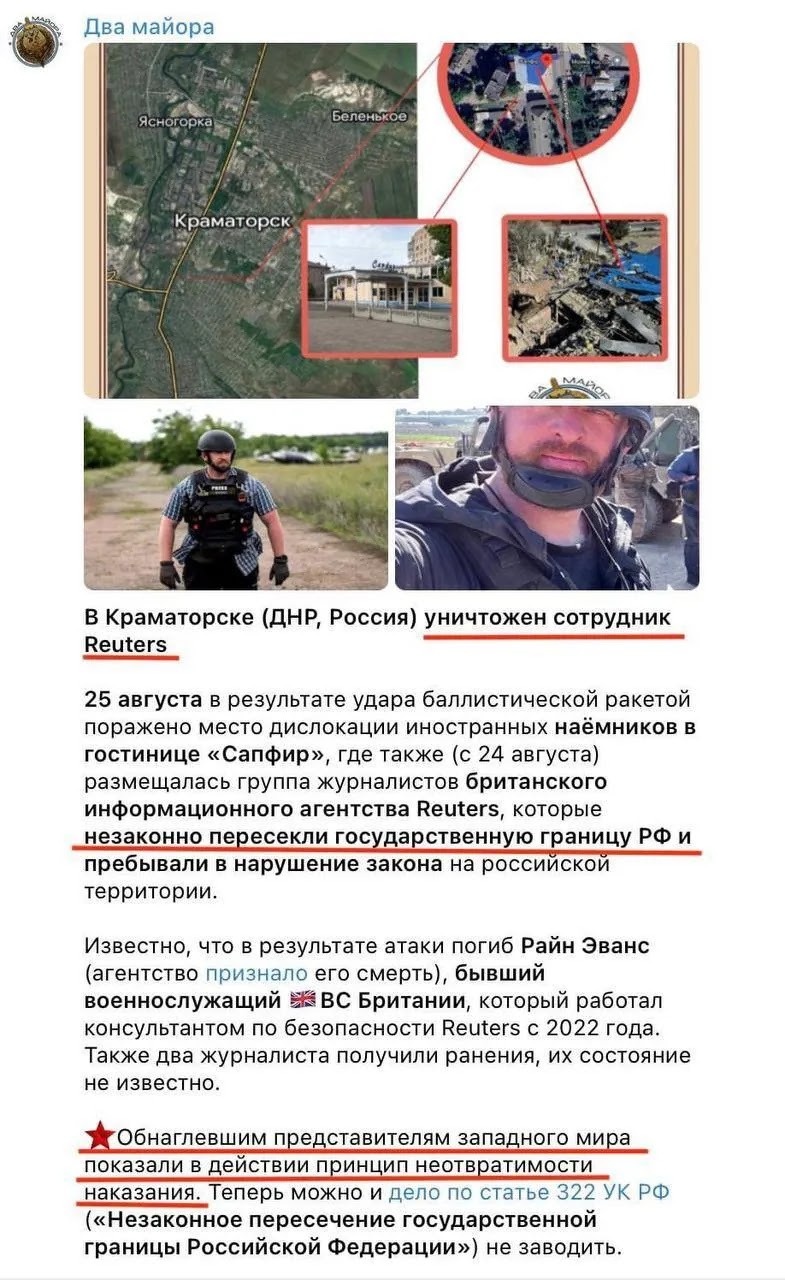
Russian propagandists admit that Reuters reporters have been targeted

The source is Russian Telegram channel Dva mayora, close to the Russian defense ministry (hattip and screenshot: Obozrevatel).

Translation from Russian:

"In Kramatorsk (Donetsk People's Republic, Russia), a Reuters employee has been eliminated

On Aug. 25, as a result of a strike by a ballistic missile, a base of foreign missionaries in the Sapphire Hotel was hit. At the same location (since Aug. 24), journalists of British news agency Reuters had been residing. They had illegally crossed the state border of the Russian Federation, and were staying on Russian territory in violation of the law.

It is known that Ryan Evans died as a result of the attack (the agency has acknowledged his death), a former member of British Armed Forces who had worked as a safety consultant for Reuters since 2022. Also, two journalists have been injured; their condition is not known.

The arrogant representatives of the Western world have been shown effectively the principle of irrevocability of punishment. Now, there is no need to press charges based on Paragraph 322 of the Penal Code (Illegal crossing of the state border of the Russian Federation)."

(Kramatorsk is a Ukrainian city under Ukrainian control but land-grabbing Russia claims it.)


Tuesday, August 06, 2024

Cowardly US Administration Sabotages Ukraine's War Effort

 From Forbes:

"Ukraine Had A Chance To Blow Up Russia’s Best Warplanes On The Tarmac. The White House Said No — And Now It’s Too Late

David Axe 

For months, Ukrainian officials have been begging their foreign allies for permission to use the best donated weaponry—in particular, powerful ballistic missiles—to hit Russian warplanes that have been parking out in the open at airfields inside Russia within quick flying time of Ukrainian cities.

For months, those allies have demurred, citing the risk of escalation as Russia’s wider war on Ukraine grinds into its 29th month.

Clearly growing impatient, Ukrainian forces have stepped up their attacks on the most vulnerable Russian airfields—strictly deploying Ukrainian-made munitions. On Saturday, Ukrainian drones targeted Morozovsk air base in southern Russia 200 miles from the front line in eastern Ukraine.

According to the Ukrainian intelligence directorate, the drone raid destroyed a Russian air force Sukhoi Su-34 fighter-bomber, damaged two additional Su-34s and burned down an ammunition warehouse.

The directorate published satellite imagery of the base depicting what it described as “extensive areas of scorched earth” resulting from the ammo cooking off in the aftermath of the attack.

This isn’t the first attack on Morozovsk, but it is one of the most destructive. It’s a bittersweet victory for the Ukrainians, however. Similar raids are getting harder to pull off as the Russians redeploy their warplanes to less vulnerable bases.

It’s obvious what the Ukrainian intelligence directorate is trying to achieve. By targeting Morozovsk and other airfields near the Russia-Ukraine border, the directorate hopes to destroy the key enablers of Russia’s glide-bombing campaign: the warplanes that carry the bombs as well as the bombs themselves.

Since dropping its first crude glide bombs on Ukraine last year, the Russian air force has really embraced the satellite-guided munitions. Thanks to their pop-out wings, the hastily-built “KAB” glide bombs possess just enough range—25 miles or more, depending on the model—to allow Su-34 fighter-bombers to hit Ukrainian troops and civilians from beyond the range of the best Ukrainian air defenses.

Every day, the Russians drop as many as 100 KABs, some weighing more than three tons. “Unfortunately, in urban environments, their large and frequent use is highly effective,” Ukrainian analysis group Frontelligence Insight reported.

“Even though they are often imprecise, the sheer payload is enough to demolish or severely damage buildings, even if the KAB doesn’t hit the target directly,” Frontelligence Insight continued. “When buildings collapse, underground basements trap people inside, making rescue operations impossible, especially when the Russians conduct double and triple-tap attacks.”

As urban demolition weapons, the KABs have been a deciding factor in practically every recent Russian victory all along the 700-mile front line. “In the past, like in the battle for Bakhmut [last year], it sometimes took days for Russian artillery to damage buildings enough to force defenders to retreat,” Frontelligence Insight explained. “Now, entire buildings can collapse in seconds, rendering them useless for defensive purposes.”

It’s a top priority of the government in Kyiv to blunt the glide-bombing campaign by destroying the bombers, the bombs—or both.

There was a rare opportunity to deliver a major blow against the KAB infrastructure earlier this summer, when the Russian air force’s 47th Guards Bomber Aviation Regiment parked dozens of Su-34s—out of roughly 100 in service—in open at Voronezh Malshevo air base in southern Russia 100 miles from the border with Ukraine.

Voronezh Malshevo is a reasonably well-defended base, so the Ukrainians pleaded for permission to fire their best American-made Army Tactical Missile System rockets at the base. The ATACMs are almost impossible to intercept.

But the administration of U.S. Pres. Joe Biden said no. “Our policy has not changed,” Jake Sullivan, Biden’s national security advisor, told reporters last month. As before, Ukraine would only be allowed to fire ATACMS at targets in Russian-occupied Ukraine.

The Russians observed the heated diplomacy regarding ATACMS—and made a rare proactive decision to pull the Su-34s from Voronezh Malshevo and other border airfields.

“Between the second half of June and mid-July, Russian forces relocated a lion’s [share] of valuable military assets away from the border area with Ukraine,” Frontelligence Insight noted. The departure of Su-34s from Voronezh Malshevo was among “the most notable movements.”

Today many of the Su-34s are at bases hundreds of miles from the border. They’re not invulnerable to Ukrainian drones—the farthest-flying models range more than 1,000 miles.

But they are safe from most Ukrainian drones, as well as from the ATACMS, the most powerful of which range just 190 miles. If the White House ever grants permission for ATACMS raids on Russian bases, it might be too late. The most valuable targets may be too far away.

Obviously, a handful of Su-34s—as well as some stocks of KAB bombs—remain at border airfields such as Morozovsk: Ukraine just hit three of the planes plus their ammo.

But to end the glide-bombing campaign, Ukraine needs to destroy scores of Su-34s—not one or several. And smarter Russian deployments are making that harder to achieve."