Wednesday, October 02, 2024

Anne Applebaum: Russia still wants to make Ukraine into a colony again

 From the Atlantic:

"The Only Way the Ukraine War Can End

Russia has to stop fighting.

Monday, September 30, 2024

America is bleeding Ukraine to death

 From the Atlantic:

"The Abandonment of Ukraine

The American strategy in Ukraine is slowly bleeding the nation, and its people, to death.

By Karl Marlantes and Elliot Ackerman 

On a recent trip to Ukraine, we walked through the rubble of a children’s hospital in Kyiv targeted by the Russians, toured an apartment building in Kharkiv where floor after floor had been destroyed by Russian missiles, and visited the front lines to meet with soldiers who spoke of the brutality of Russian human-wave tactics. But the most unsettling thing we saw was the American strategy in Ukraine, one that gives the Ukrainian people just enough military aid not to lose their war but not enough to win it. This strategy is slowly bleeding Ukraine, and its people, to death.

...We have a combined 60-year breadth of combat experience between us, including Vietnam, Iraq, and Afghanistan. The horrors of war are not unfamiliar to us. Yet both of us felt deeply disturbed as we finished our trip.

In Kharkiv, we met with a group of Ukrainian combat veterans. Before the war, Victoria Honcharuk, a 24-year-old medic, lived in the United States, where she’d been accepted to a graduate program at Harvard while working in New York City in investment banking. When war broke out in February 2022, she left that life behind and returned home to defend her country. Her unit of medics, composed entirely of volunteers, draws no pay. Approximately half of the friends she began service with have been killed or wounded... When a member of our group observed that Ukraine’s future would involve young people, like her, leading and rebuilding her country, she paused and politely reminded us that they could rebuild it only if they survived...

Ukraine’s President Volodymyr Zelensky has spent a great deal of time pleading with his allies for weapons and permission to use them to their full capabilities. But his administration is now pleading simply for the delivery of weapons that have already been pledged. Currently, these delays are the result of U.S. Department of Defense protocols that affect the drawdown rates of U.S. stockpiles... Ironically, we keep our weapons in reserve for a crisis exactly like the one playing out in Ukraine. We must make those weapons available to those who would use them in our shared defense.

The war in Ukraine is at risk of being lost—not because the Russians are winning but because Ukraine’s allies have not allowed them to win. If we encourage the Ukrainians to fight while failing to give them the tools they need for victory, history will surely conclude that the Russians weren’t the only ones who committed crimes against Ukraine."

***

Let me just remind readers that back in 1994, the USA and the UK pressured Ukraine into disarming, promising to defend it in return - the Budapest Memorandum.

Sunday, September 29, 2024

West's Ukraine policy is "appeasement-light"

 From Politico:

"West’s Ukraine policy of incrementalism is appeasement-light — and it’s failing

Both Europe and the US must acknowledge that our fear of provoking Moscow is what ends up reliably provoking Moscow


Wednesday, September 25, 2024

AFP hits a low

As we are approaching the first anniversary of the Oct. 7 massacre in Israel committed by Hamas and Palestinian "civilians", AFP hits a new low. It has published a sympathetic report titled Tragic tale of two West Bank teenagers freed in Gaza truce, about two young Palestinian terrorists killed by Israeli armed forces after being released from Israeli prisons. To me, it is no tragedy when wannabe murderers get their just deserts. Keep up the good job, IDF!

Sunday, September 22, 2024

Expert slams Trump's plan for Ukraine

 From the Hill:

"The Trump-Vance plan for Ukraine is insane

by Eliot Wilson, opinion contributor - 09/18/24

Former President Donald Trump’s approach to foreign affairs is dominated by an extreme “America First” stance that often manifests itself as isolationism. His intrinsic thin-skinned paranoia makes him view any engagement with other countries or international organizations as a potential attempt to take advantage of America, and this has shaped his policy on Ukraine.

He has also long had a starstruck admiration for Vladimir Putin, describing the Russian as a “genius” and “pretty savvy.”

As a result, Trump declared last year that, if elected, he would bring an end to the war between Russia and Ukraine before he was even inaugurated for his second term as president in January 2025 and stop the “endless flow of American treasure to Ukraine.”

During last week’s debate against Vice President Kamala Harris, moderator David Muir asked Trump if he wanted Ukraine to be victorious in the conflict. “I want the war to stop,” Trump replied. “I want to save lives. I think it’s in the U.S. best interest to get this war finished and just get it done.”

Commentators have read a great deal into Trump’s unwillingness to explain the terms on which he would end the conflict. But a few days ago, his running mate, Sen. JD Vance, appeared on The Shawn Ryan Show podcast and was more forthcoming. Vance’s explanation revealed an astonishing willingness to abandon Ukraine and award a huge geopolitical win to Russia and Putin, fulfilling the worst fears that many had sketched into Trump’s evasions.

“What it probably looks like is the current line of demarcation between Russia and Ukraine, that becomes like a demilitarized zone,” Vance told Ryan.

That simple statement is sweeping and catastrophic for the government in Kyiv. Effectively, Trump’s peace plan would cede Crimea, annexed in 2014, and the 20 percent of Ukrainian territory currently under occupation, to Russia. The message is clear: If you invade a neighboring country and maintain a military advantage, Trump’s America is content to see you steal as much territory as you can grab.

Ukraine would likely be forced into more concessions. To accommodate one of Putin’s principal demands, it would have to agree to abandon its application to join NATO and not to become a member of what Vance called “allied institutions” — presumably the European Union, which recognized Ukraine as a candidate country in June 2022.

This would be nothing short of a Russian veto on Ukrainian foreign policy. A nation that cannot choose its allies is a vassal state.

Compelling Ukraine to make this kind of diplomatic surrender would have implications beyond the current conflict. Closing off NATO membership would tear up the declarations made by the alliance in Washington this year, that “Ukraine’s future is in NATO,” and in Vilnius last July, which reiterated the commitment made in Bucharest in 2008 that Ukraine should become a member of the alliance.

It would also completely undermine NATO’s “open door” policy, derived from Article 10 of the North Atlantic Treaty, which stipulates that the signatories can “invite any other European State in a position to further the principles of this treaty and to contribute to the security of the North Atlantic area to accede to this treaty.” The open door would be slammed shut.

Finally, we need to imagine the clear message such a settlement would send to America’s allies around the world that they cannot count on U.S. support. No treaty or agreement, no public declaration of solidarity has any value if Washington just decides not to honor it...

What conclusion would America’s NATO allies in Eastern Europe draw? The Baltic states (Estonia, Latvia and Lithuania) have suffered under Russian occupation within living memory, and Putin regards their independence as a threat to his country’s security. They know what Moscow’s hegemony means: autocracy, repression, deportations and mass murder. If the U.S. is content to surrender parts of Ukraine to a similar fate, what protects them?

The vision set out by Vance would amount to the biggest unilateral betrayal of an ally since the Munich Agreement in 1938, when Britain and France abandoned Czechoslovakia to Nazi Germany. It would broadcast to the world that a commitment by the U.S., written or spoken, had no weight or meaning. It would not be “America First” but “America Only” — and everyone else must look after themselves."


Thursday, September 12, 2024

How Biden mercilessly and short-sightedly keeps harming Ukraine

 From the Foreign Policy:

"Biden’s ‘Escalation Management’ in Ukraine Makes the West Less Safe

Washington should abandon a failed approach to Moscow that does not learn or self-adjust.

By , a senior research fellow at the Finnish Institute of International Affairs. 
 
In Robert De Niro’s 2006 spy thriller The Good Shepherd, fictional mob boss Joseph Palmi (played by Joe Pesci) tells CIA officer Edward Wilson (played by Matt Damon): “You’re the guys that scare me. You’re the people that make big wars.” To which the CIA man responds: “No, we make sure the wars are small ones, Mr. Palmi.”
 
Viewers may be tempted to see some dark truth in that dialogue—namely, that the U.S. government plots and schemes to create wars, with the only saving grace being that it tries to keep them contained. There is, however, another possible reading that is altogether more relevant for our time: It is the wars initiated by other states that Washington tries to keep small.

Keeping the war from going beyond Ukraine’s borders or escalating to the nuclear weapons stage is the thread running through the Biden administration’s response to the Russian invasion of Ukraine from the start. Washington has set a very clear constraint on Western assistance to Kyiv: Support is restricted to diplomatic, economic, and security assistance, while the United States and other NATO states must not become belligerents in the war. In short, sanctions and weapons supplies, but no boots on the ground or pilots in the air.

But Washington’s abundance of caution has gone much further than the simple decision of not putting U.S. and NATO personnel at risk of direct conflict with Russia. Rather than providing Kyiv as quickly as possible with the full spectrum of weapons that it needs to take on a peer adversary, there has been a long series of delays and hesitations regarding arms deliveries that cannot be explained purely by technical factors, such as the availability of weapons or the need to train Ukrainians to use them. Instead, a pattern has emerged of purely political hesitations by the White House, notably regarding the long delays prior to authorizing deliveries of longer-range missiles and combat aircraft as well as the current blockage on any use of Western weapons against military targets and related infrastructure deep within Russia. The volume of military aid has also slowed markedly, with $6 billion of the $7.8 billion approved by the U.S. Congress in April still unused and about to expire on Sept. 30.

Taken together, these policy choices define the White House’s escalation management approach. To keep the war small, Washington has placed a very tight leash on Kyiv’s prosecution of the war. The result is a pattern of politically chosen limitations on the type of weapons and munitions delivered, the amount and speed of the aid, the numbers of Ukrainians trained on critical weapons, and the permitted uses of the equipment.

Washington has also made sure that European allies abide by the same limits, vetoing or delaying proposed deliveries and overruling key allies’ objections to targeting restrictions, even in situations where the weapons concerned are not from U.S. production.

By essentially micromanaging Ukraine’s strategy and tactics, the White House has sought to keep the war small. The Biden administration’s theory of escalation management also finds its expression in the nebulous formula of helping Ukraine “as long as it takes”—rather than declaring the goal to be a Ukrainian victory and using the formula of “whatever it takes” which is preferred by many European allies.

Indeed, views differ among NATO member states regarding the level of military assistance that the West should provide, with Northern and Central European allies often at the forefront of pushing for more decisive assistance. It’s clear that none of these governments wants a wider war, nor one that involves nuclear weapons; they and their populations would be among the first to suffer from any such escalation. Many of them know and understand Moscow extremely well. Hence, their more forward-leaning positions suggest that there may be something broken in how the White House seeks to manage escalation—and whether escalation management is even the right approach.

A current case is illustrated by the long-standing proposals by London and Paris to let Kyiv use British- and French-made weapons they already supplied to Ukraine—in particular, Storm Shadow and SCALP cruise missiles — to strike targets in Russia, including the military airfields that Russia uses to launch bombing runs on Ukrainian energy infrastructure and cities. By the end of May, Finland, Canada, Poland, Czechia, Denmark, and Sweden, among others, had all expressed public support for abolishing restrictions on Ukraine’s use of allied-supplied weapons.

As Ukrainian President Volodymyr Zelensky said at the time, the Europeans were trying to build a new consensus before moving forward, “with the position in Washington being crucial.”

Washington responded in the narrow spirit of escalation management by avoiding the simple choice that key allies called for — and salami-slicing it into smaller steps. At the end of May, the White House apparently gave the green light to Ukraine for short-range strikes into a narrow border zone in Russia, but only if the target was directly involved in the Russian attack on the eastern Ukrainian city of Kharkiv. This was clarified in late June to allow for short-range strikes into any bordering region of Russia. Deep strikes into Russia remain verboten.

A further illustration of the Biden team’s escalation micromanagement mindset came with a visit by Ukrainian officials in Washington, D.C., in August. There, they presented the U.S. side with an exact list of targets that could be attacked with Western deep-strike capabilities, effectively asking for permission for each individual target.

The U.S. position has slowly evolved since summer 2022. At first, Ukraine was only allowed to fight within its borders and only at rocket-launcher range. Reluctantly, the White House then allowed deep-strike range—but only at targets within Ukraine (for example, to target the Russian Black Sea Fleet in occupied Crimea). Now, strikes into Russia’s border region at rocket-launcher range are permitted, but deep strikes into Russia are not. It took two years and four months for Washington to reach that position, which is still heavily and one-sidedly detrimental to Ukraine. Russia never placed any range or target limitations on itself and has launched deep strikes into Ukraine since the beginning of the war. Lithuanian Foreign Minister Gabrielius Landsbergis condemned this imbalance on X: “We cannot allow Russian bombers to be better protected than Ukrainian civilians are.”

Crucially, if deep strikes into Russia were a trigger for escalation, the world would know by now. Ukraine has launched repeated drone strikes at Russian energy infrastructure, including strikes on oil refineries more than 600 miles into Russia in April and May as well as an attack on a refinery in Moscow on Sept. 1. No escalation by Russia has been observed since then. Ukraine’s successful invasion of Russia’s Kursk region, the first occupation of Russia by a foreign force since World War II, also went unanswered beyond rhetoric.

In sum, what we have is a White House applying an escalation management algorithm that does not learn or self-adjust. Ideally, U.S. decision-makers would repeatedly test and update their estimates of Russia’s intentions and possible actions, with the aim of ratcheting up toward greater effectiveness. Instead, their algorithm remains impervious to their allies’ inputs and observable reality in the war as Ukraine acts and Russia reacts. Worse, Washington’s broken algorithm subjects Ukraine to avoidable dangers and losses that will saddle any postwar scenario with greater costs and risks. These avoidable dangers and losses also threaten the entire outcome of the war.

The choice to use target distance as a key variable to salami-slice assistance into supposedly less-escalatory steps suggests a narrow mental map: one that views the Russia-Ukraine war almost exclusively as a land war where the only important variable is the location of the front line. But the location of that front line will matter a lot less if Ukraine loses the air war that Moscow wages against Ukraine’s home front. For months now, Russian airstrikes have repeatedly hit Ukraine’s critical energy infrastructure and other targets across the country. Russia’s aims are obvious: to make Ukrainian cities uninhabitable in order to trigger large population movements, disrupt defense efforts, and force Kyiv to surrender.

The air war is also a key factor influencing the location of the front line—in particular, Russia’s use of devastating glide bombs delivered by bombers flying out of airfields that are located deep inside Russia and thus protected by the White House. Indeed, the use of long-range precision fires to take out these and other enemy targets is a key component of U.S. military doctrine — hence the repeated calls by prominent retired U.S. Air Force and Army commanders to lift range restrictions on Ukraine and take the air war seriously.

In every area that pertains to the air war, U.S. assistance has fallen far short of what it could be. Even in air defense, U.S. shipments have been a tiny fraction of what Washington has in its inventory and can inarguably spare. As for F-16 fighter jets, while the United States supports European transfers to Ukraine, it is not donating any of its own. A further disappointment is that the United States reportedly refuses to prioritize the training of Ukrainian pilots on these aircraft, a situation that a prominent Ukrainian lawmaker described in June as deliberate and caused by “purely political” delay tactics.

Allowing Ukraine to conduct deep strikes into Russia using all means at its disposal, including by entering Russian airspace to fire air-launched missiles, is essential for both the land war and air war. With respect to Ukraine’s air defense, the concept that is discussed among security experts is to “shoot the archer, not the arrow” — in other words, to target Russian launch capabilities rather than individual missiles. It would be much too costly in both lives and weaponry if Russia’s offensive capabilities remain untouched. For the land war, Ukraine needs the ability to take out all relevant military targets and dual-use infrastructure that Russia uses to propel its aggression.

The overall concept, then, should not be escalation management but threat removal: the demolition of the means that Russia uses to attack Ukraine. Ukraine isn’t asking the United States or Europe to do any fighting. It just needs the tools and permissions to do what the United States or any other nation would not hesitate to do if it were under attack: stop the threat.

The alternative is to continue with the slowness inherent to the escalation management approach. That approach costs Ukraine time, which it pays for in lives, and gives Russia more time to learn to fight more effectively. In sum, escalation management is failing to secure a Russian defeat and is instead generating an even more dangerous Russian war machine.

This week, signals from the Biden administration suggest there could finally be a loosening of restrictions on deep strikes. But even if these signals indicate another salami slice of escalation management, the diagnosis remains: It will still have taken two-and-a-half years to authorize Ukraine to do something every NATO ally would take for granted. U.S. policy continues to be too slow, too costly, and too dangerous for both Ukraine and the West.

Switching from a demonstrably costly and failing approach of escalation management to a policy of threat removal would go hand-in-hand with a new Western framing for the war. The United States and its European allies should agree on the political goal that the war should end with Russia feeling both beaten and deterred. This implies the need to deepen the support to Ukraine with the aim of ensuring that it liberate all of its territory, including Crimea and the Donbas, and that it is able to durably deter Russia from future aggression.

The outcome, then, is not a war that stays small but no war at all. To achieve that vision—the only vision that will secure long-term peace in Europe—Washington needs a new algorithm."                    

Friday, September 06, 2024

Germany falls into obscurantism, again

 Nette Nöstlinger and Svetlana Shkolnikova, Politico: 

"Putin ‘wins’ in eastern Germany

BERLIN — A heated debate on Russia is crashing the normally more provincial politics of eastern German states, and Vladimir Putin is likely loving it.

In regional elections in the formerly communist east on Sunday, Russia-friendly parties on both extremes of the political spectrum surged — and they are already demanding that German leaders radically change their way of dealing with the Kremlin.

That includes the populist-left Sahra Wagenknecht Alliance (BSW), a new party named after its founder, a leftist icon who started out in politics as a member of East Germany’s communist party, which took third place in both Thuringia and Saxony.

One of BSW’s post-election demands: that Berlin halt a plan, announced in July, for the United States to deploy long-range missiles in Germany starting in 2026 to defend NATO territory. Putin, soon after, threatened to take “mirror measures,” accusing the U.S. and its allies of escalating tensions.

“Many people are afraid that Germany will allow itself to be dragged into this war and many people also see the great dangers of the U.S. missile plans,” Wagenknecht said on German public television after the regional elections. 

Members of her party, who also advocate a stop to military aid for Ukraine and peace negotiations with Putin, have since suggested they won’t form coalitions with any party that supports the presence of U.S. missiles.

“We see that this is a measure that directly increases the risk of war for Germany and we believe that a state government must really raise its voice here,” Amira Mohamed Ali, co-leader of BSW, said on German public radio.

The BSW’s stance puts the conservative Christian Democratic Union (CDU), which won in Saxony and came in second in Thuringia, in a difficult position...

Nearly 3 out of 4 people in eastern Germany do not want the deployment of U.S. missiles in their country, according to a Forsa poll from late July. (Nationwide, half of Germans reject the plan.) 

That helps explain why the conservative premier of Saxony, Michael Kretschmer, who led his CDU to a narrow victory over the AfD on Sunday, has views that are out of step with his party’s national leaders when it comes to Russia. In fact, on that subject, he often sounds a lot like a politician in BSW. 

“We can no longer provide funds for weapons to Ukraine only for these weapons to be used up and achieve nothing,” he told a German media outlet ahead of the election. Kretschmer has also called for a referendum on the U.S. missile deployment.

It remains unclear how the CDU will navigate its dilemma over whether to work with BSW. But one thing seems certain: The Kremlin is very pleased that a debate is taking place due to the party's rise.

The rise of Russia-friendly parties in eastern Germany has been a focus of attention on Russian state television. Coverage of the election on “60 Minutes,” a popular Russian political show, included a segment highlighting the success of BSW, a party, as a narrator put it, that was "formed around the concept of peace.”

The party’s message, according to the show, has found resonance in an eastern Germany where “there is nostalgia for the socialist past and resistance to the U.S. and NATO is quite strong.”

When a guest on the show wanted to dissect the election results in Germany, the host, Yevgeny Popov, also a Russian parliamentarian, intervened in a half-joking manner.

“What is there to analyze?” he said. “Putin won!”"


Tuesday, September 03, 2024

How America betrays its allies

From Chatham House:

"Are Ukraine’s F-16s another case of too little, too late?

Keir Giles

Senior Consulting Fellow, Russia and Eurasia Programme

Western-supplied F-16 combat aircraft have now been in Ukrainian service for several weeks. In 2022 and 2023, some had high hopes that provision of F-16s would be a game changer for Ukrainian warfighting capabilities. 

Yet their final introduction has been something of a ‘soft launch’, without the expectations of a sudden and dramatic impact that accompanied other high-profile new weapons deliveries to Ukraine.

Western dithering

Providing fighter aircraft to Ukraine has been called for since the very earliest days of the conflict. At that time, one of the foremost objections to doing so was the length of time that it would take to train pilots and maintenance personnel, and provide suitable facilities – with periods of months or over a year being quoted. 

With the conflict now in its third year, those objections – and the subsequent delay in making the decision to provide the aircraft – seem more misplaced than ever. What is more, Russia has been given ample time to plan for the appearance of Ukraine’s new aircraft type, and adapt to it. 

In addition, just as with deliveries of Western tanks like Abrams and Challengers, F-16s have arrived in very limited quantities, which will necessarily curb their impact. And the challenges of integrating this new capability have already been tragically illustrated by the destruction of one aircraft in what may have been a friendly fire incident.

Furthermore from the outside, there seems little discernible urgency from Ukraine’s Western allies to resolve training and maintenance bottlenecks that will place continuing limits on the numbers of F-16s Ukraine can operate.

Washington’s constraints

...One other crucial point is also not yet clear – though it might become painfully so later: whether or not the US has placed restrictions on how F-16s can be utilized, in the same way it has done with ATACMS missile systems for example. 

Even though Ukraine’s F-16s do not come directly from the US, but via the Netherlands and Denmark, Washington’s policy may amount to a blanket ban affecting Western weapons. 

There has been confused and contradictory reporting on what restrictions may or may not have been set on the use of British and French Storm Shadow and SCALP missiles. But one interpretation is that the US has found a way to ensure that the UK and France also do not allow them to be used for strikes within Russia’s internationally recognized borders. 

Given limitations on how other weapons systems provided to Ukraine can be used, with strict bans on any use that would impact Russia too severely, it is likely that similar constraints will have been placed on the F-16s. 

As ever, the paradox is that despite being the biggest provider of military aid to Ukraine by volume, the US is the supporter that attracts the most criticism, due to the rules it sets governing the use of equipment. 

Some expected that Washington’s policy would change following Ukraine’s audacious move across the Russian border into the Kursk region. 

As well as the local, tactical benefits, the incursion put an end to suggestions that Russia would resort to nuclear use if fighting spread to its own territory. That idea has joined the long list of other supposed ‘red lines’ that have now been irrevocably crossed. 

In theory, that should provide convincing evidence that restrictions on Ukrainian use of US-supplied weapons should be eased. But as I explain in detail in a forthcoming book, that evidence is not useful if the United States and Germany have concluded that it is not in their broader strategic interest for Russia to be defeated. 

They have already shown that they will not be swayed by any amount of empirical evidence that their policy is self-defeating, or by calls from other allies of Ukraine, including the front-line states most at risk from any possible ‘escalation’, to lift restrictions.

Probing the limits of US support

Russia is reported to be constructing new airfields close enough to Ukraine to be within the range of US-supplied missiles, if only they were permitted to be used. That suggests that Moscow has confidence in the reliability of US-mandated safe zones for the foreseeable future. 

That’s a continuing problem, and one which is likely to be causing defence planners in other countries neighbouring Russia severe concern. Given the consistent pattern of US behaviour, they are likely to be looking for means to ensure that if they do come under attack from Russia, the US will not try to limit their options for defending themselves. 

Ukraine has drawn up detailed targeting lists for sharing with the United States, indicating what could be struck if restrictions were lifted. 

That will have been a calculated gamble, after the great care that was taken to conceal plans for the Kursk incursion not only from Russia but also from Washington, amid concern that it would be blocked like other previous operations – and following persistent reporting of discussion of Ukrainian plans between the Pentagon and Moscow. 

But that gamble is an essential part of the ongoing conversation, probing the limits of US support. That task becomes ever more urgent as November’s presidential election draws closer, and with it the possibility of a Trump presidency that could bring an abrupt end to all US aid.

Ukraine cannot make good the time that has been lost to the hesitancy and timorousness of some of its principal backers. Its vital task now is instead to make the most of the time there is left: to gain the maximum possible benefit from the current military situation on the front line, and the political situation in Washington, before one or the other changes dramatically for the worse."

Saturday, August 31, 2024

Estonian defense minister: Western restrictions on weapons for Ukraine are idiotic

 From Ukrainska Pravda:

"Source: a European Pravda reporter, citing Pevkur's statement at the GLOBSEC conference in Prague

Details: The minister entered the debate on the "strategic uncertainty" surrounding Western assistance to Ukraine, noting how Western partners often speak of providing Ukraine with "the assistance it needs" and "for as long as necessary" yet deliberately avoid specifying what the end goal should be, in order not to constrain the war's outcome.

Pevkur emphasized that this lack of certainty means the West is not providing Ukraine with what it needs.

"The key question we politicians have to answer is whether we want Ukraine to fight or win. We lack a political decision regarding the fact that we want Ukraine to win. If this decision is made, then the next steps become clear," he stressed.

He is convinced that if Ukraine's victory is defined as a goal, the West will be able to adopt a victory strategy. Pevkur emphasized that Estonia, which officially seeks Ukraine's victory, has taken these steps.

"The strategy we are proposing states, among other things, that we should spend 0.25% of GDP on helping Ukraine," the minister said, adding that this would be enough to supply the weapons Ukraine needs.

"The problem is not the supposed lack of a strategy in Ukraine: Ukraine knows what to do. The problem is the lack of funds and the absence of weapons. And there are also idiotic restrictions that I don't understand," he added."


Ukrainian expert: The USA does not want Ukraine to win

 Ukrainian military expert Oleg Zhdanov thinks that no matter how much Ukrainians want Americans to help them win in the war, those in power in the USA have other goals. For the West, the defeat of Russia is regarded as dangerous, therefore the USA wants smooth regime change in Russia:

"I am pessimistic. I see that the USA tries to keep the situation in control according to their own plan. Therefore, unfortunately, I don't think we will be allowed to use the maximum distance of ATACMS. I have the impression that currently puts maximum efforts into preventing the collapse of the Russian Federation... You see, there is a currency crisis in Russia now. All economists and finance experts say that the ruble will collapse any moment. What does the USA do? It allows the Moscow Stock Exchange to trade dollars until the beginning of October. That's all. Money started flowing into the Russian treasury, Putin has money to fund the war again, has money for social payments, the collapse of the finance system didn't happen, the financial and economic crisis of the Russian Federation didn't happen."

***

I wonder, how many in the US elite, let alone citizenry, know this?

Украинцам хотелось бы, чтобы американцы помогли им одержать победу в войне, но действующая власть в США преследует другие цели, сообщил Олег Жданов. Для Запада поражение РФ и последующий раскол кажется чем-то опасным, поэтому США стремятся к тому, чтобы произошла безболезненная смена режима в России.

читайте подробнее на сайте "Диалог.UA": https://www.dialog.ua/opinion/300763_1725106201


Tuesday, August 27, 2024

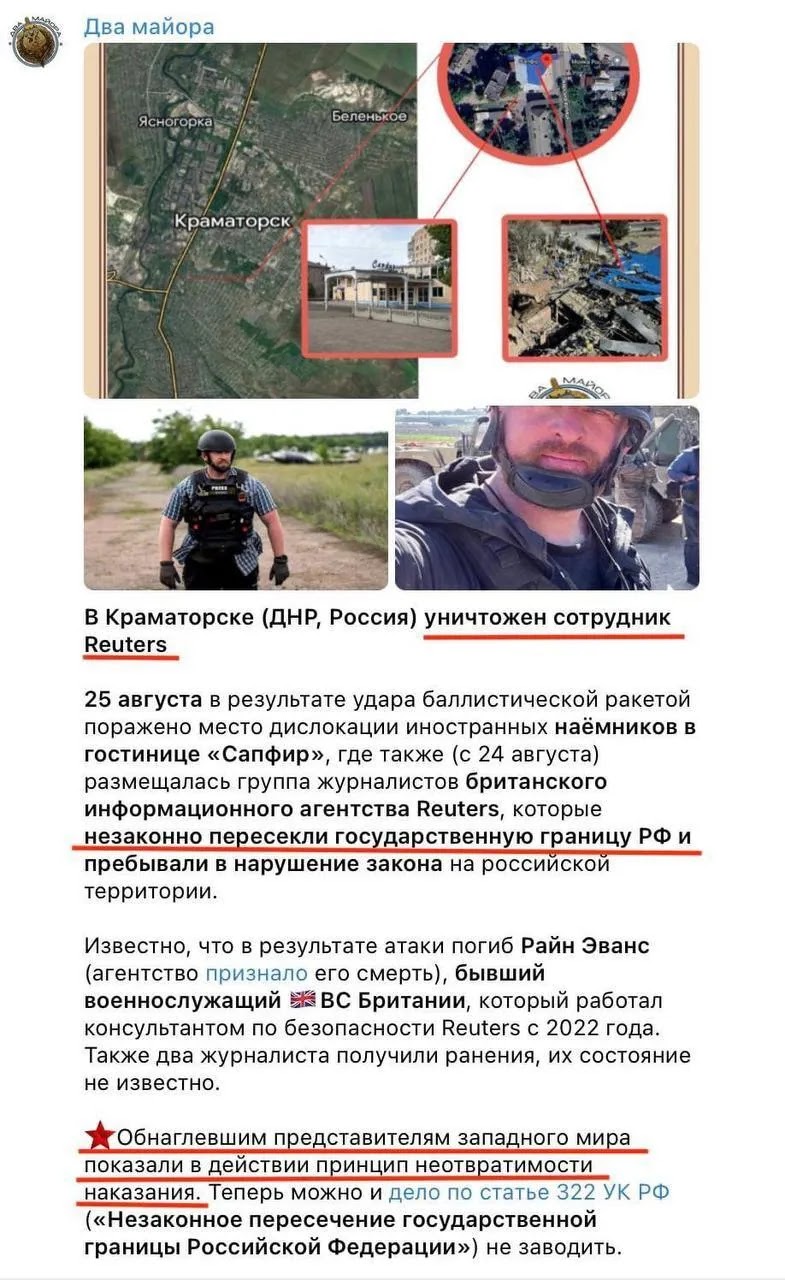
Russian propagandists admit that Reuters reporters have been targeted

The source is Russian Telegram channel Dva mayora, close to the Russian defense ministry (hattip and screenshot: Obozrevatel).

Translation from Russian:

"In Kramatorsk (Donetsk People's Republic, Russia), a Reuters employee has been eliminated

On Aug. 25, as a result of a strike by a ballistic missile, a base of foreign missionaries in the Sapphire Hotel was hit. At the same location (since Aug. 24), journalists of British news agency Reuters had been residing. They had illegally crossed the state border of the Russian Federation, and were staying on Russian territory in violation of the law.

It is known that Ryan Evans died as a result of the attack (the agency has acknowledged his death), a former member of British Armed Forces who had worked as a safety consultant for Reuters since 2022. Also, two journalists have been injured; their condition is not known.

The arrogant representatives of the Western world have been shown effectively the principle of irrevocability of punishment. Now, there is no need to press charges based on Paragraph 322 of the Penal Code (Illegal crossing of the state border of the Russian Federation)."

(Kramatorsk is a Ukrainian city under Ukrainian control but land-grabbing Russia claims it.)


Tuesday, August 06, 2024

Cowardly US Administration Sabotages Ukraine's War Effort

 From Forbes:

"Ukraine Had A Chance To Blow Up Russia’s Best Warplanes On The Tarmac. The White House Said No — And Now It’s Too Late

David Axe 

For months, Ukrainian officials have been begging their foreign allies for permission to use the best donated weaponry—in particular, powerful ballistic missiles—to hit Russian warplanes that have been parking out in the open at airfields inside Russia within quick flying time of Ukrainian cities.

For months, those allies have demurred, citing the risk of escalation as Russia’s wider war on Ukraine grinds into its 29th month.

Clearly growing impatient, Ukrainian forces have stepped up their attacks on the most vulnerable Russian airfields—strictly deploying Ukrainian-made munitions. On Saturday, Ukrainian drones targeted Morozovsk air base in southern Russia 200 miles from the front line in eastern Ukraine.

According to the Ukrainian intelligence directorate, the drone raid destroyed a Russian air force Sukhoi Su-34 fighter-bomber, damaged two additional Su-34s and burned down an ammunition warehouse.

The directorate published satellite imagery of the base depicting what it described as “extensive areas of scorched earth” resulting from the ammo cooking off in the aftermath of the attack.

This isn’t the first attack on Morozovsk, but it is one of the most destructive. It’s a bittersweet victory for the Ukrainians, however. Similar raids are getting harder to pull off as the Russians redeploy their warplanes to less vulnerable bases.

It’s obvious what the Ukrainian intelligence directorate is trying to achieve. By targeting Morozovsk and other airfields near the Russia-Ukraine border, the directorate hopes to destroy the key enablers of Russia’s glide-bombing campaign: the warplanes that carry the bombs as well as the bombs themselves.

Since dropping its first crude glide bombs on Ukraine last year, the Russian air force has really embraced the satellite-guided munitions. Thanks to their pop-out wings, the hastily-built “KAB” glide bombs possess just enough range—25 miles or more, depending on the model—to allow Su-34 fighter-bombers to hit Ukrainian troops and civilians from beyond the range of the best Ukrainian air defenses.

Every day, the Russians drop as many as 100 KABs, some weighing more than three tons. “Unfortunately, in urban environments, their large and frequent use is highly effective,” Ukrainian analysis group Frontelligence Insight reported.

“Even though they are often imprecise, the sheer payload is enough to demolish or severely damage buildings, even if the KAB doesn’t hit the target directly,” Frontelligence Insight continued. “When buildings collapse, underground basements trap people inside, making rescue operations impossible, especially when the Russians conduct double and triple-tap attacks.”

As urban demolition weapons, the KABs have been a deciding factor in practically every recent Russian victory all along the 700-mile front line. “In the past, like in the battle for Bakhmut [last year], it sometimes took days for Russian artillery to damage buildings enough to force defenders to retreat,” Frontelligence Insight explained. “Now, entire buildings can collapse in seconds, rendering them useless for defensive purposes.”

It’s a top priority of the government in Kyiv to blunt the glide-bombing campaign by destroying the bombers, the bombs—or both.

There was a rare opportunity to deliver a major blow against the KAB infrastructure earlier this summer, when the Russian air force’s 47th Guards Bomber Aviation Regiment parked dozens of Su-34s—out of roughly 100 in service—in open at Voronezh Malshevo air base in southern Russia 100 miles from the border with Ukraine.

Voronezh Malshevo is a reasonably well-defended base, so the Ukrainians pleaded for permission to fire their best American-made Army Tactical Missile System rockets at the base. The ATACMs are almost impossible to intercept.

But the administration of U.S. Pres. Joe Biden said no. “Our policy has not changed,” Jake Sullivan, Biden’s national security advisor, told reporters last month. As before, Ukraine would only be allowed to fire ATACMS at targets in Russian-occupied Ukraine.

The Russians observed the heated diplomacy regarding ATACMS—and made a rare proactive decision to pull the Su-34s from Voronezh Malshevo and other border airfields.

“Between the second half of June and mid-July, Russian forces relocated a lion’s [share] of valuable military assets away from the border area with Ukraine,” Frontelligence Insight noted. The departure of Su-34s from Voronezh Malshevo was among “the most notable movements.”

Today many of the Su-34s are at bases hundreds of miles from the border. They’re not invulnerable to Ukrainian drones—the farthest-flying models range more than 1,000 miles.

But they are safe from most Ukrainian drones, as well as from the ATACMS, the most powerful of which range just 190 miles. If the White House ever grants permission for ATACMS raids on Russian bases, it might be too late. The most valuable targets may be too far away.

Obviously, a handful of Su-34s—as well as some stocks of KAB bombs—remain at border airfields such as Morozovsk: Ukraine just hit three of the planes plus their ammo.

But to end the glide-bombing campaign, Ukraine needs to destroy scores of Su-34s—not one or several. And smarter Russian deployments are making that harder to achieve."


Sunday, July 28, 2024

Open letter of scientists supporting Ukraine's NATO membership

 From the Guardian:

Should Ukraine join NATO?

Open letter
 
On 8 July, the eve of NATO’s 75th anniversary summit, a Russian missile struck Ukraine’s largest children’s hospital, destroying, among other sections, its cancer center, hematology lab and surgical transplant unit. Russia launched 40 missiles at cities across Ukraine that day, killing more than 40 people, wounding numerous others, and demonstrating yet again that there are no legal, political or moral lines it won’t cross in its determination to conquer Ukraine.

As Ukrainian doctors, rescue workers and volunteers evacuated child patients, many of them still in hospital gowns and attached to IVs, from the bombed-out hospital, heads of state from NATO’s 32 member countries arrived in Washington DC to discuss Russia’s war in Ukraine and how to strengthen Ukraine’s defense. Although they affirmed that “Ukraine’s future is in NATO”, and that the country’s path to the alliance is “irreversible”, Ukraine’s potential membership was once again deferred: the Washington summit declaration stated that an invitation for Ukraine to join NATO would come “when Allies agree, and conditions are met”.

The allies do not yet agree. NATO membership for Ukraine is supported by some European member states – in particular, the Baltic and Nordic states and Poland. At the same time, key powers like the US and Germany remain opposed. The arguments against Ukraine’s NATO membership, which have been proffered repeatedly since Russia’s attack on Ukraine began in 2014, ultimately reiterate the same concern: that any step, however small, would be seen as threatening Russia’s security, and would therefore provoke greater conflict. In reality, Russia’s calm acceptance of Finland and Sweden, two of its neighbors who joined NATO in 2022, has put the lie to the claim that Russia is on a hair trigger about NATO drawing any closer. It is time to acknowledge that Russia opposes Ukraine’s NATO membership only because it would obstruct Russia’s continued aggression against that country.

The focus on Russia’s alleged “NATO expansion anxiety”, and attempts to appease it, ignore Russia’s genocidal propaganda and systematic war crimes in occupied territory of Ukraine, including massacres, mass rape and torture. Russia’s actions demonstrate a clear intent to destroy Ukraine as a nation, rather than to alleviate its own security concerns. The idea that extending security guarantees to Ukraine would further incentivize Russia’s brutal prosecution of this war is unfounded, since Russia is fully determined to destroy Ukraine and needs no additional motivation to do so.

Secondly, it is a fact that Russia has not attacked a single NATO member. Instead, it has threatened, invaded and occupied non-member countries: Georgia, Moldova and now Ukraine. The territorial boundary between NATO and non-NATO countries has so far proved the only red line that Russia has (however warily) respected, even as it breaks numerous other international treaties and agreements. Russia’s resurrected imperialist militarism can only be contained by the existence of a much stronger military alliance.

Finally, attempts to appease the Kremlin fail to address Russia’s determination to secure anti-western global power. Russia already fully controls Belarus and has been actively forming its own alliances with China, North Korea and Iran, which stand for the destruction of the democratic order. Russia bombed Syrian cities to keep Bashar al-Assad (a dictator who used chemical weapons against civilians) in power. Russia supports terrorist organizations globally, including the Taliban and Hamas, and may soon send missiles to Yemen’s Houthis.

Assuming that appeasing Russia’s demands will resolve the war, or somehow de-escalate it, is naive. Impunity for Russia’s war crimes in Syria, Georgia and Ukraine has only emboldened the Kremlin. The question of Russia’s escalation is thus not “if”, but “how far?” How far will its escalation be allowed to go before democracies muster the political backbone to halt it? Western democracy must stand in unity and determination against the growing threat to global security represented by the Kremlin.

There is still time for the most powerful military alliance in the world to make a historically and politically justified decision to neutralize the existential threat posed to Ukraine by Russia. Sacrificing Ukraine in the interest of avoiding a NATO-Russia war only increases the likelihood of such war, and of further wars, as Russia will conclude that NATO’s vaunted article 5 may be negotiable, if a broader war can be averted.

Inviting Ukraine to join NATO would mark a definitive step away from the politics of appeasement and back to the rule of international law and protection of human rights. A decision to extend security guarantees to Ukraine would not only safeguard the Ukrainian state, via the only means yet shown to be successful, but would also reassert NATO and the western democracies as effective political agents on the world stage. 

Victoria Somoff, Dartmouth College

Sarah D Phillips, Indiana University

Sophia Wilson, Southern Illinois University Edwardsville, president, AAUS

Oxana Shevel, Tufts University

Maria Popova, McGill University

Vitaly Chernetsky, University of Kansas/University of Basel, president, ASEEES

Amelia Glaser, UC San Diego

Emily Channell-Justice, Ukrainian Research Institute, Harvard University

Yuliya V Ladygina, The Pennsylvania State University

Giovanna Brogi, University of Milan (Italy)

Marci Shore, Yale University

Jaryna Turko Bodrock, Harvard University, Slavic bibliographer

Andreas Umland, analyst, Stockholm Centre for Eastern European Studies

Natalie Kononenko, University of Alberta, emerita

Ani Kokobobo, University of Kansas

Yuriy Gorodnichenko, University of California, Berkeley

Victoria Donovan, University of St Andrews

Katerina Sviderska, Université de Montréal

Anastasia Fomitchova, University of Ottawa

Otari Gulbani, Central European University

Abigail Scripka, Leibniz Center for Contemporary History, Potsdam

Michael Alpert, US National Heritage fellow

Mayhill Fowler, Stetson University

Kristina Hook, Kennesaw State University

Olga Bertelsen, Tiffin University

Yohanan Petrovsky-Shtern, the Crown Family professor, Northwestern University

John Vsetecka, Nova Southeastern University

Nataliia Goshylyk, University of California, Berkeley

Oksana Lutsyshyna, University of Texas at Austin

Jonathan Stillo, Wayne State University

Natalia Khanenko-Friesen, University of Alberta, Canada

Jessica Robbins-Panko, Wayne State University

Halyna Herasym, University College Dublin

Ivan Kozachenko, University of Warsaw

Polina Vlasenko, University of Oxford

Valeria Sobol, University of Illinois, Urbana-Champaign

Anna Chebotarova, University of Oslo

Robert Romanchuk, Florida State University

Oksana Malanchuk, University of Michigan

Sofiya Asher, Indiana University, Bloomington

Olga Kostyrko, independent researcher

Ievgeniia Kopytsia, University of Genoa

Kseniya Oksamytna, City, University of London

Mariya Lesiv, Memorial University of Newfoundland and Labrador

Jars Balan, University of Alberta

Steve Swerdlow, University of Southern California

Jessica Storey-Nagy, Indiana University Bloomington

Marko Pavlyshyn, Monash University

Ilona Solohub, VoxUkraine

Maria Rewakowicz, University of Washington

Yuliya Komska, Dartmouth College

Olena Nikolayenko, Fordham University

Svitlana Melnyk, Indiana University

Markian Dobczansky, University of Illinois Urbana-Champaign

Roman Ivashkiv, University of Alberta

Oleksandra Wallo, University of Kansas

Tatyana Deryugina, University of Illinois, Urbana-Champaign

Jurij Dobczansky, Library of Congress

Ana Rewakowicz, Université du Québec à Montréal, Canada

Serhii Plokhii, Harvard University

Ainsley Morse, University of California, San Diego

Bohdan Klid, University of Alberta

Thursday, July 18, 2024

Russia's Medvedev promises destruction of Ukraine within a decade

 Form the Institute for the Study of War:

"Russian state news outlets editorialized comments by Russian Security Council Deputy Chairperson Dmitry Medvedev and claimed that he said that the Ukrainian state will no longer exist by 2034, likely to support the Kremlin's efforts to prepare the Russian public for a long war in Ukraine while promising that Russia will complete its objective to destroy Ukrainian statehood within a decade. 

Russian media editorialized comments made by Russian Security Council Deputy Chairperson Dmitry Medvedev in an interview with Russian outlet Argumenty i Fakty (AIF) on July 17.[1] Medvedev claimed that "it is not for nothing" that NATO General Secretary Jens Stoltenberg suggested that Ukraine could be able to join the alliance within the next ten years, concluding that Ukraine will "never" join NATO because NATO leadership will have changed by 2034 and because "it is quite possible that the notorious country 404 [a derogative use of the 404 computer 'error' code meant to suggest that Ukraine is not a real state] will not exist either."[2] Medvedev notably did not explicitly say that Ukraine will cease to exist by 2034 — rather it was a tangential implication of his statements — but Russian news outlets, including Kremlin newswire TASS, immediately began publishing stories with headlines such as "Medvedev Admitted that Ukraine Will No Longer Exist in 2034" and, "Medvedev Predicted the Disappearance of Ukraine by 2034."[3]

There are several implications to the way that Russian media is currently editorializing Medvedev's statements. First and foremost, the explicit suggestion that Russia will be able to "destroy Ukraine" by 2034 is a promise to the Russian public that Russia will be able to win the war and achieve its objective to destroy Ukrainian statehood within a decade. This sets careful information conditions and societal expectations for a war that will last another decade, but one that will end with Russia's desired "victory." This Russian narrative also directly and strongly undermines select Kremlin officials' separate attempts to suggest that Russia is willing to "negotiate" for "peace" with Ukraine and further emphasizes that the Kremlin's only desired end-state for the war is the complete destruction of the Ukrainian state and people. Russian President Vladimir Putin has carefully articulated his goals for the war as such and has demanded that Ukrainian forces withdraw from territory that Russian forces do not control as a precondition for any kind of "peace" negotiations, as ISW has previously assessed.[4] Neither Ukraine nor the West can expect to negotiate with Russia on Russia's terms if Russia's terms are premised on the eradication of Ukraine and its people in the next ten years.

[1] https://aif dot ru/politics/russia/dmitriy-medvedev-poryadok-zapada-eto-kidalovo

[2] https://aif dot ru/politics/russia/dmitriy-medvedev-poryadok-zapada-eto-kidalovo

[3] https://tass dot ru/politika/21379443; https://rg dot ru/2024/07/17/medvedev-zaiavil-chto-ukrainy-k-2034-godu-uzhe-ne-budet.html; https://lenta dot ru/news/2024/07/17/medvedev-predrek-ischeznovenie-ukrainy-k-2034-godu/; https://www.gazeta dot ru/politics/news/2024/07/17/23476651.shtml; https://www.m24 dot ru/news/politika/17072024/709038; https://www.mk dot ru/politics/2024/07/17/medvedev-rasskazal-kogda-ukraina-prekratit-svoe-sushhestvovanie.html; https://russian.rt dot com/ussr/news/1342388-medvedev-ukraina; https://by.tsargrad dot tv/news/medvedev-zajavil-chto-ukrainy-mozhet-ne-byt-k-2034-godu_1028843; https://t.me/tass_agency/261080

[4] https://isw.pub/UkrWar060724; https://isw.pub/UkrWar063024"


Tuesday, July 16, 2024

Shooting Trump's shooter was escalation (satire)

 Translating Dmitriy Yarosh's comment in the Ukrainian Obozrevatel news site about the attempted assassination of Donald Trump:

"The terror act against Trump: how can you shoot against a terrorist's territory?

The terror act against (ex) president Trump was of course very bad.

But how could the snipers of US Secret Service open fire in return? How can you shoot against a terrorist's territory?

How can aggression against a president be an excuse for eliminating a terrorist?

They had to hold negotiations with the shooter, absolutely not violate his rights, and finally give him that roof.

Let him live and flourish.

Double and triple standards are the modern geopolitics of so-called democratic countries.

And we have to do our own business, that is, fight for the right to be Ukrainians."

(The approach to the shooter suggested in this sarcastic post is of course the approach of Western countries, and above all the USA, to Putin.)